

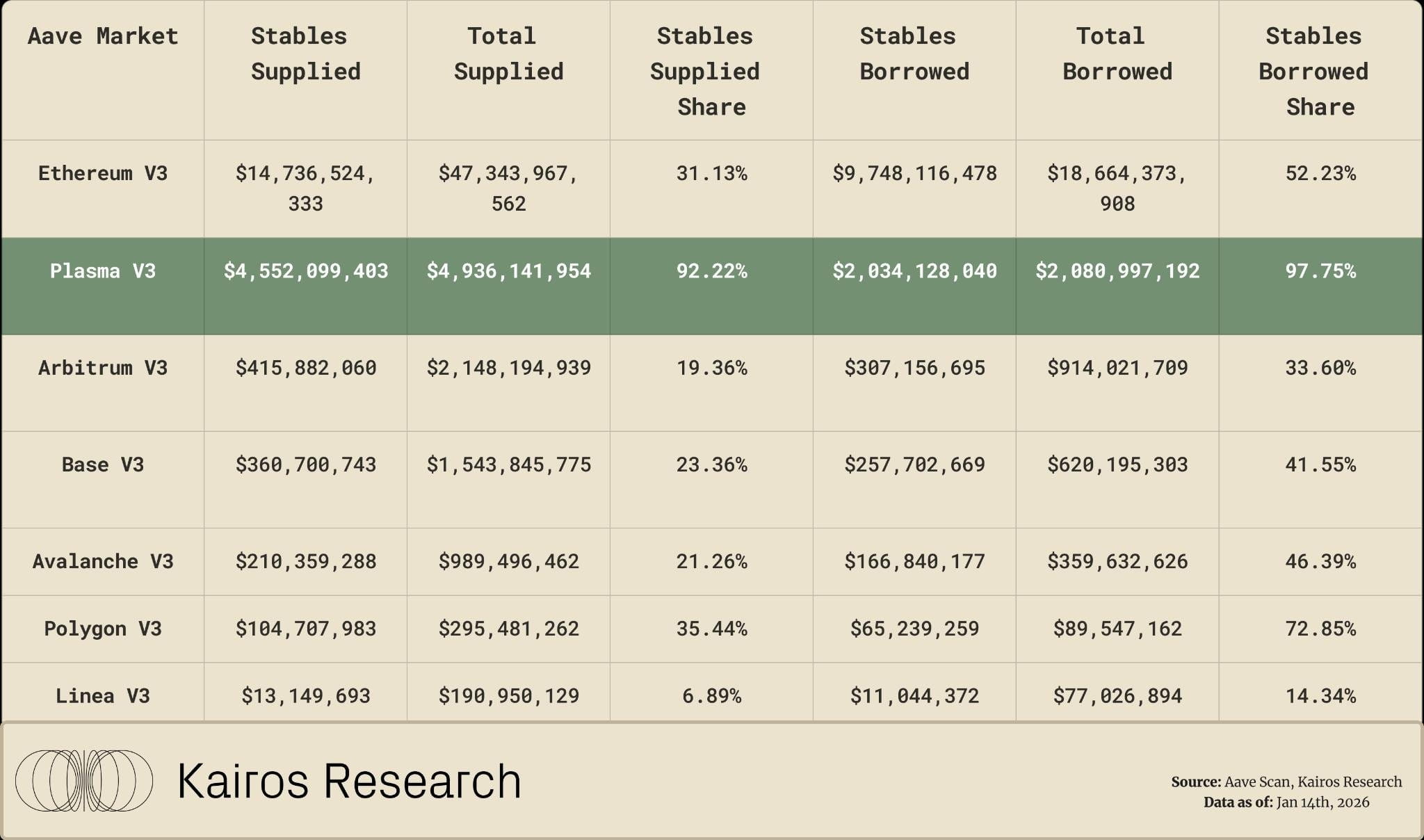
This article only discusses Plasma (@plasma) itself, without talking about the industry, other chains, or using metaphors. What I did today is also very simple: I gathered the mainnet Beta article from its official website, the public rules of XPL, and the key data disclosed by exchanges regarding XPL, and I verified them according to the standard of 'stablecoin settlement network.' The feeling I got from the verification is that Plasma's ambition is very clear, even to the point of being somewhat 'narrow-minded'—it does not want to rely on a universal ecosystem; it wants to rely on stablecoins, especially transfers, depth, and lending rates related to USD₮, to establish itself as a default channel. The problem lies in this: the narrower the goal, the fewer excuses there are; once it cannot be achieved, there is no way out.
I will start with its most solid statement, as this sentence determines the rationality of all its subsequent actions. Plasma stated very plainly in its public article about the mainnet Beta: on September 25, 2025, the mainnet Beta launches alongside XPL, and it claims that 'approximately $2 billion in stablecoins will be active on Plasma from day one,' and this capital will be deployed to over 100 DeFi partners, including Aave, Ethena, Fluid, Euler, etc., and they clearly lay out their goals: to create deep USD₮ markets, to push USD₮ borrowing rates down to very low levels, so that the chain has 'usable financial activities' from day one, rather than just launching an empty shell network. This claim is quite bold and clever, as the stablecoin settlement network fears cold starts; without turnover, it has no meaning. However, similarly, the bolder the claim, the easier it is to be smacked down by data later, because 'active' is not a term that you can define; it will ultimately fall on cold, hard metrics such as transaction count, turnover rate, borrowing utilization rate, slippage, and interest rates. As long as these metrics are not right, no matter how much you say 'we are a stablecoin chain,' users will not leave their money behind.
Next, I will review the rules of XPL to understand how it ensures 'sustainability' for this system. The data disclosed by Binance regarding XPL is critical: the genesis total is 10 billion XPL; at launch, the circulation figure on Binance is 1.8 billion XPL, about 18%; the HODLer airdrop distribution is 75 million XPL (0.75%); and there are additional marketing distribution arrangements, with 50 million added after listing and another 150 million added six months later. Another point I must keep an eye on is its inflation mechanism: maximum supply is not capped; validator rewards in the first year will inflate by 5% of the initial maximum supply, then decrease by 0.5% each year until a lower limit of 3%. Putting this information together, my first reaction is not 'good or bad news,' but a more realistic question: If Plasma wants to keep the stablecoin path low-friction in the long term, its system security budget and participant incentives must involve long-term expenditures, and inflation is its 'fixed cost' prepared for itself. The question then becomes: can real stablecoin settlement activities keep up with this cost curve? If not, the system will increasingly rely on inflation and marketing to maintain heat; if it can, then inflation becomes an acceptable security cost rather than a burden that crushes price and mindset.
Then I will look at how Plasma arranges XPL in the documentation, especially the locking rules. It states very clearly: non-U.S. buyers will be fully unlocked at the mainnet Beta launch; U.S. buyers have a 12-month lock-up, fully unlocking on July 28, 2026. This rule is very 'project-specific,' as it directly impacts the future pace of supply release and also affects market expectations for the mid-term structure. More importantly, it reflects Plasma's compliance posture: the path of stablecoin settlement becomes more significant, making it increasingly impossible to fully follow the free rhythm of crypto-native systems. You may not like it, but it is part of reality. For Plasma, locking is not marketing; it is a path choice; path choice brings costs in terms of pace and potential for cooperation.
As I write this, I have already sorted out the core contradictions of Plasma: it wants to make stablecoin settlement as 'usable as the financial system,' but it must also maintain 'composability, lendability, and market-making' on-chain. Stability and activity are not naturally compatible. The stablecoin settlement network fears volatility, while DeFi activity tends to bring volatility. Plasma’s solution, based on its public materials, appears to be starting from a point of 'having a large stablecoin liquidity from day one + direct deployment to mature financial protocols + pursuing deep USD₮ markets and low borrowing rates,' attempting to use scaled capital to lower interest rates, use depth to reduce slippage, and use availability to retain funds. Whether this approach is correct, I prefer not to use subjective terms; I would rather say something harsher but more realistic: this approach can only be sustained through long-term operations and risk control, not just by relying on technical parameters. Because depth is not something that can be written down, and interest rates are not something that can be shouted out; they are the result of long-term capital structures.
So today, I wrote a few 'acceptance criteria' for Plasma in my notes, but I won’t write them as bullet points; I’ll directly say them in the order I would look at them.
I will first check whether stablecoins are 'moving' on-chain rather than 'lying still.' Plasma claims that there are $2 billion in stablecoins active from day one; this 'activity' must manifest in sustained transfer frequency, repeated use between addresses, and the proportion of stablecoin-related transactions in the overall chain transactions. If stablecoin balances are large but the transaction structure resembles 'moving in and sitting there,' it indicates that they are more passively parked rather than being used as settlement tools. The lifeline of a settlement network is turnover, not stock. Low turnover leads to hollow borrowing and market-making, distorting interest rates through a few large players and subsidies, ultimately resulting in 'looks like a lot of money, but isn’t actually usable.'
Next, I will focus on the 'depth quality' of the USD₮ market, rather than just TVL screenshots. Plasma publicly states that it aims to create a deep USD₮ market and pursues very low USD₮ borrowing rates. I will only recognize two things: whether slippage during large trades is controllable in the long term; whether the real utilization rate of funds on the lending side is stable. Many projects can make depth look impressive during the subsidy period, but once incentives decrease, the pools will thin out, market makers will withdraw, and slippage can suddenly become very unattractive. For stablecoin settlement, this is a fatal issue because users are not here to experiment; they will immediately switch back to more familiar pathways. For Plasma to succeed, it must maintain 'transaction quality' even after incentives decrease. This is not something that can be solved by merely saying 'we cooperate with many protocols'; it requires a real funding structure, market-making mechanisms, and long-term risk management arrangements.
The third point I will focus on is 'what exactly keeps borrowing rates low.' Plasma itself has listed 'minimum USD₮ borrowing rates' as a goal in its mainnet Beta article; this goal can easily be misunderstood as a marketing slogan, but for a stablecoin settlement network, it is actually one of the core variables determining whether funds are willing to stay. Whether the rate is low is not the point; the point is the source of the rate. If low rates come from subsidies, then once the subsidies stop, rates will rebound; if low rates come from depth, ample funds, and a healthy demand structure, then they could be sustainable. I will treat 'the interest rate curve after the subsidy tide recedes' as one of Plasma's most important mid-term tests. Because if the interest rate ultimately relies solely on subsidies, Plasma will be forced to continuously consume XPL-related incentives or external funds to maintain performance, which is a tiring and fragile path.
In the fourth point, I will focus on whether XPL is truly a 'necessity' in the system. I don’t want to use abstract terms; I’ll be more direct: Plasma needs to run long-term, validators need rewards, and the network needs a security budget. Binance has clearly disclosed the inflation path: 5% in the first year, gradually reducing to a 3% lower limit. So, the supply-side pressure on XPL is a long-term issue. Whether the system can bear it depends on whether XPL simultaneously plays a key role in the system's operation, ensuring that the demand side relies not just on trading sentiment, but on the network itself. The allocation structure for XPL in the Plasma documentation also hints at what it aims to achieve, for example, a large proportion for ecology and growth (the document states ecology and growth at 40%, i.e., 4 billion XPL), indicating a heavy reliance on ecological advancement and growth incentives in the short term. However, if ecological advancement merely brings people in once without generating 'long-term settlement behavior,' that 40% may turn into 'high-consuming marketing budgets'; conversely, if it can use these resources to solidify USD₮ market depth, lending availability, and key application pathways, then this 40% won't be a waste but a foundational investment for establishing a settlement network.
I will also pay close attention to the date of July 28, 2026, because this is the time explicitly stated in the documentation for the 'full unlock for U.S. buyers.' This date is not a mystical point of 'must drop' or 'must rise' for me, but a structural examination point: by then, Plasma will have been live for some time; whether it has successfully established a stablecoin settlement loop should be quite clear. If by that time, the on-chain stablecoin turnover rate hasn’t significantly increased, and the USD₮ market depth relies more on incentives, with lending availability dependent on subsidies, the market will easily project all contradictions onto supply release; conversely, if Plasma has formed stable turnover and retention by then, supply release will become a 'normal variable that can be accommodated,' rather than a magnifying glass.
I also want to add a point closely related to Plasma: positioning itself as a stablecoin settlement network means it must ensure sufficient 'composability.' It’s not enough to say 'we are EVM compatible'; the key actions related to stablecoins must be able to complete a closed loop on-chain. For instance, after I transfer USD₮ in, can I smoothly enter lending, and can I easily exchange or do market-making with what I borrowed? Do funds move from lending to DEX to yield management and back to the account without frequently needing to step out? As long as key actions frequently need to leave Plasma to complete, it will degrade into a toolchain for certain steps rather than a settlement base. Plasma needs to be the base, not just a tool in a toolbox.
As I write this, I must clarify my stance: I do not want to portray Plasma as 'destined for success.' The difficulty of a stablecoin settlement network lies in its reliance not on explosive points but on long-term stable financial activities. The public claims of $2 billion in stablecoins, 100+ partners, deep USD₮ markets, and low borrowing rates all point to one reality: it is using scale to exchange certainty, using depth to exchange interest rates, and using availability to exchange habits. If this route works, Plasma will become very 'hard,' but the pace will be slow; if it does not work, it will not fail explosively but rather in a more unpleasant and silent manner: funds will slowly flow out, turnover rates will not rise, and the ecosystem can only rely on new incentive cycles to support itself, ultimately becoming 'seemingly busy but actually busy with attracting new users, not settlement.'
I ultimately return to the point of 'project relevance': the value of Plasma derives from one thing: whether stablecoin settlement and turnover on-chain can be sustainable. All other discussions must serve this matter. I do not want to see its short-term rises and falls; I want to know whether it can make the three USD₮ related matters usable in the long term: transfer certainty, market depth quality, and borrowing rate structure. If these three matters are achieved, then the inflation costs of XPL become meaningful, the 40% allocation for ecological growth is not wasted, and the so-called 'active $2 billion stablecoin from day one' is not just a pretty phrase. If these three matters are not achieved, no matter how much it emphasizes being a stablecoin chain, I can only consider it as positioning, rather than delivering settlement capabilities.
I wrote this piece very restrainedly because projects like Plasma don’t need to be written as overly passionate. It needs to prove itself, not by enthusiasm, but through data, turnover, and usability. I will continue to monitor it, but I will only focus on whether it fulfills the main line it has committed to.