


Dusk looks professional when everyone's screen says the same thing.
Same alerts. Same dashboards. Same quiet confidence that nothing unusual is happening because nothing unusual is being reported. Validators are online. Latency is flat. Dusk Attestation exports line up. It reads like competence.
And it keeps reading like competence.. even when it should not.
On Dusk, what validators can observe is already scoped. Confidential execution means you do not get the full picture by default, so operators lean harder on what they're entitled to see at all.. the surfaces that can be shared without reopening a disclosure scope. Over time, that becomes the primary instrument panel. If it doesnot twitch, nobody does.
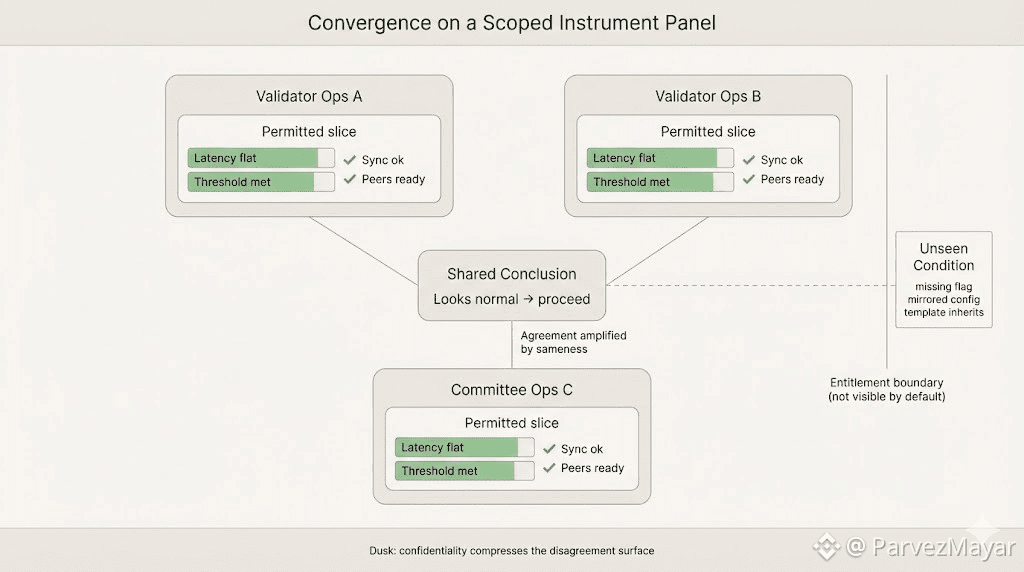
You can see it in the notebook traces. Identical charts captured minutes apart by different teams. The same green bands. The same thresholds. Professional setups converging on the same interpretation because they are all watching the same permitted slice.
No one is cutting corners. No one is asleep.
A validator on Dusk rotates a process and forgets to carry one small, boring flag. Another mirrors the change because it is documented as "standard". A third inherits it because the template already includes it. The committee cadence doesn’t wobble. Finality keeps landing. Repetition does the rest.
Somewhere inside that sameness, a condition drifts. Not enough to trigger alarms. Not enough to violate obligations. Just enough that, if one operator had seen something slightly different, they might have hesitated. They did not. None of them did. And yeah.... maybe they couldn't have given what they were allowed to see.
Later, an ops reviewer notices the absence before they notice the issue. Logs look too similar. Reports agree too easily. When every professional reaches the same conclusion at the same time, the question is not "are they right?" It's "what didnt get a chance to disagree?"
On a transparent system, dissent leaks out naturally. Someone sees a blip. Someone else argues. On Dusk, dissent has to be manufactured on purpose. Confidentiality removes accidental second opinions, and pulling extra eyes in is nota casual debugging move here... it changes the Dusk entitlement set, it changes who can read what and now someone has to own that scope change.
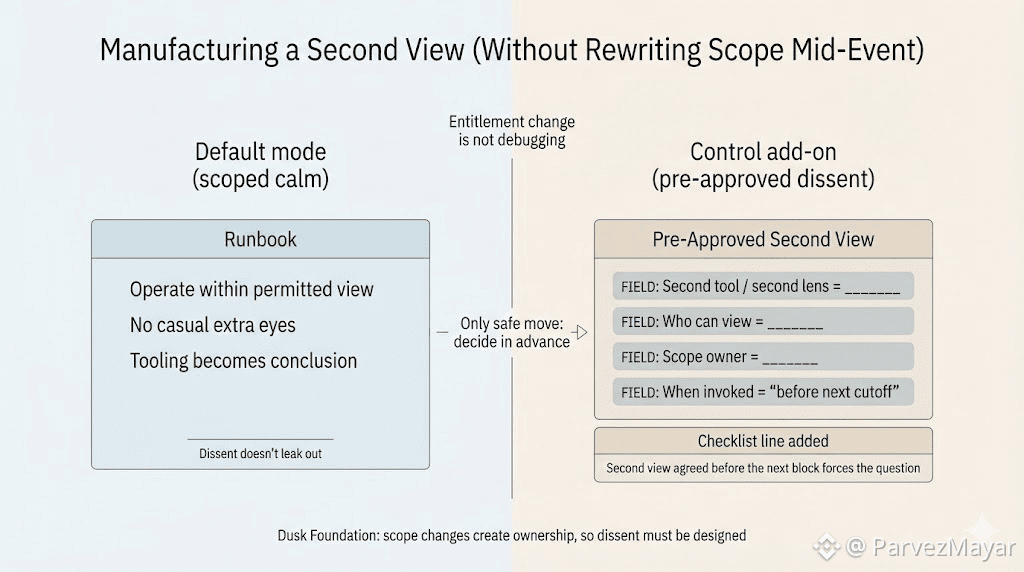
The validators did their jobs. That is not even the failure mode though. The failure mode is how clean it looks while everyone is making the same call off the same limited view.
Charts stayed green. Thresholds held. Runbooks didn’t force a pause—so the tooling became the conclusion. Nothing contradicted it, so nothing slowed it down.
Then you hit the part nobody likes writing down honestly... if the first "real signal' would require widening scope to even see it, what exactly were we calling professionalism up to this point?
The ticket does not get an incident tag. It gets a new checklist line. Pre-approved second view. A second tool. A second pair of eyes agreed before the next block forces the question.
Maybe it's enough. Nobody can prove it from this view. #Dusk $DUSK @Dusk