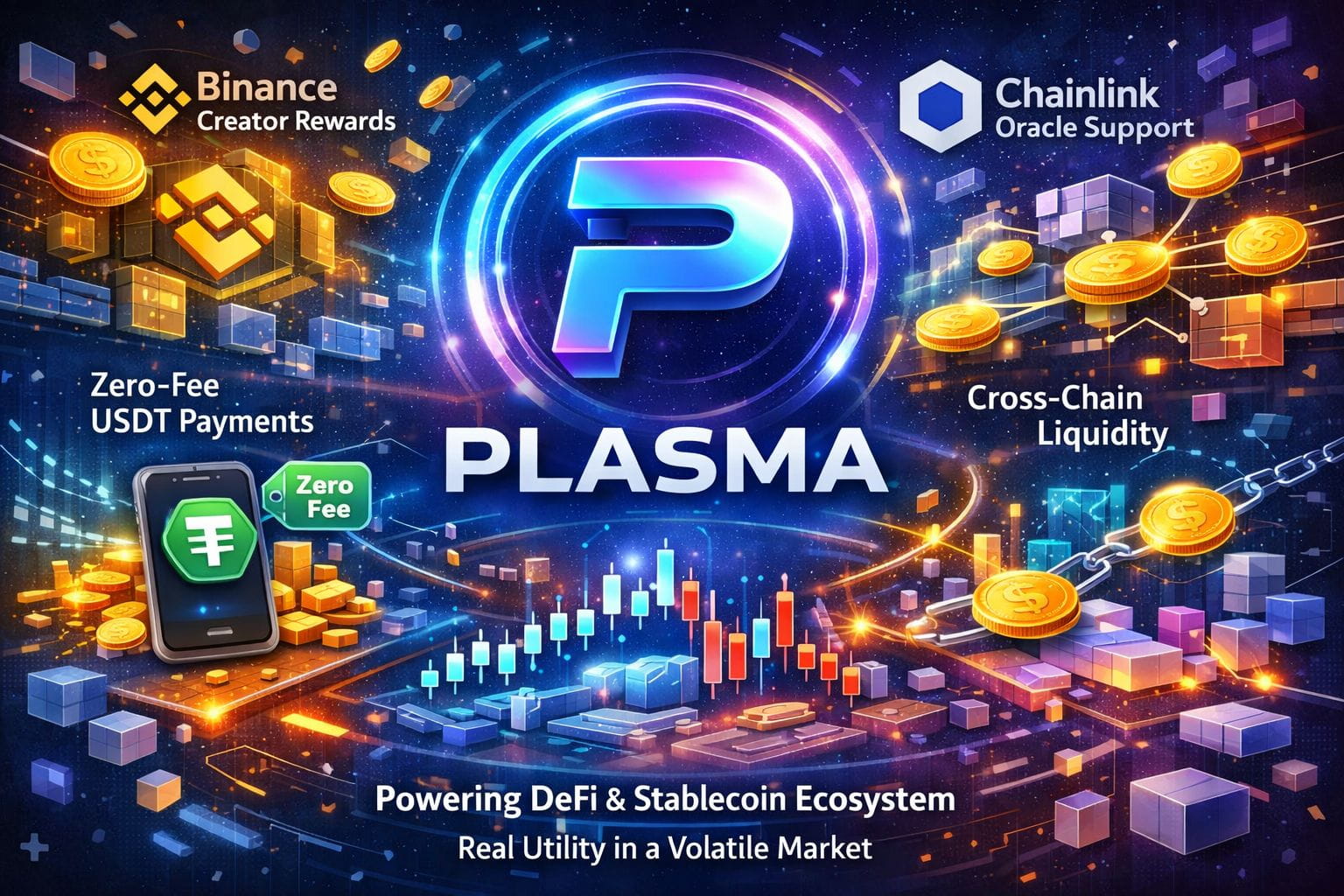
Since its mainnet launch in late 2025, Plasma (XPL) has been one of the most talked-about infrastructure projects targeting stablecoin payments at global scale. Rather than positioning itself as a sprawling general-purpose Layer-1, Plasma has stayed committed to a clear mission: make stablecoins—especially USDT—fast, low-cost, and reliable for everyday use. That focus is now paying tangible dividends as the protocol’s real-world integrations and ecosystem campaigns unfold in early 2026.
At its core, Plasma’s blockchain is engineered specifically for stablecoin settlement and payments, with zero-fee USDT transfers, sub-second finality, and EVM compatibility for developer adoption. Its architecture leans on a tailor-made consensus and tooling stack that prioritizes throughput and user experience over flashy multipurpose features. This design has positioned it less as an abstract crypto “layer” and more as a foundational payment rail for the digital dollar economy.
One of the defining developments this year has been exchange-led community engagement. Major campaigns from Binance—such as the 3,500,000 XPL CreatorPad reward initiative—are actively incentivizing content creation, community participation, and broader awareness of Plasma’s ecosystem potential. These campaigns are explicitly designed not only to drive short-term engagement but also to seed longer-term network participation by lowering barriers to entry for users and creators alike.
These ecosystem incentives occur against a backdrop of real utility milestones. Plasma’s integration into Tether’s cross-chain volume flows has helped it secure a place in the broader liquidity network for USDT, with significant transaction flows routed through Plasma as part of cross-chain settlement infrastructure. Wallets and liquidity bridges now treat Plasma as one of the go-to chains for stablecoin settlement, reinforcing its core design principle of payments first.
Another dimension of Plasma’s momentum is institutional and regional expansion. Late in 2025, the project secured a VASP license and expanded operations in Europe with a presence in Amsterdam, signaling intent to comply with regional regulatory frameworks and participate meaningfully in regulated payment ecosystems. The pursuit of other licenses (including MiCA and EMI frameworks) underscores Plasma’s ambition to operate as a legitimate financial infrastructure provider, not just a niche blockchain network.
Stablecoin holder products have also been a key component of adoption strategy. The Plasma USDT Locked Product on Binance Earn has drawn significant participation by offering daily USDT yields and rewarding participants with XPL tokens. At launch, the product hit caps in record time, illustrating strong demand from stablecoin holders for yield products that combine liquidity utility with token incentives.
Despite this progress, Plasma’s journey has not been without its challenges. Like many new Layer-1 tokens, price volatility and unlock schedules have cast a shadow over sentiment. Market analyses have pointed to substantial token unlocks in 2026 that could exert downward pressure on XPL’s price if adoption does not accelerate commensurately—a dynamic familiar to holders of early infrastructure tokens across the ecosystem.
But it’s crucial to separate token price noise from ecosystem growth. Plasma’s total value locked (TVL) and on-chain activity tell a more nuanced story. While the ecosystem has experienced fluctuations in speculative memecoin activity, the underlying demand for stablecoin settlement and on-chain liquidity remains steadfast. The emphasis from core developers has been on building products that serve real utility—from stablecoin rails for cross-border payments to integrations with lending protocols that deepen usable liquidity.
Looking ahead, Q1 2026 is shaping up to be pivotal. Staking and delegation mechanics for XPL are expected to go live, enabling token holders to participate in network security and earn yield passively—an important milestone that transitions Plasma from being simply a payments layer to a participatory PoS ecosystem. The rollout of staking will also broaden the narrative beyond trading markets toward governance and long-term engagement.
Plasma’s roadmap also includes expanding stablecoin support beyond USDT and building out on-ramps and off-ramps with financial partners, targeting not just crypto natives but mainstream users and businesses. The architecture’s focus on zero-fee transfers and developer accessibility can make the network attractive for fintechs that want fast, low-cost rails without reinventing payment infrastructure.
Perhaps most importantly, Plasma aims to stitch itself into the fabric of everyday economic activities. Whether it’s corporate treasury payments, cross-border remittances, or yielding stablecoin deposits on yield platforms, the project’s infrastructure is intentionally practical. Its capacity to handle high transaction volumes while minimizing friction could be the defining factor in its adoption beyond crypto circles and into broader financial processes.
In summary, Plasma’s evolution in early 2026 is a study in steady infrastructure build-out amid market turbulence. With a clear design philosophy, active ecosystem support from exchanges, evolving staking mechanics, and licensing initiatives, Plasma is translating theoretical potential into tangible network participation. The challenges around token economics and volatile markets are real, but they have not derailed the project’s core mission: to make stablecoin transfers instantaneous, inexpensive, and global. Whether that vision ultimately reshapes how digital dollars move at scale remains to be seen, but the foundational pieces are in place for Plasma to make a lasting imprint on the future of stablecoin finance.