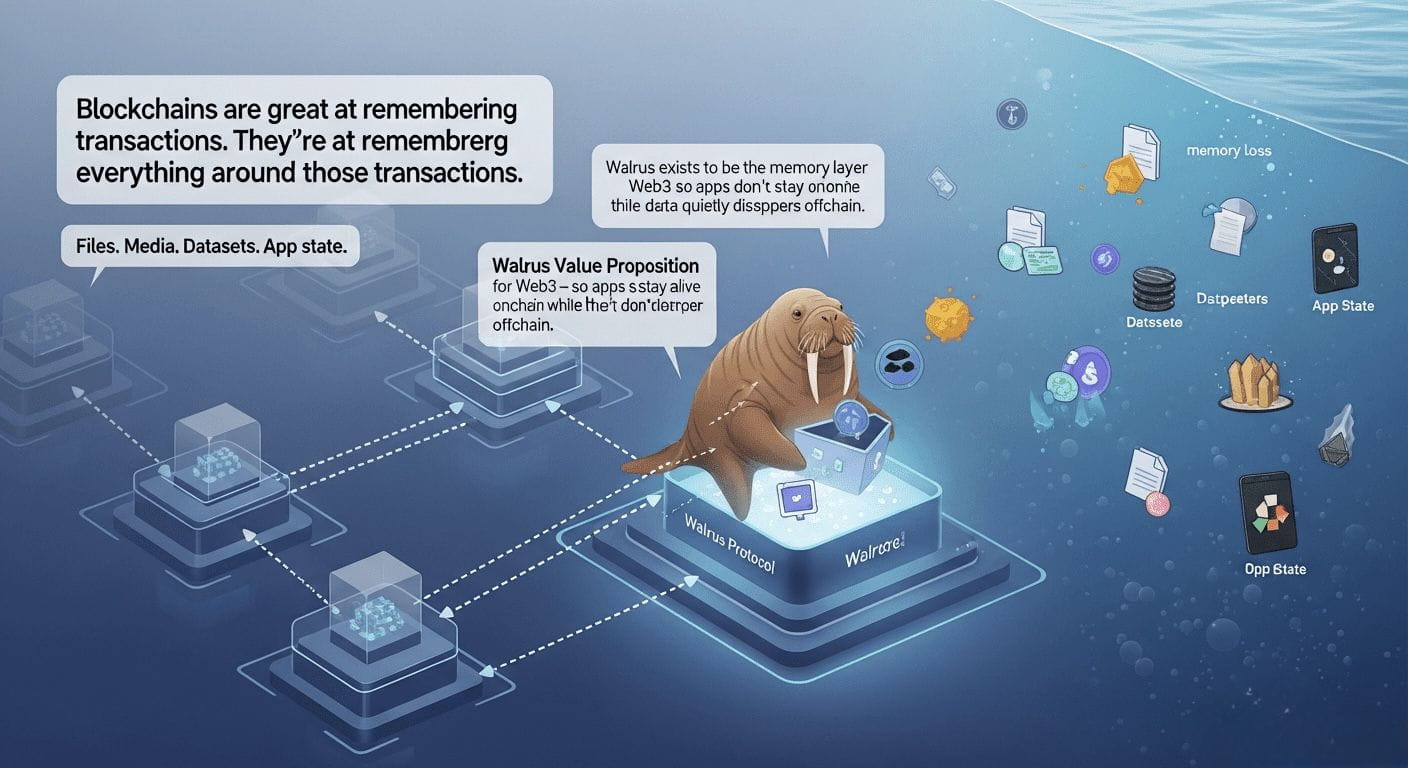
Walrus Protocol was not created to chase a trend. It emerged from a problem that most Web3 systems try to ignore because it is uncomfortable and difficult to solve. Blockchains are excellent at proving actions, but they are surprisingly bad at remembering everything that gives those actions meaning.
Early blockchain design focused on execution. Transactions, state changes, ownership transfers. What happened around those actions was often pushed elsewhere. Files, media, datasets, application state, and historical context were stored offchain using centralized services. As long as those services worked, everything looked fine.
Walrus starts from the assumption that this arrangement is fragile.
I’m seeing Walrus treat data loss as a silent failure mode of decentralization. When storage disappears, applications technically still exist onchain, but practically stop functioning. NFTs lose metadata. Games lose assets. AI models lose training data. The chain remembers the action, but forgets the substance.
This is where the original idea behind Walrus took shape. Instead of viewing storage as a secondary service, Walrus treats it as infrastructure. Something that must survive beyond hype cycles, user attention, and changing incentives.
Technically, Walrus is built around erasure coded distributed storage. Data is split into fragments and spread across independent nodes. Only a subset of those fragments is required to recover the original object. This design does not assume perfect node behavior. It assumes churn, failure, and degradation over time.
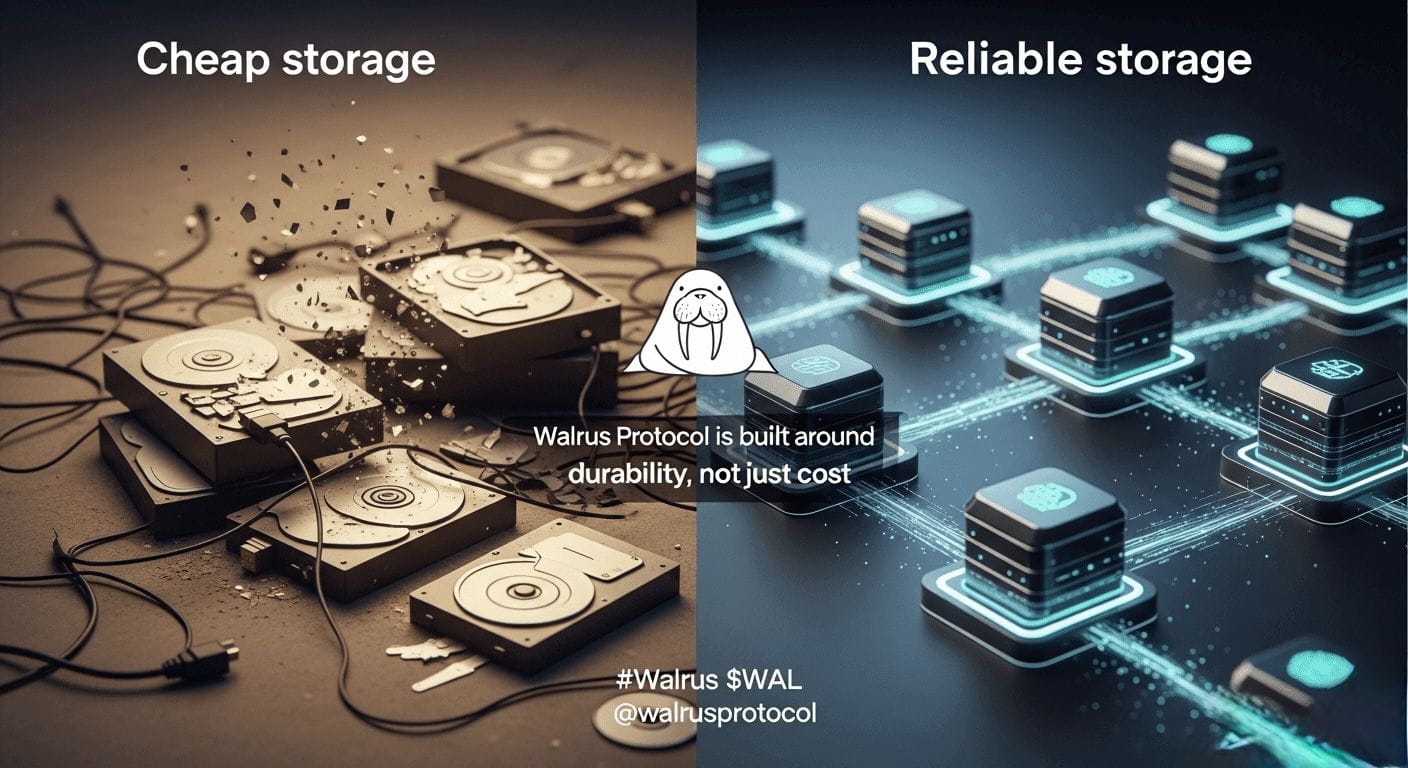
They’re not optimizing for the cheapest storage today. They’re optimizing for data that still exists years later.
Walrus integrates deeply with the Sui blockchain, which allows stored data to be treated as verifiable objects rather than passive files. This matters because it allows applications to reference, verify, and reason about data over time. Storage becomes programmable, not just retrievable.
If it becomes normal for applications to depend on large datasets, media, or long lived records, we’re seeing why Walrus matters. Execution alone is not enough. Memory is required.
The $wal token exists to support this responsibility. Storage is not a one time transaction. It is an ongoing obligation. WAL is used to pay for storage, reward nodes that keep data available, and align incentives around long term availability.
Walrus is not loud about what it does. It does not promise instant performance. It promises persistence. In decentralized systems, that promise may end up being more important than speed.