


When you first explore the Vanar ecosystem, one thing becomes immediately clear: governance is not an afterthought. It is a foundational principle that shapes how the network evolves, how security is maintained, and how real-world applications—gaming, AI, metaverse, and brand integrations—can function reliably. At the heart of this participatory process is VANRY, the native token that serves not only as a utility asset but also as a mechanism for influence, accountability, and shared decision-making.
Unlike many blockchain networks where governance may feel distant or symbolic, Vanar embeds governance into its design so that participation is both meaningful and actionable. By holding and staking VANRY, you move from being a passive observer to an active contributor in shaping protocol upgrades, economic parameters, and ecosystem priorities. This article delves into how VANRY enables governance participation, the mechanisms behind protocol upgrades, and the reflective role you play as a stakeholder in this evolving ecosystem.
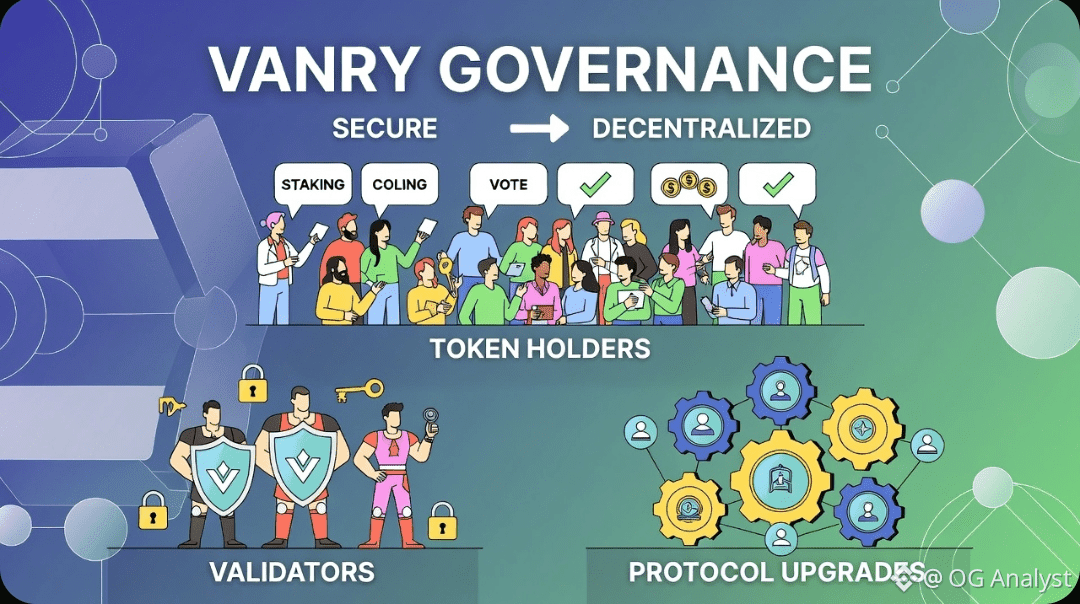
Understanding Governance in the Vanar Ecosystem
Governance in blockchain networks is often discussed in abstract terms—voting, proposals, community oversight—but in practice, many networks struggle to make governance accessible and effective. Vanar approaches this differently. Its governance model is integrated, transparent, and economically aligned, leveraging VANRY as the connective tissue between token holders, validators, and protocol decision-making.
At its core, governance on Vanar revolves around three pillars:
1. Participation – You, as a token holder, can actively stake or delegate VANRY to influence decisions.
2. Accountability – Validators and stakers have real economic incentives to act in the network’s best interest.
3. Evolution – Protocol upgrades are proposed, discussed, and implemented based on community consensus backed by VANRY stakes.
What makes this system particularly human-centric is the reflective alignment of incentives. Every decision you make, every vote you cast, carries tangible weight because it is backed by economic commitment. In other words, governance on Vanar isn’t just theoretical; it is a mechanism where your engagement directly influences outcomes.
VANRY as the Key to Participation
When you hold VANRY, you hold more than a token—you hold governance power. The network incentivizes you to use this power thoughtfully, because staking VANRY signals your confidence in validators and proposals. The act of staking isn’t passive; it is a statement of trust and alignment with the network’s future.
Through staking, you gain the ability to:
Delegate influence: Support validators who align with your vision for the network.
Vote on proposals: Participate directly in decisions that determine protocol upgrades, fee structures, and ecosystem allocations.
Shape validator behavior: Validators backed by your stake are economically accountable, encouraging honest, consistent participation.
This design ensures that governance is participatory rather than hierarchical. Your voice matters not because it’s loudest, but because it carries economic commitment. It’s a reflective system: the more you invest in the network’s health, the more influence you have over its evolution.
Delegation and Shared Responsibility
You might wonder whether governance requires running a full validator node. Vanar makes it approachable. Through delegation, you can contribute to governance without managing infrastructure directly. This is where VANRY shines: it allows token holders to influence network security and protocol evolution indirectly by supporting validators they trust.
Delegation achieves several key objectives:
Decentralization: The network can scale governance participation without requiring every participant to be a technical operator.
Risk sharing: Delegators and validators share economic exposure, ensuring both are incentivized to act honestly.
Reflective alignment: Your choice of validator signals your perspective on network priorities, from security to upgrade readiness.
By using VANRY as a bonding and signaling tool, Vanar balances accessibility with accountability. You can participate meaningfully without technical barriers, yet your influence remains significant.
Voting Mechanisms and Proposal Evaluation
Governance on Vanar is structured and deliberative. Proposals can range from technical protocol upgrades, like changes to consensus parameters, to economic adjustments, like validator rewards or ecosystem funding. When you stake or delegate VANRY, you gain the right to vote on these proposals, turning abstract ideas into actionable decisions.
Here’s how the process works in practice:
1. Proposal Submission: Any participant, including validators or token holders, can submit a proposal for consideration.
2. Community Review: The community evaluates the proposal, discussing potential benefits, risks, and implementation considerations.
3. Voting Period: VANRY stakers vote in proportion to their stake. This ensures that votes are backed by economic commitment, not just popularity.
4. Outcome and Implementation: Successful proposals are executed within the protocol, often requiring coordination between validators and developers.
This system is both reflective and participatory. When you vote, you’re not simply selecting an option—you’re engaging with the network’s evolution. Your decisions are informed by a combination of personal insight, community discussion, and long-term alignment with the protocol’s goals.
Protocol Upgrades Driven by Community Insight
Protocol upgrades are one of the most visible outcomes of governance. In Vanar, these upgrades are not unilateral decisions by a centralized team. Instead, they emerge from proposals evaluated by both validators and VANRY stakers. This ensures that every change reflects collective judgment rather than individual preference.
VANRY enables this process in several ways:
Economic Signaling: Staked VANRY signals support for a proposal or validator, making it clear which directions the community prioritizes.
Accountability Enforcement: Validators implementing upgrades are economically bonded to VANRY, discouraging negligence or malfeasance.
Transparent Voting: The system records votes and outcomes on-chain, creating an immutable record of community decisions.
Through this approach, you see that upgrades aren’t arbitrary—they are the product of collective reflection, deliberation, and economic alignment.
Aligning Incentives Between Stakeholders
One of the challenges in blockchain governance is misaligned incentives. Too often, decision-making is dominated by short-term actors or disconnected stakeholders. Vanar addresses this by tying governance influence directly to VANRY stake, ensuring that those who participate are invested in the network’s long-term success.
As a VANRY holder, you influence:
Validator Selection: Validators are incentivized to maintain uptime and honest behavior, knowing that their performance affects your delegated stake.
Economic Parameters: Decisions like transaction fees, staking rewards, or resource allocation reflect the collective insight of engaged participants.
Ecosystem Growth: Governance proposals can allocate VANRY toward developer grants, ecosystem initiatives, or partnerships, influencing how the network grows and adapts.
This alignment is reflective: when you participate, you understand that your choices carry consequences—not only for yourself but for the broader Vanar ecosystem.
Accessibility and User-Centric Design
You might be concerned that governance requires deep technical expertise. Vanar addresses this by simplifying participation without compromising influence. Through intuitive staking dashboards, clear proposal tracking, and delegation options, VANRY holders can participate meaningfully even without operating infrastructure.
This accessibility ensures that governance reflects a broad cross-section of the community, not just technical specialists. It reinforces human-centered design: you can contribute, understand outcomes, and see the direct impact of your decisions.
Reflecting on Your Role as a Governance Participant
When you engage with Vanar governance, you quickly realize it’s a dynamic dialogue rather than a static vote. Every staking decision, every delegation, every vote contributes to a living network that evolves in response to real-world demands. You are not just reacting to the protocol; you are shaping its trajectory.
This reflective engagement has deeper implications:
Responsibility: Each decision has economic and functional consequences, encouraging thoughtful participation.
Collaboration: Governance becomes a conversation between token holders, validators, and developers, balancing diverse perspectives.
Resilience: By embedding accountability through VANRY, Vanar reduces risks of misaligned or malicious upgrades.
In this way, governance is not a task—it’s an ongoing responsibility that connects your actions to the network’s success.
The Broader Implications for Network Evolution
VANRY-enabled governance is more than a mechanism for votes—it is a strategic lever for ecosystem development. Through governance, the community can:
Adjust protocol parameters to support gaming, metaverse, and AI applications.
Allocate resources to innovative projects that drive real-world adoption.
Ensure that security, performance, and usability evolve together rather than in isolation.
In practice, this means that when you stake or vote with VANRY, you are contributing to a cohesive, adaptive system. Protocol upgrades become a reflection of both technical insight and community consensus.
Conclusion
VANRY transforms governance from a theoretical concept into a living, participatory process. By linking economic stake to voting power, aligning incentives between validators and token holders, and making participation accessible, Vanar ensures that you have both influence and responsibility. Every vote, every delegation, and every proposal becomes part of a larger conversation, one that reflects collective judgment and long-term alignment with real-world needs.
When you engage with governance through VANRY, you are not simply observing the network—you are shaping it. Protocol upgrades, ecosystem initiatives, and network parameters are not imposed from above; they emerge from a reflective, participatory, and accountable system. This approach ensures that Vanar evolves responsibly, remains secure, and continues to meet the demands of real-world applications, from gaming to AI to brand integrations.
In short, VANRY enables governance in a way that is practical, humanized, and deeply reflective, ensuring that every participant’s voice contributes meaningfully to the network’s evolution. You hold the key, and with it, the responsibility and opportunity to shape a blockchain designed for adoption, resilience, and collective success.
What Cryptographic Standards Are Used in VANRY Transactions to Ensure Integrity?
When you engage with blockchain networks, one of the first questions you might ask is: how do I know my transactions are secure? In the Vanar ecosystem, the VANRY token represents more than a digital asset—it embodies trust, accountability, and integrity, all enforced through rigorous cryptographic standards. Every time you send, receive, or stake VANRY, a layered system of cryptography is quietly at work, ensuring that your assets are safe, transactions are immutable, and the network can operate with confidence even under high-demand conditions.
This article explores the cryptographic framework behind VANRY, explains why each component matters, and reflects on how these standards collectively safeguard the network. By understanding these mechanisms, you can appreciate the depth of security and the thoughtful engineering embedded in Vanar’s design.
The Role of Cryptography in Blockchain Integrity
At its core, blockchain is a trustless system. You do not rely on a central authority to validate transactions; instead, the network ensures integrity through mathematical and cryptographic guarantees. In the case of VANRY, cryptography serves several purposes:
1. Transaction authenticity – ensuring that only the rightful owner can spend tokens.
2. Data integrity – guaranteeing that transaction information cannot be altered after submission.
3. Non-repudiation – preventing parties from denying their participation in a transaction.
4. Network security – protecting against attacks like double-spending, tampering, or replay attacks.
Understanding how Vanar achieves these guarantees requires examining the specific cryptographic standards employed in VANRY transactions.
Digital Signatures: The Foundation of Trust
One of the first cryptographic mechanisms you encounter when transacting with VANRY is digital signatures. Digital signatures ensure that each transaction is genuinely authorized by the token holder.
Vanar relies on elliptic curve cryptography (ECC) for its signatures, specifically using curves optimized for speed and security. ECC provides a strong level of security while keeping computational requirements low—critical for high-throughput applications like gaming, AI, and metaverse interactions.
Here’s why this matters for you:
Authentication: When you send VANRY, your private key generates a unique signature. Validators can verify this signature with your public key, confirming the transaction’s origin without exposing your private key.
Integrity: Any alteration to the transaction data invalidates the signature, immediately signaling tampering.
Efficiency: ECC signatures are compact and fast to verify, enabling Vanar to maintain high transaction throughput without compromising security.
For you, this means every transaction is securely tied to your identity in a cryptographic sense, without ever revealing sensitive information.
Hash Functions: Ensuring Data Immutability
Another critical standard in VANRY transactions is the use of cryptographic hash functions. A hash function takes input data—like transaction details—and produces a fixed-length output, called a hash. Vanar primarily uses SHA-3 (Secure Hash Algorithm 3), known for its resistance to collisions, pre-image attacks, and second pre-image attacks.
You can think of the hash as a digital fingerprint of the transaction:
Data integrity: If anyone attempts to modify a transaction, even slightly, the hash changes drastically. Validators can detect this immediately.
Efficiency in verification: Hashes allow quick comparisons without needing to process entire transaction details.
Tamper-proof chains: By linking transaction hashes into Merkle trees, Vanar ensures that blocks cannot be altered without detection.
Reflecting on this, you can see that hash functions act as the first line of defense against tampering, silently verifying every transaction in a mathematically robust way.
Public-Key Infrastructure: Secure Identities
VANRY transactions rely on public-key infrastructure (PKI) to create verifiable identities. Your wallet is tied to a public/private key pair:
Private key: Used to sign transactions; must remain confidential.
Public key: Shared with the network; used by validators to verify signatures.
PKI ensures that only you can authorize VANRY transfers, while validators and other network participants can independently confirm authenticity. This design prevents impersonation attacks, even in a decentralized environment where no central authority exists.
You might not see the cryptography at work, but every time you send VANRY, this key pair guarantees that your transaction is yours alone, and cannot be forged by anyone else.
Multi-Layered Security: Combining Signatures and Hashing
Vanar combines digital signatures and hash functions to create a multi-layered security model. Here’s how it works in practice:
1. You create a transaction detailing the sender, recipient, and amount.
2. The transaction data is hashed using SHA-3.
3. Your private key signs the hash, producing a digital signature.
4. The transaction, along with its signature, is broadcast to validators.
5. Validators use your public key to verify the signature and the hash to confirm integrity.
This combination ensures that transactions are both authentic and untampered, providing a dual cryptographic safeguard. You can think of it as a lock and seal: the signature is the lock, and the hash is the seal.
Merkle Trees: Efficient Verification for High Volume
In high-volume scenarios—like gaming or AI applications—you want a system that verifies transactions efficiently without compromising integrity. Vanar uses Merkle trees, a cryptographic data structure that allows validators to confirm the inclusion of a transaction in a block with minimal computation.
For you, the benefits are tangible:
Scalability: Even with thousands of VANRY transactions per second, verification remains fast.
Proof of inclusion: You can verify that your transaction is part of a block without downloading the entire blockchain.
Tamper resistance: Any change to a transaction alters the Merkle root, making fraud detectable immediately.
Merkle trees, combined with ECC and SHA-3, form a robust foundation for integrity, even in applications that require frequent, high-volume transactions.
Zero-Knowledge Proofs: Privacy and Validation
While integrity is essential, you might also care about privacy. Vanar integrates zero-knowledge proofs (ZKPs) in certain VANRY transaction flows, allowing validators to confirm that a transaction is valid without revealing sensitive details, such as the sender’s balance or transaction amounts.
You might reflect on this as a modern approach to privacy:
Confidentiality: Your transaction details remain private while validators confirm correctness.
Security: ZKPs are mathematically secure, ensuring no shortcuts can compromise verification.
Scalable adoption: Applications like gaming or metaverse experiences can handle private high-volume interactions without exposing users.
This shows that VANRY doesn’t sacrifice privacy for integrity; it achieves both simultaneously.
Anti-Replay Measures: Protecting Against Double-Spending
You might wonder, “Could someone copy my transaction and replay it?” Vanar prevents this through cryptographic nonces, a unique number attached to every transaction. Each nonce is sequential per account, ensuring that a previously submitted transaction cannot be reused.
Here’s why it matters for you:
Double-spend protection: Once a transaction is included in a block, it cannot be replayed.
Transaction order integrity: The sequence of actions you perform is preserved accurately.
Reduced attack surface: Attackers cannot reuse signed transactions to steal funds or disrupt operations.
This subtle cryptographic standard is critical for maintaining trust in VANRY transactions, especially when volume is high.
Validator Signatures and Consensus Integration
Cryptography in VANRY transactions isn’t limited to individual users. Validators also apply cryptographic techniques to secure the network. Each block proposed is signed, and the signatures of multiple validators are aggregated to form a proof of consensus. This ensures that:
Only blocks approved by a majority of validators are considered valid.
Malicious validators cannot alter transaction history without detection.
You can trust that once a block is confirmed, it is final and tamper-resistant.
Validator signatures work hand-in-hand with VANRY staking: validators have economic incentives to act honestly, and cryptography enforces the rules.
Layered Security in Practice: Gaming and Real-World Applications
Vanar is designed for real-world adoption, supporting high-throughput applications like gaming, AI, metaverse, and brand solutions. For you, this means:
Every in-game asset transfer backed by VANRY is cryptographically secured.
Micropayments, marketplace interactions, and tokenized rewards operate without fear of tampering or forgery.
Scaling to thousands of transactions per second does not compromise integrity, thanks to Merkle trees, ECC, and hash-based validation.
The cryptography is invisible in daily use, but it underpins every user experience, ensuring trust and reliability.
Reflective Perspective: The Role of VANRY Security in Trust
When you consider the role of VANRY, it’s clear that trust is engineered, not assumed. Cryptographic standards ensure that:
Your transactions are authentic.
Data integrity is maintained across the network.
Validators are accountable.
Protocol upgrades and network evolution remain secure.
You can reflect on this as a broader principle: VANRY is not just a token for speculation—it is a tool for secure, reliable, and accountable network interaction. Every cryptographic layer contributes to a system where your engagement carries confidence, whether you’re sending tokens, participating in governance, or interacting with gaming and metaverse applications.
Conclusion
VANRY transactions rely on a robust suite of cryptographic standards to ensure integrity, authenticity, and reliability. From elliptic curve signatures and SHA-3 hashing to Merkle trees, zero-knowledge proofs, and validator-signed consensus blocks, every layer contributes to a secure, tamper-resistant ecosystem. Nonces prevent replay attacks, PKI guarantees identity, and multi-layered verification ensures that even high-volume transactions remain trustworthy.
For you as a user, this means that every VANRY transaction—whether transferring tokens, staking for governance, or interacting with gaming or metaverse applications—is protected by mathematically proven mechanisms. Cryptography is invisible, yet foundational, enabling Vanar to support real-world adoption without compromise.
Reflecting on this, you realize that VANRY is more than a utility token: it is a guarantee of integrity, a measure of trust, and a cornerstone for a network designed to scale responsibly. The combination of advanced cryptographic standards and thoughtful system design ensures that Vanar remains secure, reliable, and ready to support the next generation of consumer-facing Web3 applications.