


The common mistake is thinking Sui is there to hold the data in Walrus.
It is not.
Sui is where Walrus settles claims about the data. The bytes sit offchain... the obligation does not though. That's the split. Everything else follows from it.
The Walrus payload, blob bytes moves outside consensus. Distributed, erasure-coded, served where it is cheap. Normal.
What lands onchain is the claim state... who committed to store what, for which window, what proof is owed, what happens if the proof does not arrive. A commitment object gets created, a window advances, a proof posts (or doesn't), a renewal flips the state (or fails). Validators can reason about those transitions without touching the blob bytes.
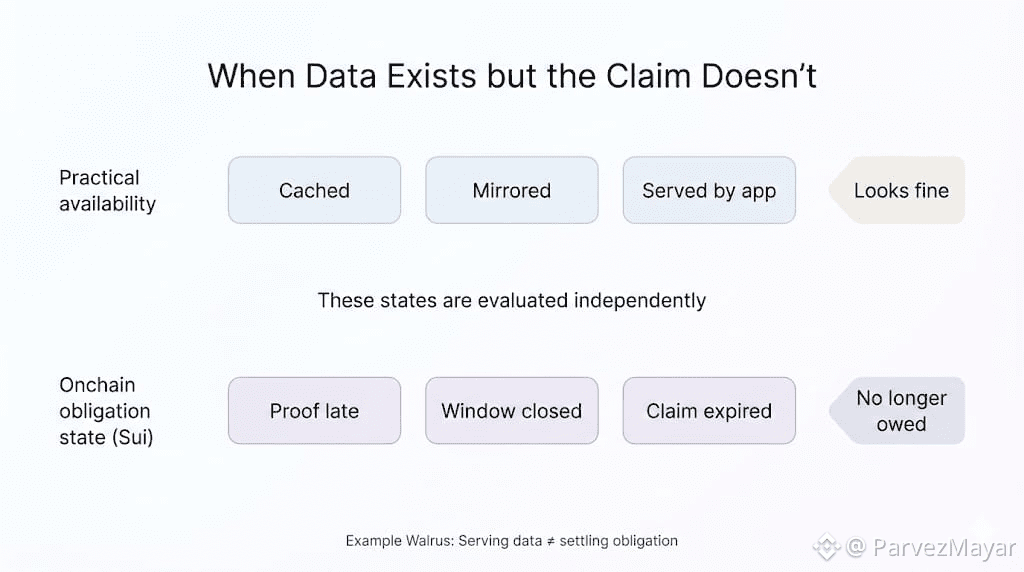
Sui's object model is doing the boring work here. Walrus is not coordinating "storage' in the abstract. It's coordinating objects with lifetimes. Commit, prove, renew and expire. The chain just checks whether transitions were legal and timely.
So failures donot look like outages.
Nothing explodes. Nothing halts.
The blob on Walrus might still be retrievable in practice cached, mirrored or whatever....and yet the claim fails to settle. Proof lands late. Renewal does not clear. The app still serves the blob from cache, support says "it's fine', and then the counterparty asks for the onchain proof.
From Sui's point of view, the window closed and the obligation ended.