

@Vanar is being built around a different assumption than many early blockchain networks. It starts from the idea that the next phase of on-chain activity will not be driven primarily by financial speculation, but by immersive digital experiences that demand real performance. Games, AI-powered environments, virtual worlds, and interactive media place very different requirements on infrastructure than simple token transfers. Vanar Chain positions itself as a system designed for those demands from the beginning.
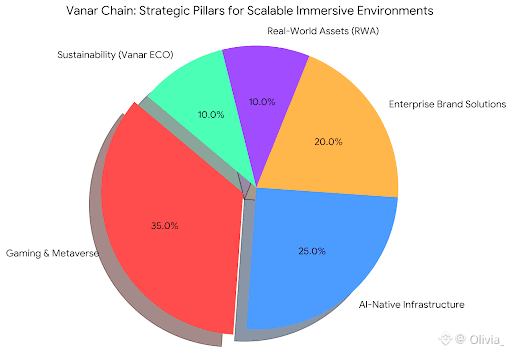
Many networks optimized for early DeFi use cases struggle when asked to support complex real-time interactions. High latency, unpredictable costs, and limited scalability become visible bottlenecks once applications move beyond basic transactions. Vanar Chain addresses this by prioritizing throughput, responsiveness, and developer flexibility. The architecture is designed to support environments where users expect instant feedback, smooth interactions, and persistent digital spaces that do not degrade under load.
This focus shapes how the network approaches scalability. Rather than treating scale as a secondary concern, Vanar Chain treats it as foundational. Applications such as multiplayer games, AI-driven simulations, or shared virtual spaces generate continuous activity, not occasional bursts. Infrastructure must handle this activity without slowing down or becoming expensive to use. By emphasizing efficient execution and low latency, the network aims to remain usable even as experiences grow more complex and user numbers increase.
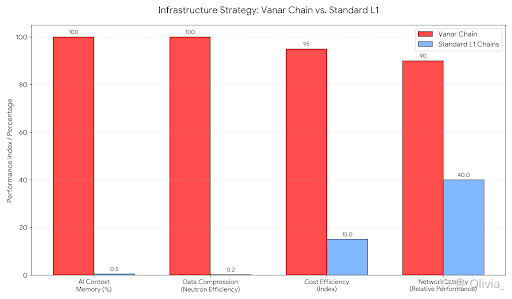
Another key element is creator accessibility. Immersive digital platforms live or die by the tools available to developers and creators. Vanar Chain places importance on making deployment and iteration straightforward, allowing teams to focus on building experiences instead of managing infrastructure limitations. This includes reducing friction in application deployment and enabling creators to scale their products without constant redesigns. Over time, this lowers the barrier for studios and independent builders to experiment and launch at a professional standard.
At the center of the ecosystem is the VANRY token, which plays a functional role in coordinating activity across the network. Rather than existing purely as a speculative asset, VANRY supports transaction processing, incentives, and alignment between participants. Developers, creators, and users all interact with the network through mechanisms tied to actual usage. This creates a structure where value flows are connected to contribution and demand, rather than abstract expectations.
Incentives matter most when a network grows. As more applications deploy and user activity increases, coordination between participants becomes more complex. VANRY is designed to support this coordination by rewarding behavior that contributes to network health and long-term sustainability. Validators and service providers are incentivized to maintain performance and reliability, while creators benefit from predictable infrastructure that supports monetization and user engagement.
What distinguishes Vanar Chain is its positioning as an execution layer rather than a narrative platform. Instead of relying on broad promises about the future of Web3, it focuses on delivering the underlying systems needed to support real products. This approach is particularly relevant as studios and technology companies explore blockchain integration beyond experimentation. For these teams, infrastructure quality matters more than novelty. They require systems that can handle real users, real workloads, and real expectations.
The roadmap reflects this practical orientation. Emphasis is placed on tooling, partnerships, and platform support that enable complex digital experiences to operate at scale. This includes support for AI-driven environments where computation and responsiveness are critical, as well as gaming and virtual world applications that require persistent state and fast interaction. By focusing on these areas, Vanar Chain aligns itself with sectors that are likely to drive meaningful adoption rather than short-term attention.
From a broader perspective, the project fits into a shift occurring across the industry. Blockchain infrastructure is moving away from one-size-fits-all designs toward specialized systems built for specific workloads. Just as financial applications require stability and predictability, immersive environments require speed, responsiveness, and scalability. Vanar Chain’s design choices reflect an understanding of this distinction.
There is also a timing element worth noting. As interest grows around AI integration, digital identity, and persistent virtual environments, the infrastructure supporting these concepts becomes increasingly important. Experiments can run on almost any network. Production systems cannot. Vanar Chain is positioning itself as an option for teams preparing to move from prototypes into live, user-facing products.
From a personal standpoint, this kind of infrastructure-first approach tends to be underappreciated early on. It lacks the immediate excitement of consumer-facing features, but it creates the conditions for those features to exist later. Networks that prioritize performance and developer experience often become more relevant over time as expectations rise. If immersive digital experiences continue to mature, systems designed specifically for them may gain importance quietly but steadily.
Ultimately, Vanar Chain is not trying to redefine what blockchain is. It is narrowing the focus to what certain applications actually need to function well. By concentrating on immersive environments, creator tools, and scalable execution, it offers a clear direction rather than a broad promise. Adoption will depend on how effectively developers and platforms can use this infrastructure in practice, but the foundation is clearly aimed at real-world deployment.
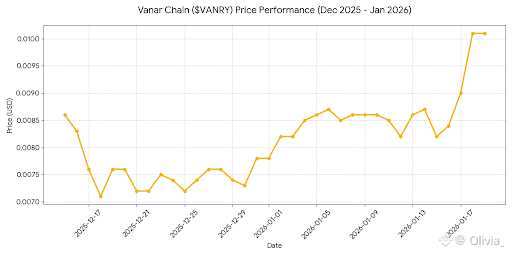
As the ecosystem develops, the success of Vanar Chain will be measured less by speculation and more by usage. Games that remain responsive, AI environments that operate smoothly, and virtual worlds that scale without friction will be the true indicators. In that sense, the project represents a shift toward infrastructure built not for attention, but for longevity.