
Dusk Foundation has steadily positioned itself as a leader in zero knowledge technology for enterprise blockchain use. What really stands out to me is how the project moved beyond theory and research into tools that companies can actually use in production. Instead of treating privacy as a niche feature, Dusk designs it as a core requirement for businesses that need verification without exposure. This overview looks at how its zero knowledge systems work, how the network reaches fast consensus, how developers build on it, how enterprises integrate it, how risks are handled, and where the broader vision seems to be heading.
How Zero Knowledge Powers the Entire Stack
Zero knowledge proofs sit at the center of everything Dusk builds. The network introduced a dedicated execution environment that allows smart contracts to run while keeping their logic, data, and results fully confidential. From my perspective, this is one of the most ambitious uses of ZK tech in a live blockchain. Transactions can be verified without revealing sensitive details, which is essential for financial and enterprise use.
On top of that, payment tools use stealth addressing and confidential transfers so value can move without leaving public trails. Scalability is handled by batching complex computations off chain and verifying them succinctly on chain. Identity and compliance checks work through selective disclosure, meaning users can prove specific facts about themselves without handing over full personal records. I see this as a practical answer to privacy first compliance, where rules are enforced but data is minimized.
All of this relies on efficient cryptographic primitives and data structures that keep performance reasonable. Compared with more experimental ZK networks, Dusk focuses on throughput that regulated environments can actually rely on.
A Consensus System Built for Speed and Reliability
Under the hood, Dusk uses a consensus model that blends staking with Byzantine agreement. Validators are selected based on stake and rotate regularly, which helps balance decentralization and performance. What catches my attention is how quickly transactions become final. Once confirmed, they cannot be reversed, which is critical for enterprises that need certainty.
The system includes penalties for downtime or malicious behavior, which encourages validators to stay reliable. Rather than chasing extreme transaction numbers, the network focuses on steady performance and high uptime. To me, this feels aligned with real business needs, where consistency matters more than record breaking benchmarks.
Tools That Help Developers Embrace Privacy
For developers, Dusk provides a full toolkit designed around zero knowledge contracts. Libraries and command line tools make it possible to write, test, and deploy private applications without starting from scratch. There is also a clear path for teams familiar with Ethereum to migrate, thanks to compatibility layers that support existing development patterns.
Grant programs support teams building applications around real world assets and compliant finance. Documentation ranges from simple tutorials to formal technical specifications, which lowers the learning curve. I get the sense that the goal is not just to attract cryptography experts, but also to help mainstream developers become comfortable working with privacy focused systems.
Real Enterprise Use in Practice
Dusk has already moved beyond theory into real enterprise pilots. Oracles provide trusted data feeds for private asset issuance, while regulated marketplaces use the network to tokenize and trade securities with automated compliance. Stablecoins can settle transactions privately, which is attractive for institutions that cannot expose balances or flows publicly.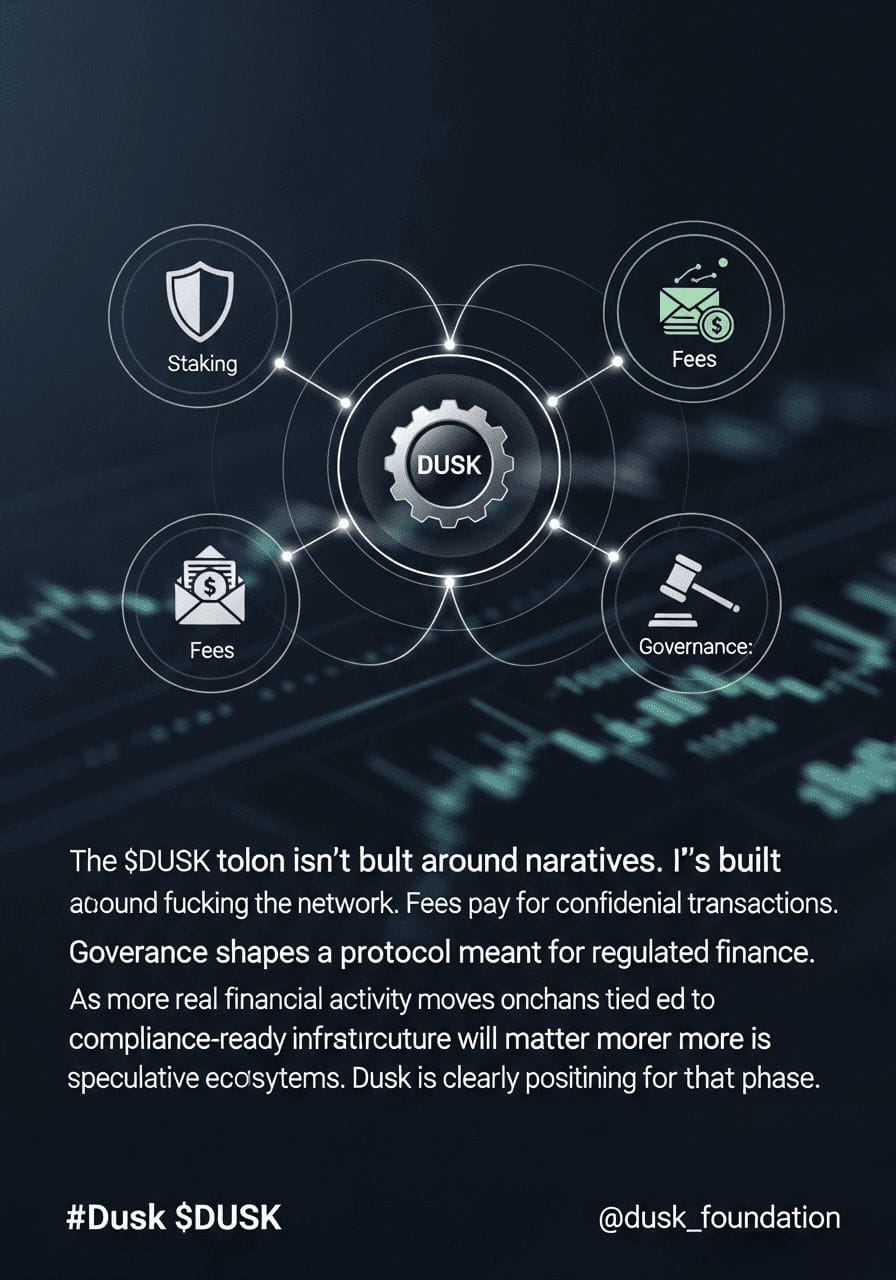
Banks and financial firms are testing trade finance and settlement workflows where sensitive data stays off chain but proofs remain verifiable. From what i see, these pilots show meaningful efficiency gains, including faster settlement times and simplified audits. The key takeaway for me is that privacy does not slow things down here, it actually removes friction.
Managing Risk and Long Term Stability
Risk management is built into both the technical and economic layers. Data feeds rely on decentralized pricing mechanisms to reduce manipulation. Token emissions are controlled to limit inflation, and a large portion of the supply is locked in staking, which supports network security.
Security audits are ongoing, covering both smart contracts and cryptographic components. The team also researches future threats, including advances in quantum computing, to make sure the system can adapt over time. I see this forward looking mindset as important for enterprises that need infrastructure they can trust for many years.
Where the Road Leads Next
Looking ahead into 2026 and beyond, the focus expands toward interoperability with other networks and deeper automation of compliance using advanced proof systems. There is also exploration into combining artificial intelligence with zero knowledge proofs to streamline reporting and decision making.
 User activity and wallet growth suggest steady traction rather than speculative spikes. From my point of view, Dusk is carving out a role as quiet infrastructure rather than a flashy platform. If adoption continues, it could become a backbone for global trade and finance where privacy and verification coexist naturally.
Dusk Foundation is not just applying zero knowledge proofs, it is shaping how they are used in real economic systems. By proving that confidentiality and accountability can live together, the project sets a standard that others may follow. The open question for me is how quickly enterprises will embrace this model as on chain adoption accelerates worldwide.
