


Dusk Network is a pioneering Layer-1 blockchain designed specifically for regulated financial markets, emphasizing privacy and compliance. Launched as a public, permissionless platform, it aims to bridge traditional finance with decentralized technologies by enabling the tokenization of real-world assets (RWAs) and streamlining processes like compliance and settlement. At its core, Dusk addresses key challenges in the financial sector, such as fragmented liquidity, mandatory custody requirements, and limited access to institutional-grade assets for everyday users.
The network's architecture is built around zero-knowledge proofs (ZKPs), which allow for verifiable computations without revealing sensitive data. This makes Dusk particularly suited for enterprise applications in decentralized finance (DeFi), where privacy is paramount. Businesses can access financing, automate trades via smart contracts, and outsource costly operations, while institutions benefit from instant clearance and reduced liquidity silos. Users, in turn, gain direct, self-custodial access to a wide array of assets from their wallets. Unlike many blockchains that retrofit privacy features, Dusk integrates them natively, providing a secure infrastructure for tokenized securities and automated financial workflows.
The Role of the DUSK Token
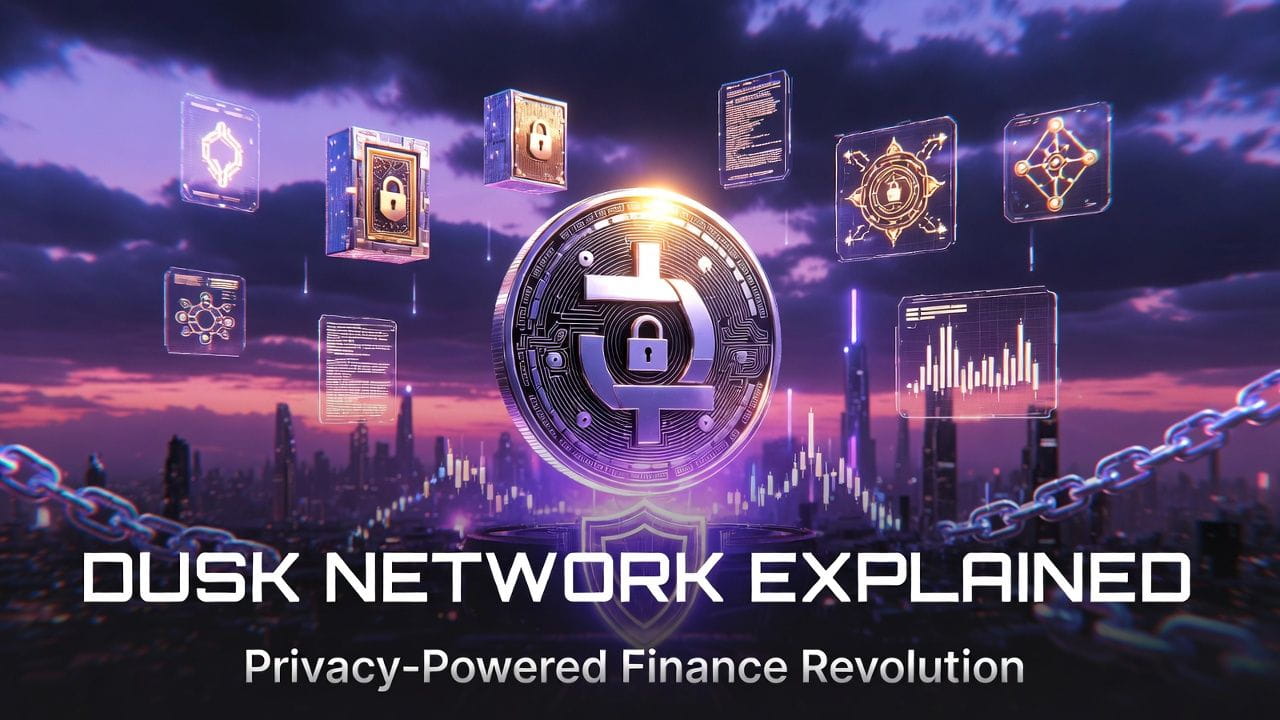
The DUSK token serves as the native utility token of the Dusk Network, powering its ecosystem and incentivizing participation. It functions as "network fuel," enabling users to pay for services like deploying and executing smart contracts, transferring assets, and covering transaction fees. DUSK is essential for staking, which secures the network through a unique Private Proof-of-Stake consensus mechanism, and it compensates nodes for bandwidth, verification, and storage.
In practical terms, DUSK facilitates atomic swaps, governance (in future updates), and interactions within the DeFi ecosystem. Transactions on the network consume gas measured in LUX (where 1 LUX = 10-9 DUSK), with fees dynamically adjusting based on demand to ensure efficient processing. This utility-driven design positions DUSK as a cornerstone for compliant, privacy-focused finance in Europe and beyond, supporting features like zero-knowledge compliance infrastructure and institutional custody solutions such as Dusk Vault.
The DUSK Token Smart Contract
Originally launched as an ERC-20 token on Ethereum and a BEP-20 on Binance Smart Chain (BSC), the DUSK token's smart contract has been a gateway for early adopters. The Ethereum contract address is 0x940a2db1b7008b6c776d4faaca729d6d4a4aa551, with verified source code that includes standard functions like totalSupply(), balanceOf(), transfer(), approve(), and transferFrom(). Similarly, the BSC address is 0xb2bd0749dbe21f623d9baba856d3b0f0e1bfec9c.
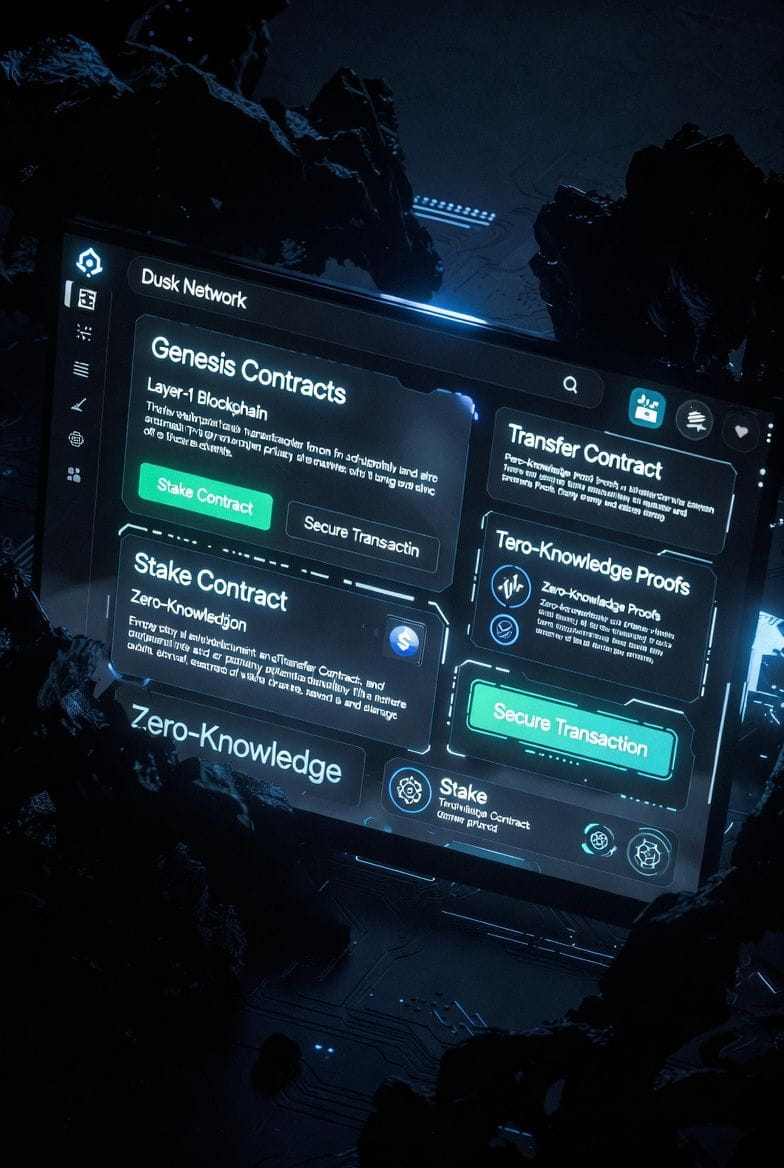
These contracts adhere to the ERC-20/BEP-20 standards, ensuring compatibility with wallets like MetaMask and decentralized exchanges. With the launch of Dusk's mainnet, users can now migrate their ERC-20 or BEP-20 DUSK to native DUSK via a burner contract, which burns the old tokens and mints equivalents on the native chain. This process is straightforward and documented for seamless transition, allowing holders to participate fully in the privacy-enhanced ecosystem.
The contract's design emphasizes security and efficiency, with 18 decimal places for precision in transactions. As of the latest data, the token has seen significant trading volume, reflecting growing interest in privacy-centric blockchains.
Confidential Smart Contracts on Dusk Network
One of Dusk's standout innovations is its native support for confidential smart contracts, making it the first blockchain to offer this feature at the protocol level. These contracts execute privately using a purpose-built zero-knowledge virtual machine (zkVM) called RUSK, which verifies transactions and state transitions without exposing sensitive details like balances, identities, or counterparties.
RUSK enables developers to build decentralized applications (dApps) with built-in privacy, compliance parameters, and controls. For instance, transactions generate ZKPs that are submitted on-chain for validation, ensuring cryptographic correctness without revealing data to validators. This model supports regulated financial logic, auditable settlements, and features like proxy voting or self-custody, all while minimizing risks of fraud and theft.
Developers can explore examples on Dusk's GitHub, such as basic smart contracts illustrating deployment and interaction. The platform's dual model allows for both transparent and private transactions, broadening its appeal for diverse use cases.
The XSC Standard: Confidential Security Contracts
Central to Dusk's financial focus is the Confidential Security Contract (XSC) standard, which governs the creation and issuance of privacy-enabled tokenized securities. XSC is engineered for maximum security, enabling the tokenization of RWAs like stocks or bonds while ensuring compliance with global regulations. It addresses privacy concerns in public blockchains by allowing selective disclosure--revealing specific information only to authorized parties.
This standard powers zero-knowledge utility tokens, which maintain confidentiality without compromising on verifiability. For example, in self-custody scenarios, XSC minimizes fraud risks by enforcing secure governance of security tokens. Combined with instant settlement and automation, XSC positions Dusk as a leader in compliant on-chain finance.
Tokenomics and Economic Model
DUSK's tokenomics are designed for long-term sustainability. The initial supply is 500,000,000 DUSK, with an additional 500,000,000 emitted over 36 years through a geometric decay schedule that halves rewards every four years. This results in a maximum supply of 1,000,000,000 DUSK. Emissions reward consensus participants, with block rewards distributed as 70% to generators, 10% to the development fund, and the remainder to committees.
Staking requires a minimum of 1,000 DUSK, with no upper limit and a two-epoch maturity period. A soft slashing mechanism penalizes misbehavior without burning tokens, maintaining network integrity. Allocation from the initial supply includes 50% for token sales, with the rest vested to teams, advisors, and development by 2022.
As of January 2026, DUSK's market performance reflects its utility, with a price around $0.17 and 24-hour trading volumes exceeding $65 million.
Dusk Network represents a forward-thinking approach to blockchain finance, where privacy, compliance, and efficiency converge. The DUSK token and its underlying contract now evolving with mainnet migration form the backbone of this ecosystem, enabling secure, confidential operations. As adoption grows, Dusk's innovations in smart contracts and token standards could redefine how financial assets are handled on-chain, fostering greater economic inclusion and trust in decentralized systems. For developers and investors alike, Dusk offers a robust platform poised for real-world impact.
