
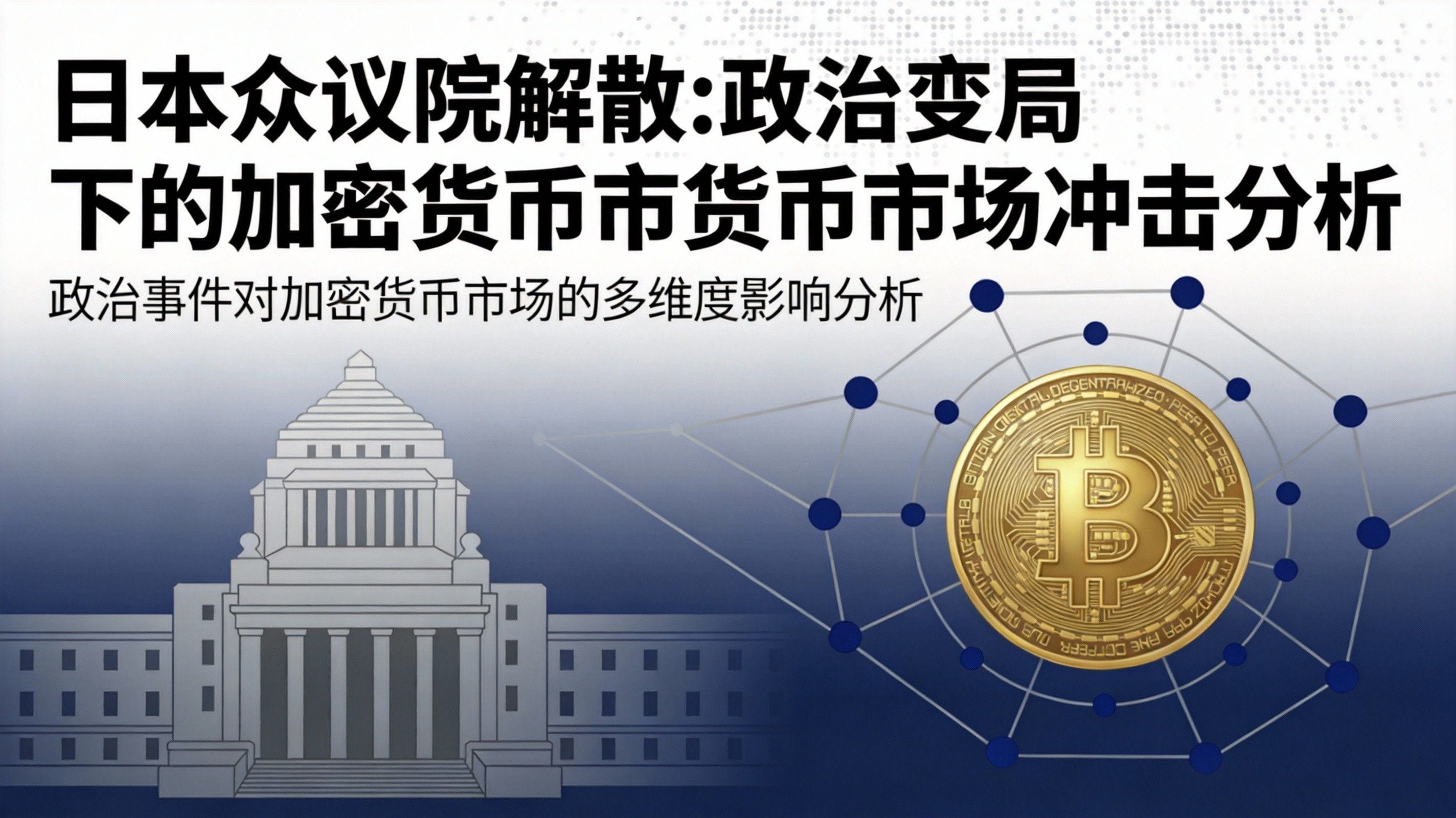
A rare event not seen in 60 years has just occurred in Japanese politics: the House of Representatives was dissolved on the opening day of the regular session of the Diet, and Prime Minister Sanae Takaichi will face an election test on February 8. This is not only a domestic political earthquake but also a macro signal for the cryptocurrency market.
Historical reference: Political events and $BTC
Looking back at the major political events in Japan in recent years, the impact on $BTC has been inconsistent—from a drop of 2.5% after Abe's assassination to a rise of 3.2% following the cabinet reshuffle. The uniqueness of this dissolution lies in the 'political surprise' style of ultra-short cycle (only 16 days), which may trigger short-term uncertainty in the market.
Three Major Influencing Channels
1. Exchange Rate Transmission
Yen fluctuations have a strong correlation with $BTC (correlation coefficient of 0.85 over the past 12 months). If political turmoil leads to yen depreciation, Japanese investors may increase their allocation to cryptocurrencies to hedge against local currency risk.
2. Regulatory Window
Periods of political change often serve as windows for accelerated policy reform. Japan’s cryptocurrency tax rate is proposed to be reduced from 55% to 20% and reclassified as a financial product, which is expected to attract capital inflow.
3. Regional Sentiment
Japan accounts for 18% of cryptocurrency trading volume in Asia, and changes in its political landscape will affect market sentiment in Korea, Singapore, and other regions, potentially triggering short-term risk aversion but also prompting funds to seek non-traditional assets.
Investment Perspective
• Short-term focus on leading indicators such as the yen exchange rate and government bond yields
• Medium-term focus on tracking tax reform progress, which is a key fundamental for the Japanese crypto market in 2026
• Maintain a diverse investment portfolio to avoid over-betting on a single event
Why is this time different?
The current global macro environment is complex—Federal Reserve policy shifts, geopolitical tensions, and rapid evolution of digital currency regulation. In this context, political changes in Japan are no longer just domestic events but may become triggers for global capital reallocation.
Especially for global assets like cryptocurrencies, changes in the Japanese market will influence global pricing through multiple channels. Investors need to break out of the traditional thinking that "political events only affect their own country" and establish a more comprehensive analytical framework.
Follow Xiao Hai to chat about the crypto world for more in-depth analysis of politics and cryptocurrencies.
