Musk's Davos debut: Behind the joke of "I am an alien" is an interstellar narrative aimed at protecting human consciousness$BTC
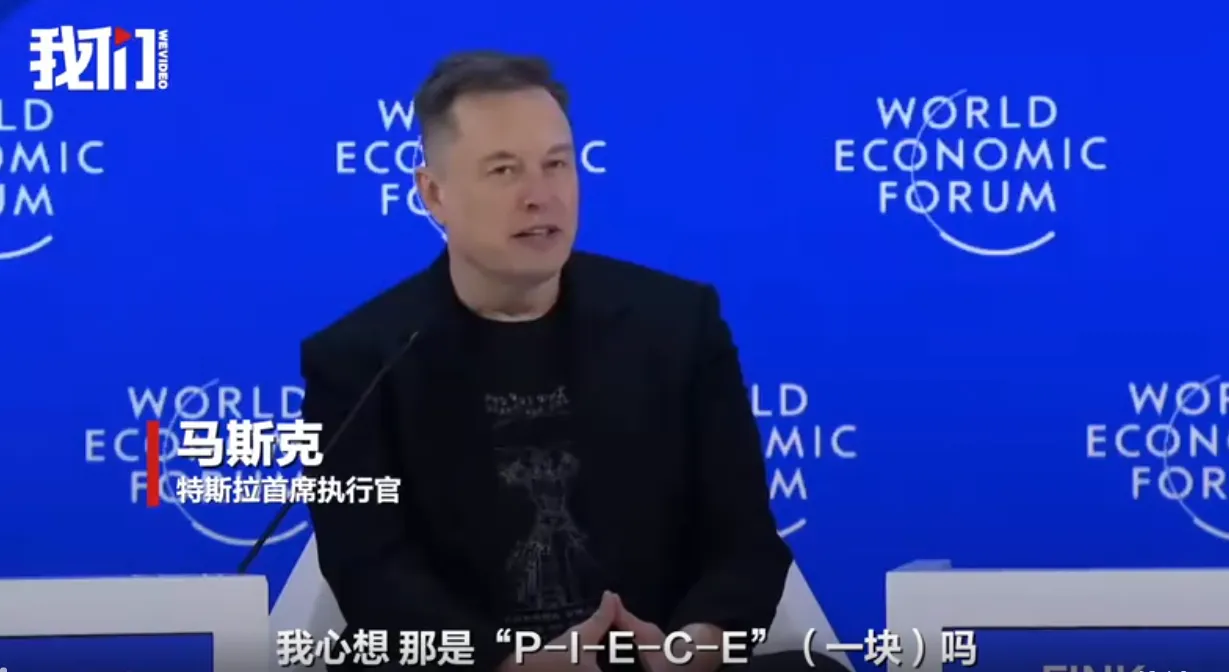
On January 22, 2026, in the town of Davos, Switzerland, Elon Musk made his debut at the World Economic Forum. During a half-hour conversation with Larry Fink, co-chair of the World Economic Forum and CEO of BlackRock, a humorous statement, "I am an alien, but they don't believe me," instantly ignited global public opinion. Behind the joke lies the grand vision of this tech mogul regarding the future of AI, the survival of civilization, and interstellar exploration.
As the most controversial and imaginative leader in the tech world, Musk's speech at Davos continued his usual style—deconstructing serious issues with a mischievous tone, then reconstructing future scenarios with precise technical blueprints and timelines. When Fink posed the intriguing question, 'Are there aliens among us?' Musk immediately responded, 'If anyone knows the answer, it must be me, because I am an alien,' prompting laughter from the audience. But he quickly shifted gears, using data from the 9,000 satellites SpaceX has in orbit to provide a serious commentary: 'We have never encountered an alien spacecraft that we needed to avoid, which convinces me that life and consciousness are extremely rare in the universe, and humans may be the only spark.' This statement not only responds to the Fermi Paradox but also reveals the core logic behind all his business plans—protecting this fragile 'light of consciousness.'
In this conversation dubbed the 'Mini Musk Universe,' 'abundance' became the recurring keyword. Musk proposed a disruptive formula: Economic output = Average productivity per robot × Number of robots. He provided a clear timeline: Tesla's 'Optimus' humanoid robot will enter factories for complex tasks by the end of 2026, be available for public sale by the end of 2027, and within 3-5 years, the number of robots worldwide will surpass the total human population. 'At that time, goods and services will be so abundant that you won't be able to think of what else you need; material scarcity will become history,' Musk's assertion is backed by absolute confidence in the integration of AI and robotics technology.
However, the road to the 'era of abundance' is not without obstacles. Musk candidly stated that the biggest bottleneck in current AI development is not chips or algorithms, but global power supply capacity. 'Chip production is rapidly increasing, but the power grid only expands by 3%-4% each year, which may lead to a future where there are 'chips but no electricity to use.' To address this, he proposed a two-fold solution: relying on solar facilities on the ground, with a solar power plant of 26,000 square kilometers capable of meeting the entire United States' electricity demand, while China's deployment of over 1,000 gigawatts of solar energy annually gives him hope for feasibility; in space, solar-powered AI data centers will be deployed, utilizing five times the power generation efficiency of Earth and a naturally cool environment to completely break through energy constraints. The prerequisite for all this is that SpaceX's 'Starship' achieves full reusability by 2026, reducing space transportation costs to below $100 per pound.
When discussing the ultimate impact of AI, Musk's predictions are filled with tension. He believes that by the end of 2026 or early 2027, AI will surpass individual human intelligence, and by 2030, total AI intelligence will far exceed that of all humanity, with the approach of the 'technological singularity' causing AI iterations to exceed human understanding. This view resonates with discussions among other tech giants at the Davos Forum—Google DeepMind CEO Hassabis once predicted a 50% chance that AI would possess all human cognitive abilities by the end of 2030, while Anthropic CEO Amodei warned that AI could trigger the contradiction of high growth and high unemployment. But Musk emphasizes the constructive nature of technology: 'AI is not a threat, but a tool for achieving abundance; the key is to make technology serve the preservation of civilization.'
In the discussion, Musk also demonstrated caution regarding technological ethics. When asked whether he plans to solve human aging, he stated that this technology 'can definitely solve' the issue but quickly added, 'Stopping aging may not be a good thing; limited lifespan can prevent societal stagnation and allow fresh ideas to drive social progress.' This seemingly contradictory attitude is precisely where his depth of thought lies—technology is ultimately a means, and the vitality and preservation of civilization are the ultimate goals.
From SpaceX's Mars colonization plan to Tesla's sustainable energy layout and Neuralink's brain-machine interface exploration, all of Musk's business endeavors point to the same core: 'Maximizing the future probability of civilization, allowing consciousness to transcend Earth's boundaries.' His joke 'I am an alien' may be the most fitting self-description—his vision has long since transcended the conventional realm of Earth-bound entrepreneurs, contemplating humanity's fate from a cosmic perspective.
Musk's first appearance at Davos can be described not just as a speech by a business leader, but rather as a declaration of future civilization. When he broke down the grand topic of 'consciousness preservation' into a concrete timeline for mass production of robots, space energy, and interstellar transportation, those once sci-fi blueprints took on a tangible quality. As he said at the end: 'The universe is vast and dark, human consciousness is the only candle within it, and our mission is to keep that light from extinguishing.' This conversation, which sparked global discussions, ultimately left the world not only with the amusing topic of 'aliens' but also with profound reflections on how humanity can harness technology and safeguard civilization.