
Why Walrus Is the Most Important Infrastructure Bet on Sui Right Now 🏗️⚡
There is a quiet paradigm shift happening in crypto infrastructure, and most people are missing it because they are distracted by price candles. This is not a meme-cycle story. This is an infrastructure supercycle story — and at the center of it sits @Walrus 🦭/acc and its native token WAL. 💎 Walrus
Let’s start with the problem.
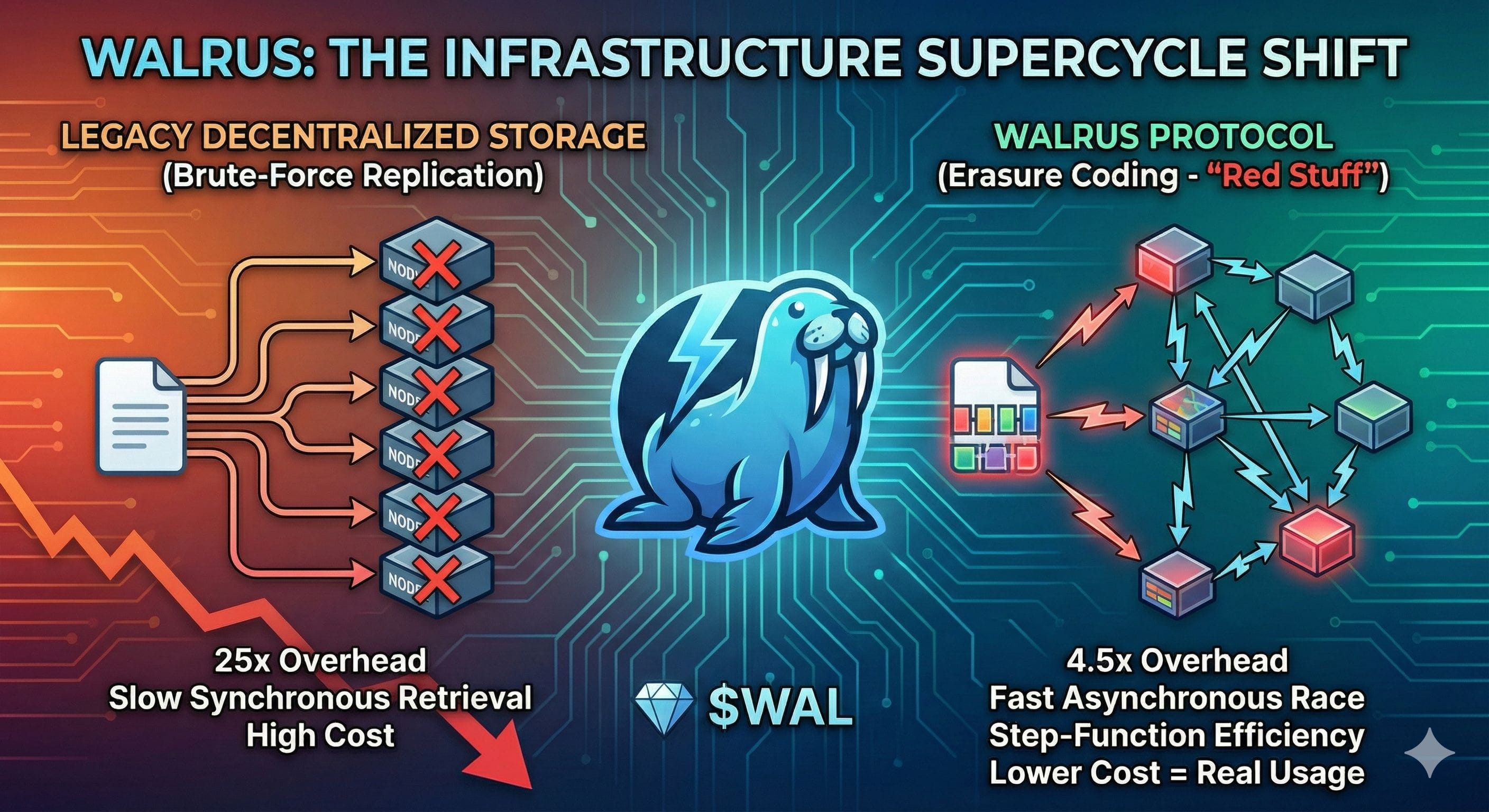
Decentralized storage has always sounded good in theory, but terrible in practice. Legacy systems rely on brute-force replication: store the same file 20–25 times across nodes and pray nothing breaks. That means insane overhead, slow retrieval, and costs that make Web2 cloud providers like AWS look unbeatable. 📉 The result? Most “decentralized storage” has been more ideology than usable infrastructure.
Walrus changes the math.
Instead of blind replication, Walrus uses erasure coding — what insiders call the “Red Stuff.” 🧠 In simple terms: rather than copying full files everywhere, Walrus breaks data into coded fragments that can be reconstructed even if parts go missing. The result is roughly 4.5x storage overhead instead of 25x. This is not a marginal improvement. This is a step-function efficiency gain.
Efficiency = lower cost
Lower cost = real usage
Real usage = sustainable demand for WAL
That’s the first moat.
The second moat is speed, and this is where most people underestimate Walrus. Traditional decentralized storage waits for nodes to respond synchronously. Slowest node wins. Walrus flips this model using asynchronous design — nodes race instead of wait. ⚡ The fastest responders serve the data, while the protocol still maintains security guarantees. Translation for non-engineers: Web2-level performance in a Web3-native system.
This matters because storage is not just about files anymore.
Enter the AI + DePIN narrative.
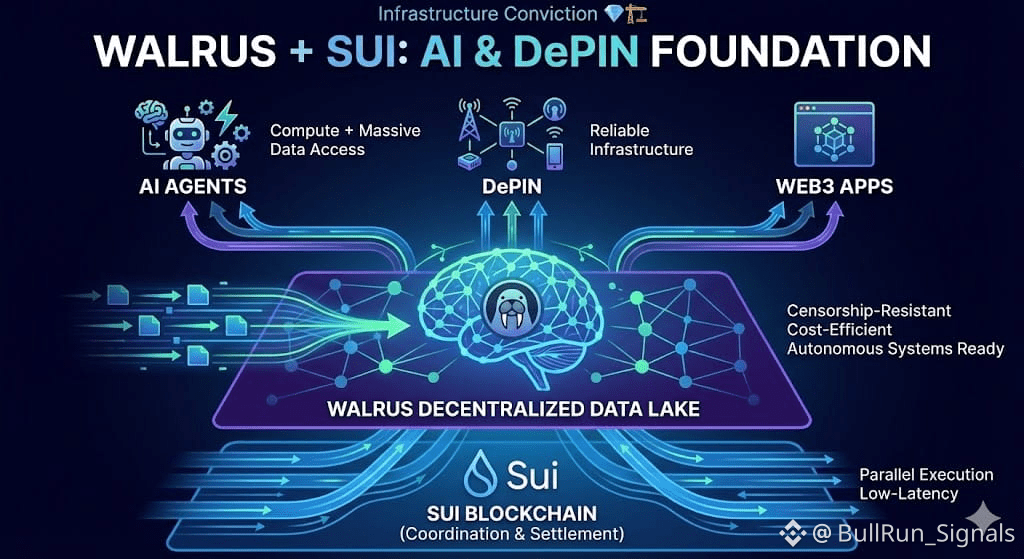
AI agents need three things: compute, coordination, and massive, reliable data access. Walrus is positioning itself as a decentralized data lake — censorship-resistant, cost-efficient, and fast enough for autonomous systems. 🧠⚡ This is why Walrus is not “just storage.” It is a foundational layer for AI-native applications that cannot rely on centralized cloud providers.
Now zoom out to the Sui connection.
Walrus runs on Sui for coordination and settlement. This is critical. Sui’s parallel execution model and low-latency design make it ideal for high-throughput infrastructure protocols. Walrus is effectively a leveraged bet on Sui’s ecosystem growth. If you are bullish on $SUI adoption, Walrus is one of the cleanest infrastructure expressions of that thesis. 💧
To be clear: this is not hype. This is architecture. Math > marketing. Protocol design > slogans.
The market always underprices infrastructure early because it is boring — until suddenly it is unavoidable. Storage is unavoidable. AI agents are unavoidable. Decentralized alternatives to AWS are unavoidable. Walrus sits at the intersection of all three.
Gem alert? Maybe.
Infrastructure conviction? Absolutely. 💎🏗️
CTA — let’s debate:
Is decentralized storage finally usable, or is Web2 still untouchable? Drop your real experience below 👇
And if you are bullish on the Sui infrastructure stack, drop a 💧 in the comments.
Follow for the next deep dive — I’ll break down the Red Stuff math in detail and why efficiency will decide the next wave of winners. 🔔