

How Walrus Keeps Your Data Safe
Losing data just plain sucks. It’s a pain in old-school Web2, and honestly, Web3 hasn’t cracked the code yet either. Centralized clouds try to dodge the problem by stashing copies in their own locked-down data centers. Decentralized networks have their own headaches—nodes drop off, incentives get weird, or you’re stuck waiting forever to recover lost files. Walrus doesn’t do any of that. Instead, it starts with a simple truth: stuff breaks. So Walrus builds for that from day one.
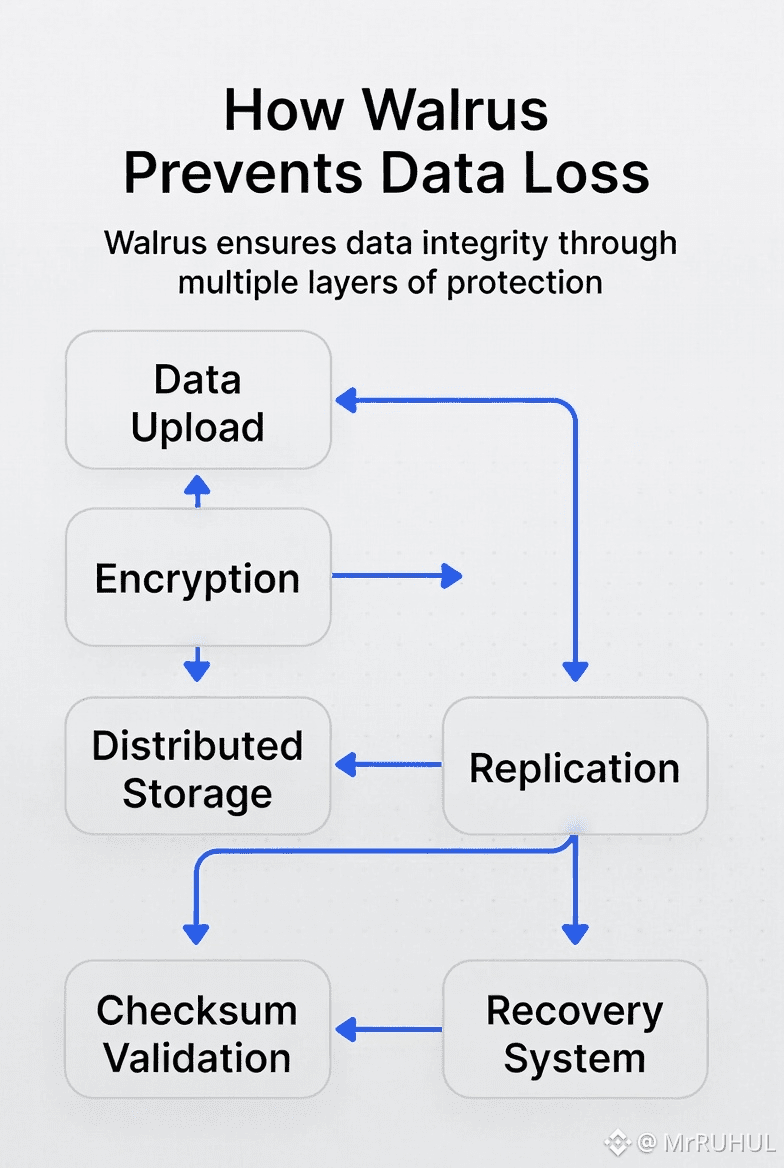
For Walrus, keeping your data safe isn’t just a bonus. It’s the whole reason it exists.
1. Redundancy, Right From the Start
Your data isn’t left sitting out as a single copy. Upload something to Walrus and it slices your files into chunks, spreading them across a bunch of independent storage nodes. No one node holds everything. If one goes offline—or two, or even more—it doesn’t matter. You can still get your data back.
Walrus expects things to go sideways. That’s just how it’s built. It sets up redundancy, so your data survives, even when things get messy. That’s what you want from real infrastructure: assume failure, but never lose a thing.
2. Smarter Storage with Erasure Coding
Instead of making endless full copies (which just eats up space and money), Walrus uses erasure coding. It splits your file into fragments, but you only need a certain number to rebuild the whole thing.
Say Walrus chops your file into N pieces, but you only need K of them to put it back together. As long as enough fragments stick around, you’re fine.
The upside? You get much better fault tolerance without blowing up your storage bill. And if a node disappears, you don’t need to panic or re-upload. Walrus just keeps humming along.
3. Watching for Problems, Always
Walrus doesn’t just drop your data and cross its fingers. It’s always watching where your fragments live, making sure they’re still there.
If too many vanish—maybe a few nodes crash or bail—Walrus jumps in. It automatically creates fresh fragments and spreads them to healthy nodes, patching things up before you even notice.
That self-healing is a big deal, especially in decentralized networks where data loss can sneak up on you as nodes disappear. Walrus doesn’t let that slow leak happen.
4. Incentives That Actually Work
A lot of decentralized storage projects fall apart because their rewards system is broken. Nodes grab your data, take the money, and sometimes vanish. Walrus fixes this by making providers earn money only if they actually store your data, prove they’re online, and keep things available. If they don’t? They lose out, or even get the boot. That gives everyone skin in the game to keep things running smoothly.
With Walrus, storing data is the main event—not some side hustle.
5. Proof, Not Promises
Walrus doesn’t just trust storage nodes. They have to show cryptographic proof, over and over, that your data’s still safe in their hands.
These proofs are quick, impossible to fake, and anyone (including Walrus or even the blockchain) can verify them. If a node tries to cheat and quietly ditches your data, the proof fails—and they pay the price.
It’s not “trust me,” it’s “prove it.”
6. Real Decentralization, Real Diversity
Here’s another problem: what if a bunch of nodes go down together because they’re all in the same spot, run by the same group, or using identical hardware? Walrus dodges that by spreading file fragments everywhere—different regions, different operators, different setups.
So even if a whole region or cloud provider tanks, your data stays safe. That kind of diversity isn’t just a bonus; it’s how Walrus stays tough.
7. Check Your Data, Anytime
Walrus uses content-addressed storage. Basically, your files are named by a cryptographic hash, not some random location.
No one can secretly mess with your stuff. If there’s any corruption, you’ll see it. And when you pull your data back, it’s exactly what you put in—no silent edits, no weird surprises.
Even if Walrus rebuilds your files from a bunch of different nodes, you get back the real deal, every time.@Walrus 🦭/acc #Walrus $WAL