

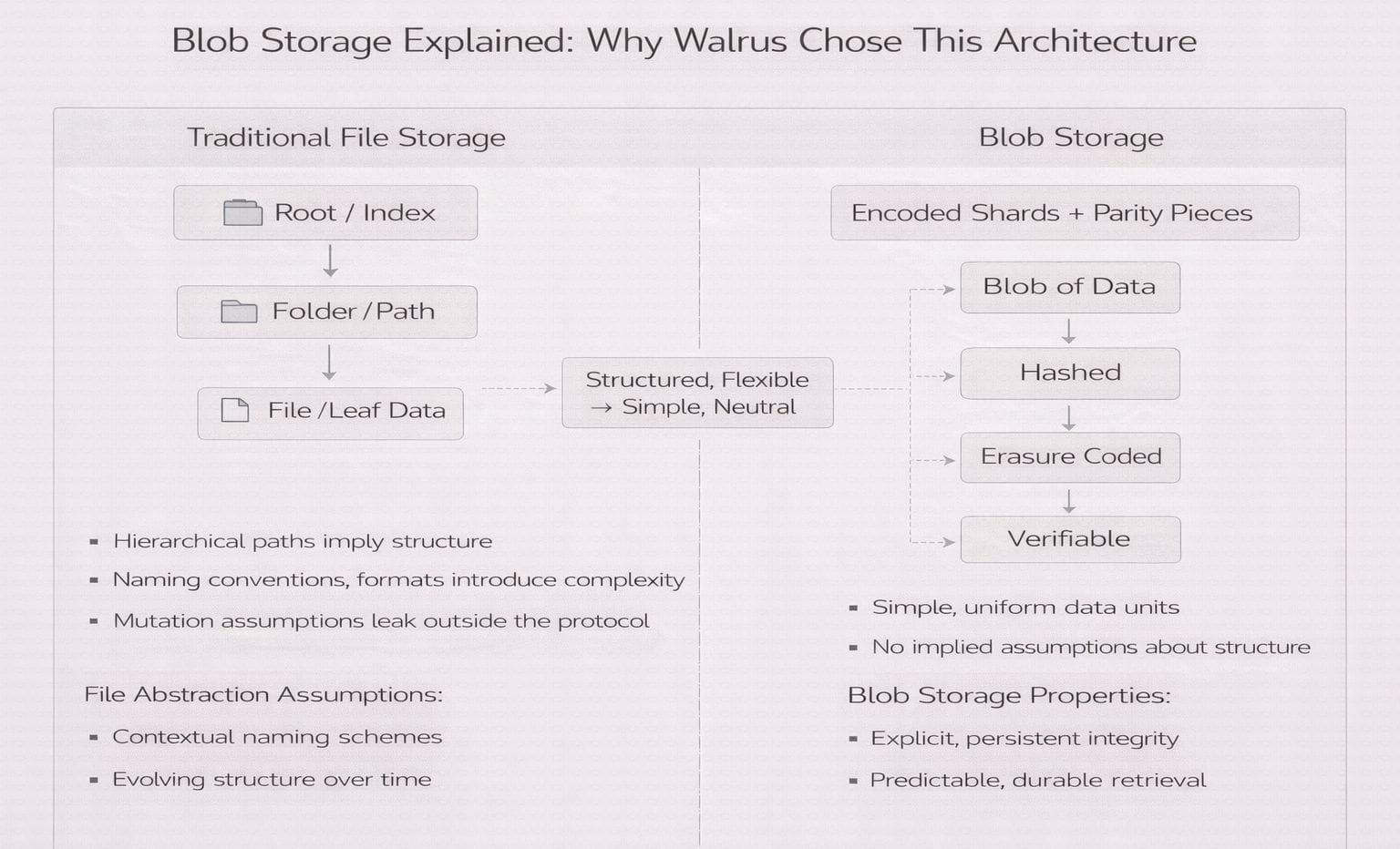
 Most decentralized storage systems inherit their structure from file systems. Data is treated as something hierarchical, addressable by paths, optimized for human organization. That mental model works for documents and media. It breaks when storage becomes a substrate for on-chain execution, proofs, and continuous interaction. Walrus chose blob storage because on-chain systems do not need files they need reliable data units.
A blob is intentionally simple. It is an unstructured chunk of data with a clear size, identity, and lifecycle. No assumptions about format. No implied semantics. This simplicity is not a limitation; it is what makes blob storage scalable. Walrus treats data as something the protocol must preserve and serve correctly, not something it must interpret.
File-based abstractions leak complexity. They make presumptions about naming schemes, directory structures, and mutation patterns that a decentralized system cannot reliably provide. When these presumptions inevitably fail, developers are left to recreate trust and logic outside the system. Blob storage escapes this problem by excising storage down to some minimum guaranteed by the network, including persistence, integrity, and retrievitability.
Another reason blob storage matters is predictability. Large on-chain applications do not interact with data sporadically. They stream it, reference it, verify it, and depend on it across time. Blobs allow Walrus to reason about cost, durability, and access without guessing how data will be used later. The system commits to storing a blob, not managing a file’s evolving state.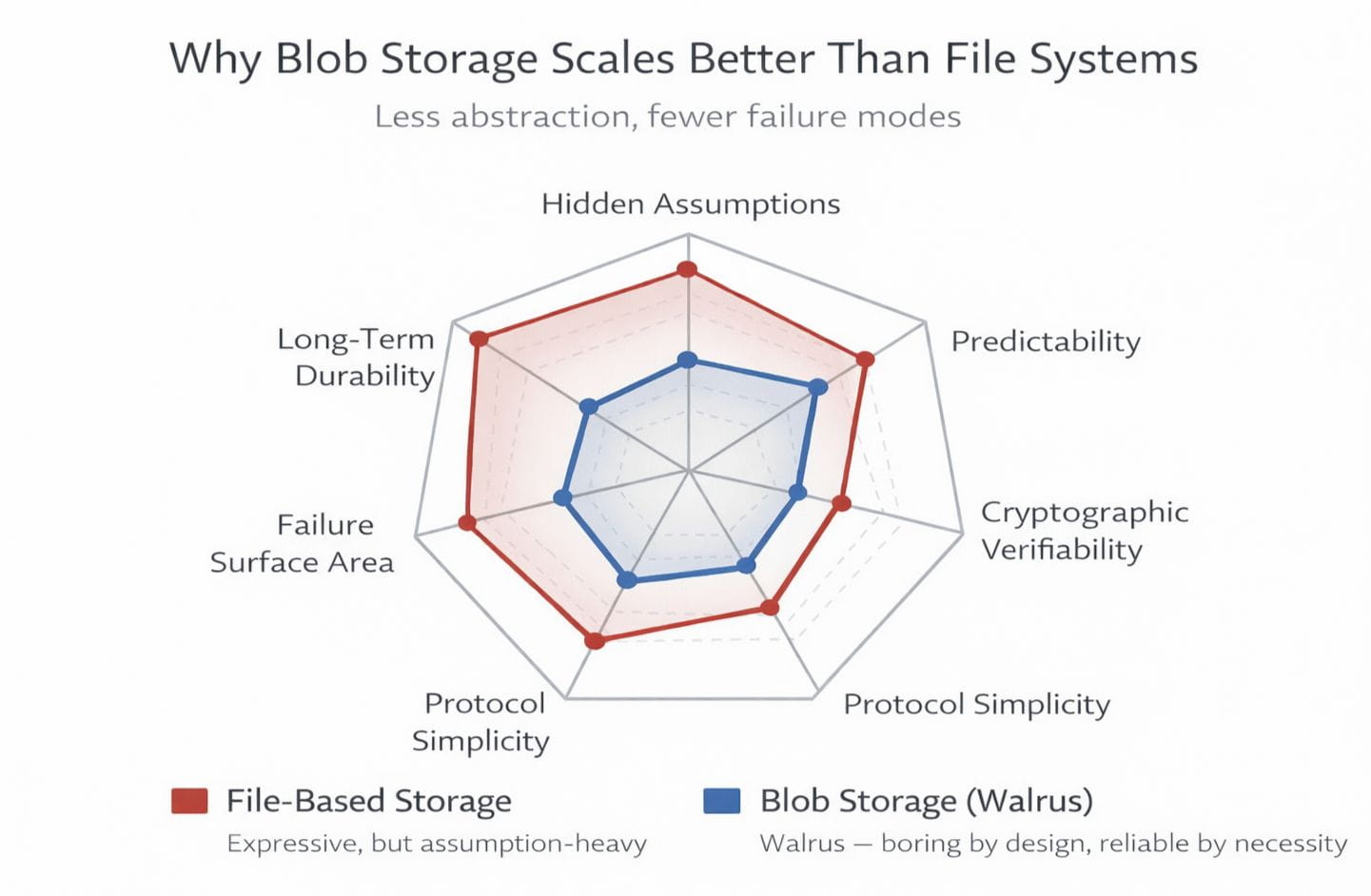
Blob storage also aligns naturally with cryptographic verification. A blob can be hashed, fragmented, erasure-coded, and proven available without ambiguity. There is no confusion about partial reads, metadata drift, or hidden dependencies. What was written is exactly what must be retrieved. This clarity is essential when storage becomes part of settlement and execution rather than a background service.
From a network perspective, blobs reduce coordination overhead. Nodes do not need to agree on structure, only on availability and correctness. This makes it easier to distribute data across heterogeneous providers without forcing them into a shared worldview about how storage “should” behave. Diversity becomes an asset instead of a liability.
Importantly, blob storage shifts responsibility to the right layer. Walrus does not decide what data means. Applications do. By keeping storage neutral and minimal, Walrus avoids embedding assumptions that would later constrain developers. The protocol guarantees durability and access; interpretation remains external and flexible.
Walrus chose blob storage because decentralized infrastructure survives by being precise, not expressive. When systems scale, every hidden assumption becomes a failure mode. Blobs remove those assumptions and leave behind something sturdier: data that exists, endures, and can be depended on without ceremony.
In a world where on-chain activity is continuous and stateful, storage cannot afford to be clever. It must be boring, exact, and reliable. Blob storage is not an optimization it is an admission that durability matters more than abstraction.