

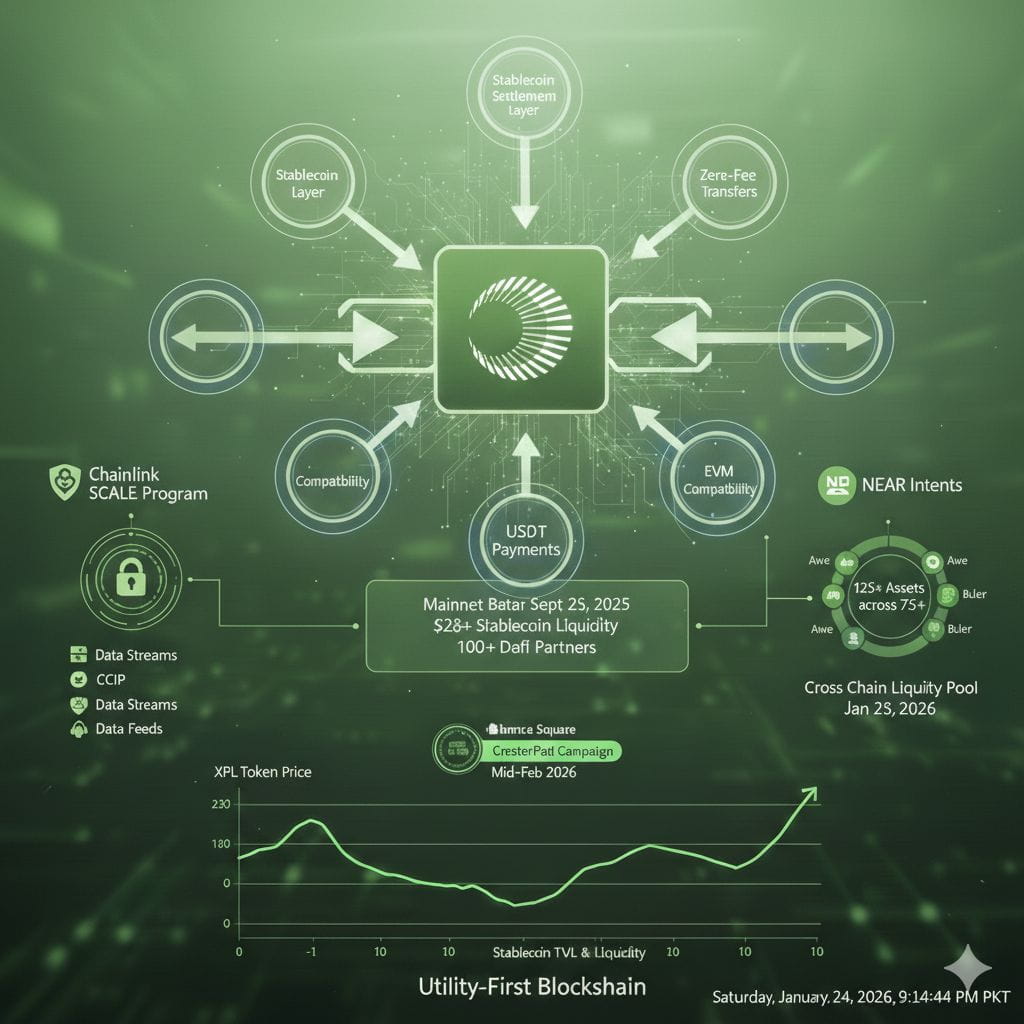
Plasma has quietly emerged as one of the most consequential infrastructure plays in crypto’s evolution from novelty to utility. Designed not as a catch-all smart contract chain but as a purpose-built Layer-1 for global stablecoin settlement, Plasma tackles a problem every institution that touches crypto eventually confronts: moving digital dollars cheaply, quickly, and securely at scale.
From its mainnet beta launch on September 25, 2025, Plasma has consistently doubled down on its stablecoin-centric thesis. The network went live with more than $2 billion in stablecoin liquidity on day one, backed by more than 100 DeFi partners, including protocols like Aave and Euler. This put Plasma immediately within the top tier of chains by stablecoin deposits—a rare beginning for a new blockchain.
What sets Plasma apart is architectural clarity: the chain is engineered from the ground up for USD₮ payments, offering near-instant finality, zero-fee stablecoin transfers, and EVM compatibility so developers can port existing smart contracts without rewrites. Its PlasmaBFT consensus protocol delivers high throughput optimized for payments rather than generalized application workloads.
One of Plasma’s signature innovations is its protocol-level paymaster system that sponsors gas for USDT transactions. Users can send digital dollars on the chain without ever needing to acquire native tokens for fees—a significant friction reduction compared to legacy Layer-1 and Layer-2 networks. These zero-fee transfers are not a gimmick; they reflect Plasma’s priority of real-world usage over speculative activity.
Complementing this user-centric design is an expanding ecosystem integration effort. Plasma joined the Chainlink SCALE program and adopted Chainlink as its official oracle provider, embedding CCIP (Cross-Chain Interoperability Protocol), Data Streams, and Data Feeds into its stack. This gives developers robust price data, secure cross-chain messaging, and reliable connectivity to more than 60 other networks—an essential foundation for DeFi use cases and global stablecoin flows.
Particularly noteworthy in early 2026 is Plasma’s integration with NEAR Intents, a rapidly growing cross-chain protocol. Announced on January 23, this integration connects Plasma’s native token XPL and its stablecoin utility into a single liquidity pool spanning 125+ assets across 25+ chains. In practical terms, builders and users can now execute large-volume stablecoin swaps and settlements with minimal friction and competitive pricing, anchoring Plasma squarely within the expanding composable financial ecosystem.
These moves have concrete ecosystem implications. They signal that Plasma isn’t content with being a siloed payments chain; it wants to be a cross-chain conduit for stable liquidity. Integrations like NEAR Intents bring Plasma into the orbit of broader DeFi activity and multi-asset settlement without undermining its core thesis. The Chainlink partnership further ensures that stablecoin rails are backed by institutional-grade data and interoperability.
Despite these advances, Plasma’s native token XPL has faced significant market pressure. Trading well below its brief peaks, the token reflects wider market conditions and the challenge many infrastructure plays encounter post-launch when speculative demand wanes. However, recent on-chain analysis suggests that TVL and stablecoin liquidity have remained resilient even as token price volatility persists. This divergence—strong usage metrics alongside muted market sentiment—is a pattern observed in other infrastructure rollouts and underscores the difference between use case adoption and short-term price movements.
In response, community and ecosystem stakeholders have pursued visibility and engagement initiatives. Binance Square launched a CreatorPad campaign that rewards content and activity around Plasma through mid-February 2026. While not a fundamental shift in technology, such programs aim to expand awareness and encourage meaningful participation beyond early adopters.
Plasma’s trajectory so far reflects a measured, infrastructure-first approach that prioritizes real economic activity over hype. Its focus on stablecoin optimization, deep ecosystem partnerships, and cross-chain accessibility positions it as a serious infrastructure contender in the ongoing shift toward programmable money. The chain grapples with the same adoption challenges every new layer faces—network effects, validator growth, and competitive landscape—but its deliberate build and integration strategy give it unique leverage as stablecoins continue their transition from speculative instruments to core financial rails.
In the next phase, key indicators to watch will be growth in actual payment activity, sustained stablecoin TVL expansion, and how effectively Plasma’s broader integrations translate into real-world usage, not just onchain metrics. If those materialize, Plasma may well define a new class of “utility-first” blockchains designed less for token narratives and more for predictable, high-frequency global value transfer.

