

Walrus exists because data does not stop being important after it is created. When something happens on-chain, people usually care about the result. A transaction goes through, an action is completed, and the system moves on. What often gets ignored is the data that stays behind. That data is proof. Proof of what happened, when it happened, and how it happened.
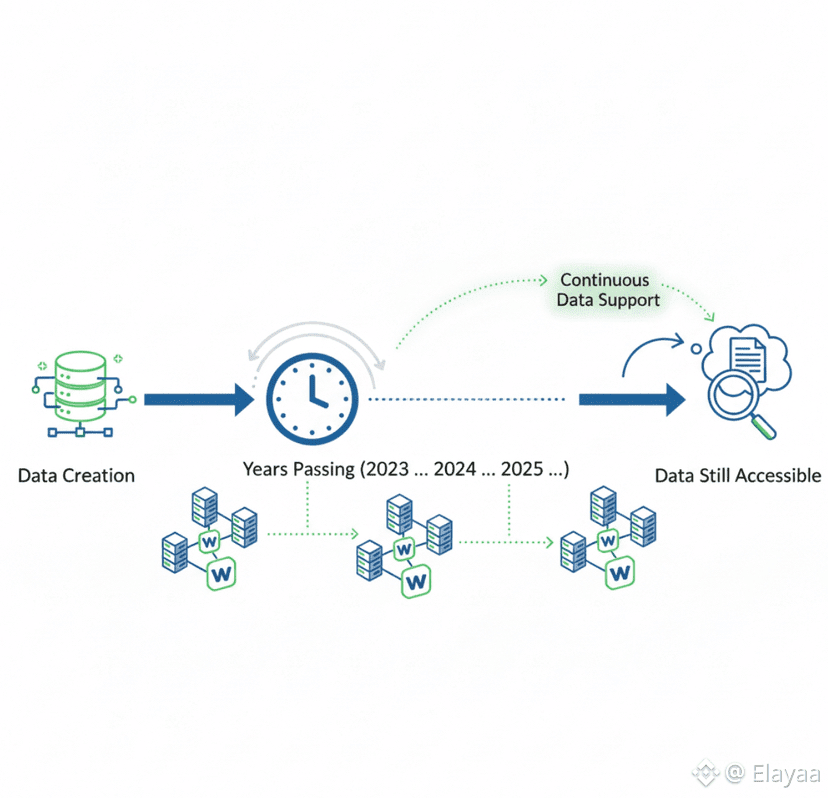
At the beginning, this proof is easy to access. The network is active, storage feels cheap, and many nodes are willing to keep data online. Everything looks fine. As time passes, things slowly change. Data grows larger. Rewards become smaller. Fewer operators want to keep storing old data that no one talks about anymore.
Nothing breaks suddenly. Access just becomes harder. Verification slowly turns into trust.
Walrus was built to stop this quiet problem.
Walrus does not run applications or execute transactions. It does not manage balances or accounts. Its role is focused. It keeps data available so anyone can verify the past without asking permission.
To do this, Walrus breaks data into small encrypted pieces. These pieces are spread across many independent nodes. No single node controls the full data. Even if some nodes leave, the data can still be recovered.
This design avoids centralization over time. Instead of pushing all responsibility onto a few large operators, Walrus shares the load across the network. This keeps the system open and resilient.
The $WAL token exists to make this reliable. Nodes earn rewards by staying online and keeping data available over long periods. They are not paid for hype or activity spikes. They are paid for consistency. If they fail, they lose rewards.
Walrus works best when things are quiet. When attention moves elsewhere. That is when proof matters the most.

