

@Walrus 🦭/acc Decentralized storage has a familiar problem: everyone likes the idea, but product teams still end up shipping with a centralized bucket because it’s predictable. The moment an app needs to handle real files—video clips, model checkpoints, user photos—the “just put it on-chain” instinct collapses into a mess of cost, latency, and operational risk. That’s the backdrop for Walrus, and it’s also why an RFP program is more than a community gesture. If the protocol wants to be useful, it has to be surrounded by the quiet, practical tools that make storage feel boring in the best way. Walrus’s Request for Proposals program is explicitly aimed at that gap: funding projects that build tooling, integrations, and new use cases in response to targeted needs, reviewed on a rolling basis with onboarding and compliance steps before work begins.
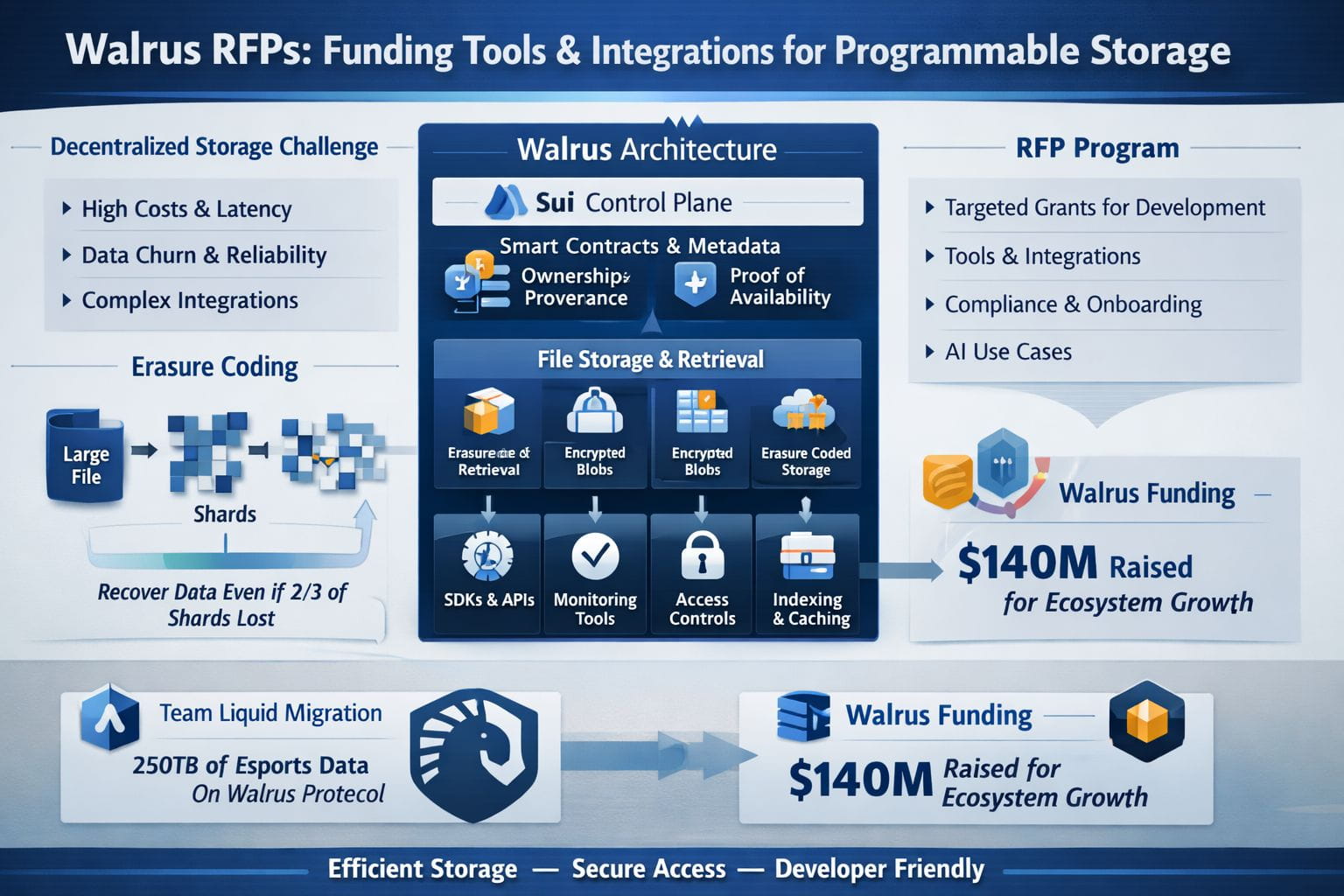
The protocol itself is designed for heavy data, and it makes a clear bet: don’t fully replicate everything everywhere. Instead, Walrus uses erasure coding—think of it as slicing a file into many pieces, spreading those pieces across independent operators, and later rebuilding the original as long as you can retrieve enough of them. Mysten Labs has described Walrus as keeping replication overhead roughly in the 4x–5x range while still being able to recover data even if up to two-thirds of the pieces are missing. If you’ve ever had to plan around outages and churn, you can feel why that kind of design gets people’s attention.
Where Walrus gets more interesting—and more demanding for builders—is the programmable angle. It’s not trying to be another general-purpose chain. Walrus leans on Sui as a control plane while Walrus nodes do the actual storage work, and stored blobs are represented as onchain objects so ownership and lifecycle can be managed in smart contracts. Walrus frames this split directly: Walrus is the data plane, while Sui coordinates metadata, economics, and verification. That design is powerful, but it also means the developer experience lives or dies by integrations: SDKs, APIs, indexing, monitoring, and the boring glue that bridges “object on Sui” to “file in my app.”
This is exactly where RFPs earn their keep. Walrus isn’t hiding what it wants: proposals that close specific gaps, with realistic milestones and clear delivery. And you can already see what that looks like in the wild. Walgo, a CLI that focuses on one-command deployment workflows, describes itself as a Walrus RFP winner for developer tooling. That might sound small, but it’s the kind of small that changes adoption. Most builders don’t abandon new infrastructure because the core idea is bad; they abandon it because the first hour feels like friction.
The same pattern shows up in SDKs and operator tooling. Walrus has documentation for running core components like aggregators and publishers—pieces that matter if you want predictable reads and uploads without relying on a single gateway. On the client side, the ecosystem is filling in language support too, including community SDKs that wrap Walrus’s HTTP interfaces. None of this is flashy, but it’s the difference between “a protocol exists” and “a product team can ship this quarter.”
Why is this showing up everywhere right now? AI is part of it, but not because “AI changes everything” makes a good headline. What’s actually happening is more practical: teams are getting pushed to prove what they’re doing with data. Where did this file come from? Who touched it? Who’s allowed to see it? Did it change along the way, and can we show that clearly? Once you start building anything serious, those questions stop being theoretical and start feeling like table stakes. Walrus has been pushing into that reality with Proof of Availability—an onchain certificate on Sui that creates a public record of data custody and anchors the start of the storage service. And with Seal, Walrus adds encryption and access control so developers can enforce “who gets to read what” without rebuilding privacy as a custom side project.
If you want a concrete signal that this is moving beyond theory, Walrus announced on January 21, 2026 that Team Liquid migrated 250TB of match footage and brand content to the protocol, using a workflow that included AI meta-tagging to speed up internal search. That’s the kind of workload that instantly surfaces integration needs: indexing, permissions, caching, and reliability tooling. It’s also the kind of story that makes an RFP program feel timely rather than ceremonial.
Funding matters here, too, but mostly because it buys time to build the unglamorous pieces. Walrus Foundation announced a $140 million private token sale led by Standard Crypto, positioning the capital as fuel for network expansion and application development alongside the protocol’s mainnet timeline. Money doesn’t guarantee usefulness, but structured RFPs at least give the ecosystem a way to turn capital into concrete deliverables that developers actually touch.
In the end, the title says it plainly: tools and integrations. Walrus can have strong protocol design—and it does, from its encoding approach to the onchain verification layer—but adoption will come down to whether builders can treat it like dependable infrastructure rather than an adventurous dependency. RFPs are a bet that you can fund that dependability on purpose, not by accident.


