
Vanar Chain is based on a premise that many infrastructures avoid facing: an L1 does not become obsolete when it stops being fast, but rather when it can no longer sustain real complexity without fragmenting. Most new chains are born as generic environments designed to execute isolated transactions, but the market no longer demands point execution, but rather systems capable of maintaining operational consistency when multiple agents, applications, and rules interact simultaneously and for extended periods.
The problem is not in the ability to process blocks, but in the inability to sustain shared context among heterogeneous components. When each application must reconstruct its own state, its logic, and its coordination rules, the network becomes a set of silos that only share basic security, but not systemic behavior. This model can work in early stages, but it becomes rigid and costly as the ecosystem grows and interdependence increases.
Here is where many generic L1s get trapped in a dead end. To functionally scale, they start adding external layers, parallel frameworks, or specific solutions that attempt to compensate for a foundation that was never designed to sustain living systems. Each new layer solves a specific problem, but introduces additional friction, cross-dependencies, and failure points that erode the global coherence of the system.
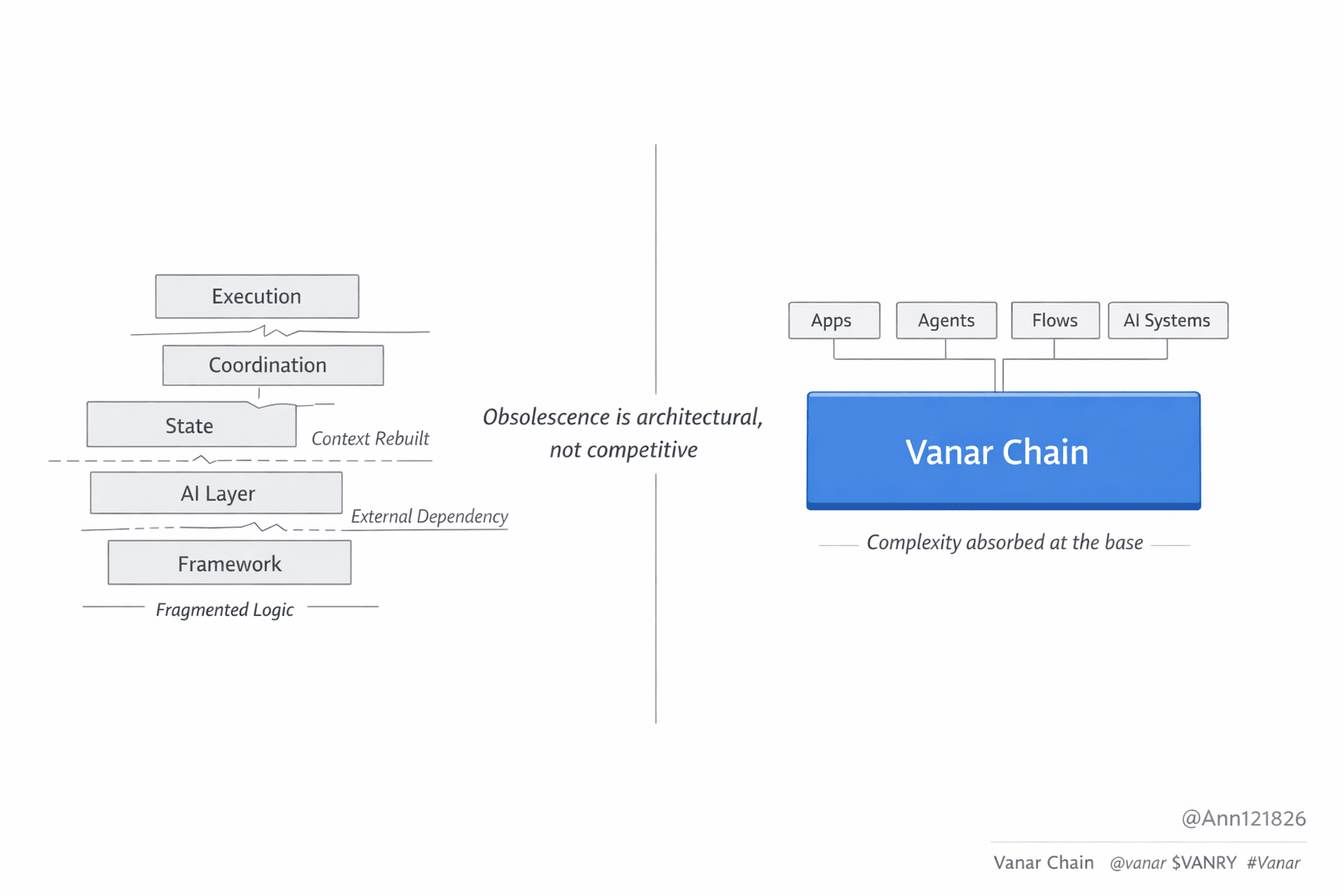
Vanar Chain addresses this obsolescence from a different angle. Instead of assuming that applications can operate as disconnected autonomous units, it treats operational continuity and coordination between components as fundamental properties of the infrastructure. This allows systems to not only execute correct actions but also maintain consistent behavior when the number of interactions, rules, and agents increases.
The difference is not cosmetic or narrative. A system that can preserve coherence under pressure allows for the design of applications that evolve without the need to restart their logic, redo their architecture, or fragment their state into multiple external layers. This reduces structural friction and prevents complexity from becoming a cumulative liability.
In this context, the obsolescence of many L1 does not come from competition, but from their own foundational decisions. Designing for demos, for simple cases, or for generic flexibility ends up limiting the ability to sustain real systems in production. Vanar Chain bets on the contrary: an infrastructure designed to absorb complexity without collapsing, where growth does not imply rupture, but continuity.
When an L1 can sustain living systems, it ceases to be an experimental environment and becomes a real operational base. That is the difference between scaling metrics and scaling systems, and it is there that Vanar Chain draws a clear line against architectures that are born obsolete without noticing.