
@Walrus 🦭/acc We talk a lot about on-chain activity, but we rarely talk about where the actual “stuff” goes. The media, the game assets, the data a model depends on, the history users build up over time—most of it ends up living elsewhere. That mismatch can make the whole decentralization story feel slightly incomplete. We say “decentralized,” but the moment your app depends on one storage provider, the whole promise starts to wobble.
What’s different right now is that people are finally naming the pressure point: data availability. It’s not just about keeping files somewhere. It’s about making sure the data behind an app is publicly retrievable so anyone can verify what happened, especially in rollup-heavy ecosystems. Celestia puts it bluntly: data availability can be roughly 95% of the costs rollups pay. And once you notice that, you start seeing why “DA layers” are suddenly a dinner-table topic in crypto circles rather than an academic sidebar.
Walrus sits inside that shift, but its angle is easy to miss if you only think of it as “another decentralized storage network.” Mysten Labs describes Walrus as a decentralized storage and data availability protocol aimed at blockchain apps and autonomous agents, rolled out first as a developer preview to Sui builders. That sequencing matters. storage belongs in the core design, not in the “we’ll deal with it later” bucket. And honestly, it reads like they know the truth—if data is hard to work with on-chain, most teams will take the shortcut and use a centralized service just to ship.
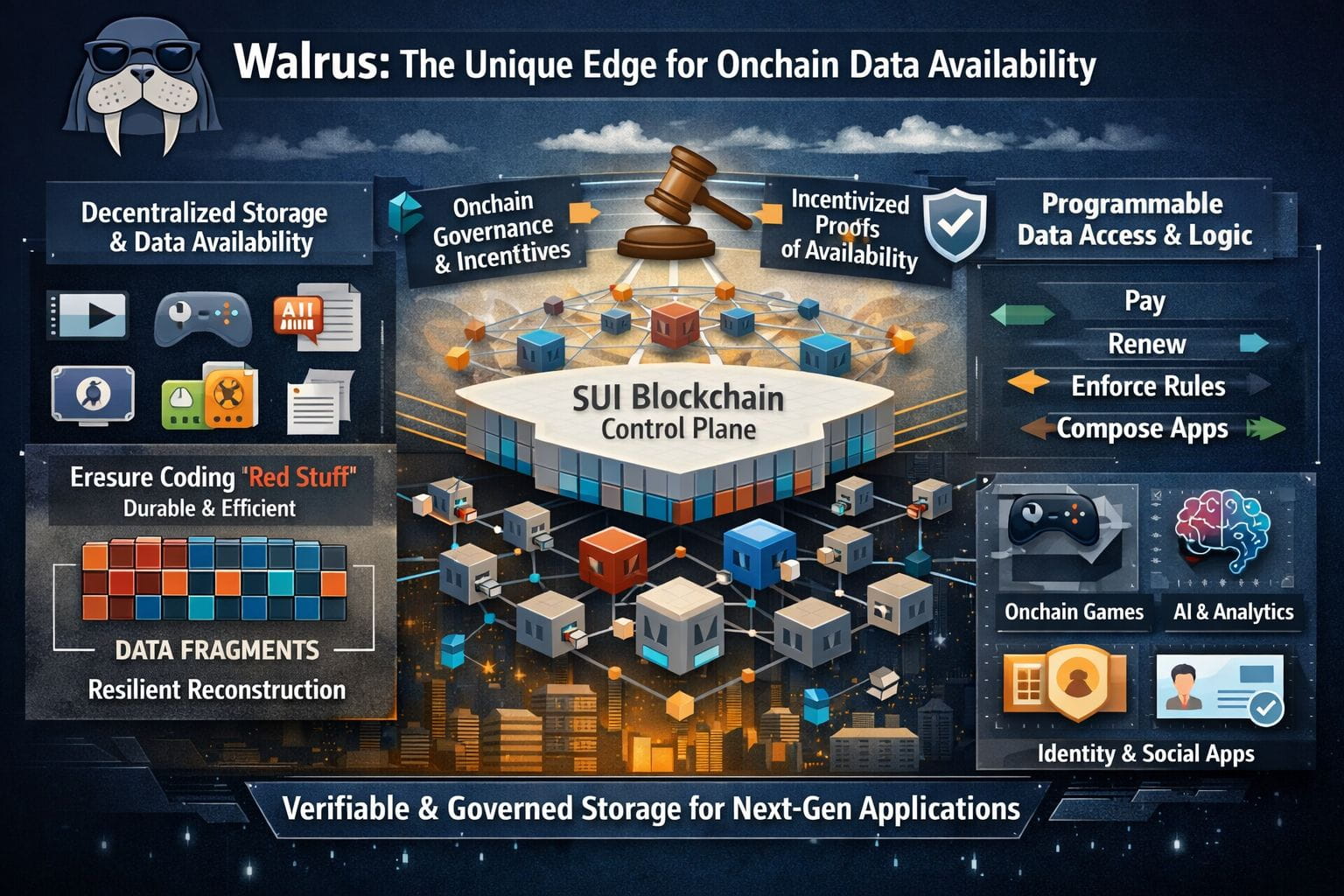
This is where the title really earns its keep. Walrus’s “unique edge” isn’t only that data stays available. It’s that availability and storage behavior are tied to on-chain rules in a way developers can actually use. Walrus uses Sui as a kind of control plane for managing blobs and coordinating incentives, instead of spinning up a separate chain just to orchestrate storage. In practical terms, that opens the door to storage that behaves less like a passive bucket and more like something you can govern: pay for it, renew it, attach rules to it, and compose it with application logic. The bytes don’t become magical. The commitments around those bytes become enforceable.
Under the hood, Walrus leans on a two-dimensional erasure coding design called Red Stuff, splitting data into pieces so it can be reconstructed even if some storage nodes go missing. Walrus’s own technical writing emphasizes the tradeoff it’s trying to escape: you shouldn’t have to choose between “replicate everything and pay a fortune” and “save money but cross your fingers during churn.” The academic paper goes further, describing how the system aims for high resilience with relatively low overhead compared to brute-force replication. If you’ve watched decentralized storage projects over the years, you know how often recovery and reliability become the unglamorous reasons teams quietly return to centralized infrastructure. Walrus is clearly trying to take that excuse off the table.
Then there’s the enforcement layer, which is where “onchain logic” stops being a slogan and starts looking like architecture. Walrus describes “incentivized proofs of availability,” using delegated proof-of-stake and penalties to push storage nodes toward honest behavior over time. I find this part oddly reassuring, because it moves the system from “trust the operator” to “trust the incentives.” It doesn’t guarantee perfection, but it does make failure legible—and legibility is a big deal when you’re building systems meant to outlast any one team.
The reason all of this is trending now, rather than five years ago, is that the applications have changed. People aren’t only trading tokens anymore. They’re trying to build on-chain games with real media, social products with histories people care about, AI workflows that depend on large datasets, and identity systems that can’t afford to lose records. Walrus’s recent partner announcements lean into exactly that direction—decentralized data pipelines, AI storage workflows, and systems that need verifiable data integrity rather than polite promises.
If there’s a bigger story here, it’s that we’re inching from “smart contracts” toward something like “smart data.” Not in a buzzword sense. In a practical sense: data that can be stored, verified as available, and governed with on-chain rules that applications can compose. Walrus is interesting because it treats that combination—availability plus programmable control—as the core product. And at this moment, with DA costs under a microscope and richer applications pushing past the limits of old patterns, that feels less like a niche idea and more like the next missing layer people have been circling around.


