
@Dusk There’s a particular kind of quiet that shows up at dusk. The day is still technically “on,” but the pace loosens. Windows turn into mirrors. Notifications feel a little louder than they did an hour ago. Dusk is usually when I feel most aware of how “on” everything is—apps, messages, the sense that life is always slightly visible. And it reminds me that privacy isn’t an extreme demand. It’s the normal need to step back, sort your thoughts, choose what matters, and change your mind without an audience.
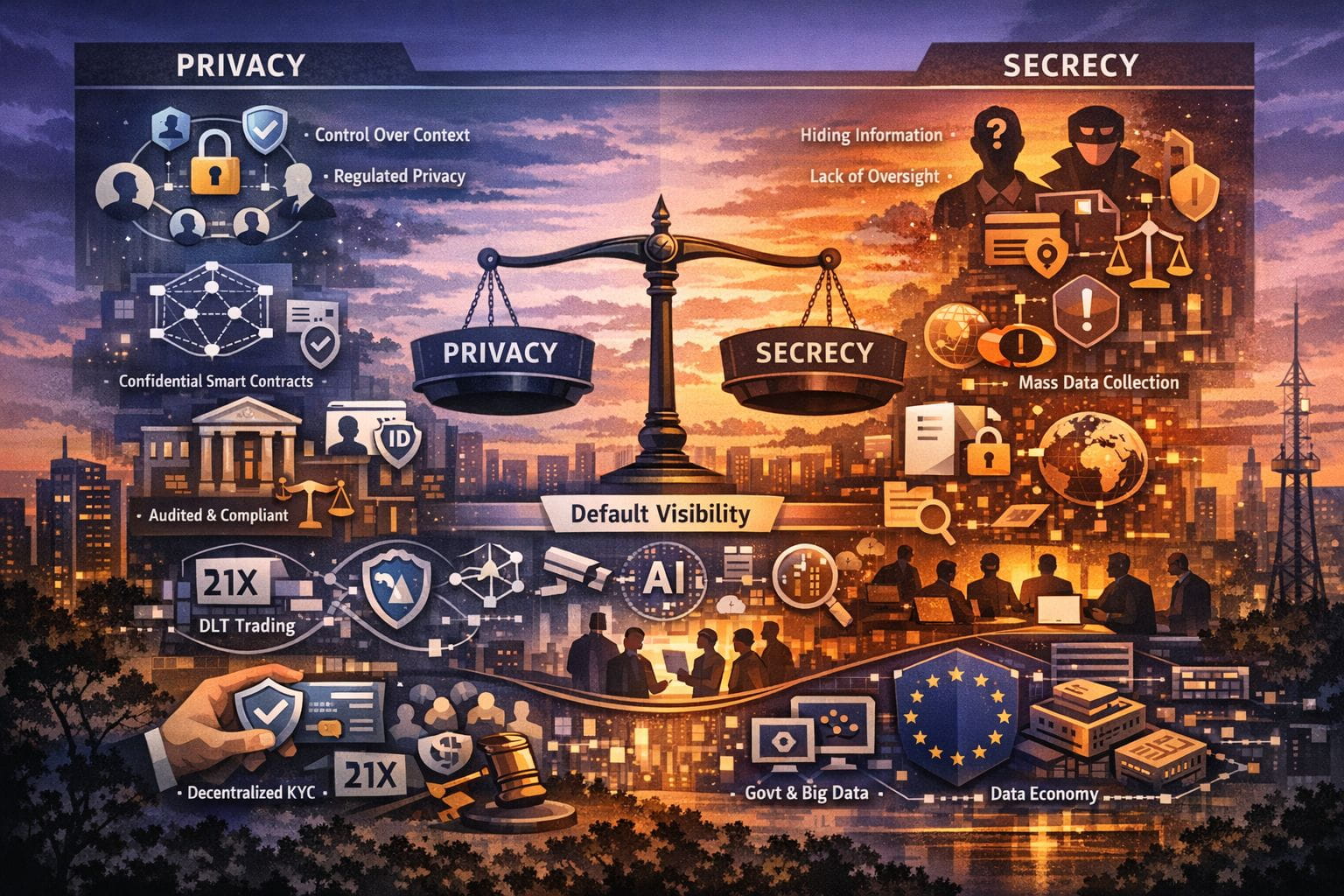
That’s why the privacy-versus-secrecy mix-up annoys me. Secrecy is keeping something from coming out. Sometimes it’s innocent, like planning a gift. Sometimes it’s a way of dodging responsibility. Privacy is different. Privacy is control over context. It’s being able to share what’s needed with the right people, and keep the rest of the noise out. It’s the difference between “I don’t want anyone to know” and “I want to decide who knows, and why.”
This split has become sharper because the world is drifting toward “default visibility.” Governments argue for more access in the name of safety, platforms keep collecting data because it’s profitable, and AI systems get better at inferring sensitive things from scraps. You can see the tension in mainstream tech: Apple, for example, stopped offering its end-to-end encrypted iCloud backup option (Advanced Data Protection) to new users in the UK, and acknowledged that UK customers would lose the ability to enable it. In Europe, the Council agreed a negotiating position in November 2025 on a child sexual abuse proposal that would make a temporary legal basis for “voluntary” scanning permanent—an approach critics fear can normalize broad monitoring over time.
Meanwhile, the data economy keeps doing what it does: turning ordinary life into a profile. The FTC’s January 2025 final order against data broker Mobilewalla—banning it from selling sensitive location data and restricting how it collects data from ad auctions—was a rare, concrete pushback. But the broader pattern is still here. Just this week, WIRED reported that ICE has asked companies about “ad tech and big data” tools it could use in investigations, which is a blunt reminder that commercial tracking doesn’t stay commercial forever.
So when people talk about privacy “in finance,” it’s not a niche debate anymore. It’s a practical question: can we get the efficiency of digital markets without building a world where every transaction becomes a permanent public record?
This is where the idea of “regulated privacy” starts to feel less like a slogan and more like a design goal. Dusk Network is one of the clearer examples of that approach. Its whole premise is that you can run financial logic on a public blockchain while keeping sensitive details confidential—through what it calls native confidential smart contracts. That’s not secrecy in the shady sense. It’s closer to how adult institutions already work: counterparties know what they need to know, auditors and regulators can verify what they’re entitled to verify, and everyone else doesn’t get to rubberneck.
The same philosophy shows up in Dusk’s Citadel work, which frames identity checks as something you can prove without endlessly copying your personal data across different companies. The project describes Citadel as a decentralized KYC approach where users can control access to their verified information and services can accept proof without collecting the whole file. If you’ve ever wondered why “privacy” so often collapses into “just trust us,” this is the opposite direction: less data spread around, fewer honeypots to leak.
What makes this feel timely, rather than theoretical, is that the regulated market infrastructure is finally catching up. ESMA reported in June 2025 that 21X AG was authorized as a DLT trading and settlement system under the EU’s DLT Pilot Regime on December 3, 2024, and that it has been operating since May 21, 2025. Dusk announced a strategic collaboration with 21X in April 2025, starting with Dusk onboarding as a trade participant and planning deeper integrations. Dusk also laid out its own mainnet rollout timeline spanning late December 2024 through early January 2025, including a target for its first immutable block on January 7.
And then there’s AI, quietly raising the stakes again. The EU’s guidance and code of practice work for general-purpose AI models is, in part, an attempt to put guardrails around systems that can extract meaning from messy human data at scale. In that environment, privacy isn’t just about what you publish. It’s about what can be reconstructed.
At dusk, the lesson is still simple. Secrecy hides. Privacy protects. In networks like Dusk, the goal isn’t to disappear—it’s to participate in modern markets without turning your identity and your transactions into a public spectacle. That difference is going to matter more each year we keep building systems that assume the opposite.
