
The AI systems are not restricted to one prompt or one transaction anymore. They work round the clock, have memory, cause activities and cross services. It is no longer the model capability that is the limiting factor, but infrastructure. The majority of the networks were made to handle discrete transactions and pay the outcomes upon execution. Misbehave That model falls apart when systems need to be able to survive, and recollect context, and holistically complete work over time.
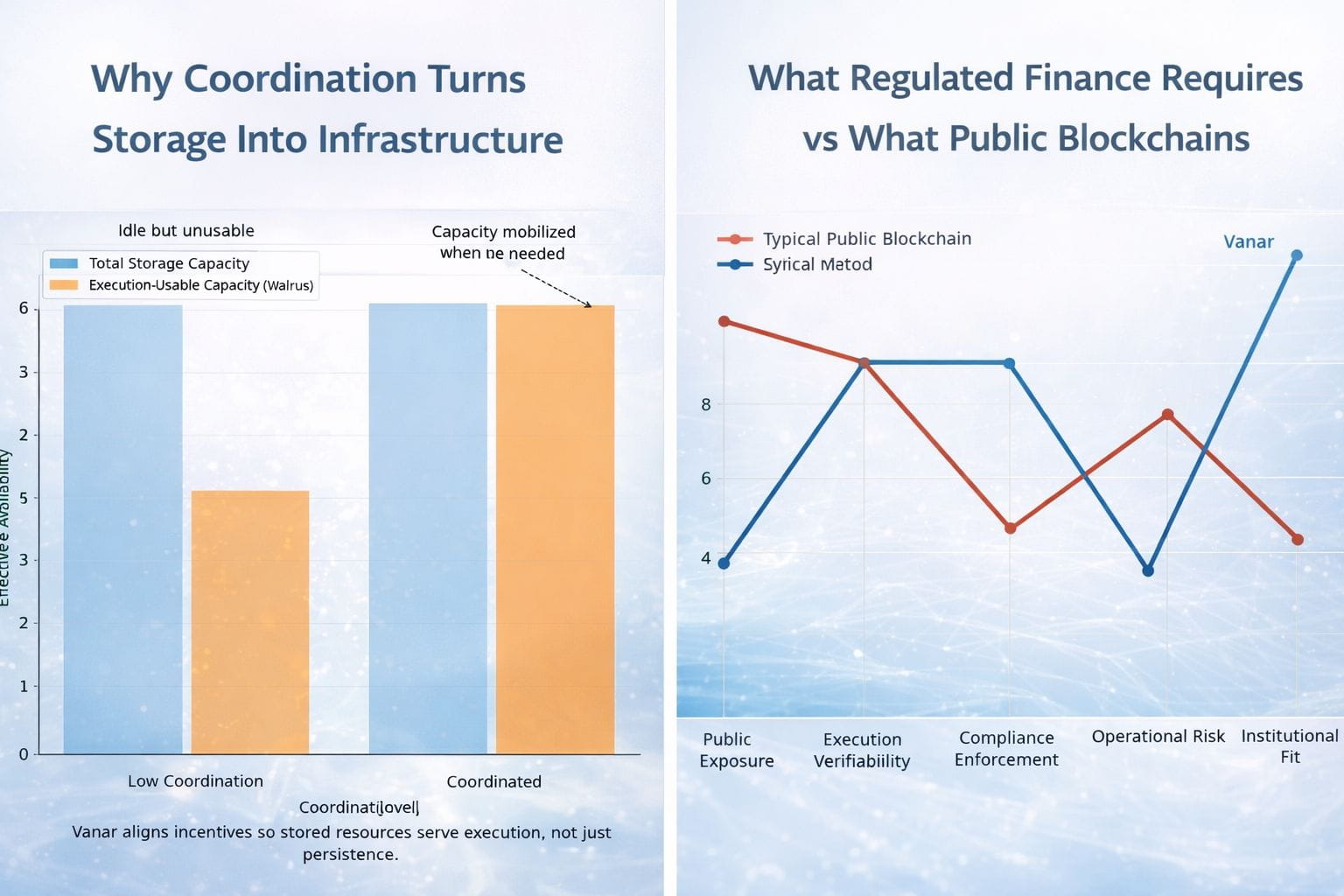
This is the starting point of the architecture of Vanar. It does not presuppose that execution can succeed, but makes it a condition. In this design, we have the execution layer VANRY, in which we implement persistence, accountability and completion on the stack. It is not placed as a story item. It is present to ensure AI long-term operations are reliable.
Perseverance is the issue of perseverance. Smart applications make use of remembered context, dynamic state and repetition. When the workflow is capable of halting in the middle of the process because of congestion, unpredictable charges, or in the case of competing demands, the system is not reliable. Best-effort models of tradition accept such a risk by reconciliation of incentives, post-execution. Vanar does not. Before it starts, it has to be economically devoted to its execution.
This commitment is made possible through $VANRY. Through its demand of initial economic commitment, the network precommits the resources required in a task- compute, storage, coordination and settlement capacity. When implementation begins, the infrastructure is bound to finish it within specified parameters. This makes execution a not-so-probable result into a certain process.
The strategy has a direct bearing to failure handling. In most settings, accountability is not clear in case a task fails. Was it a network error, a validator error or an application error? Vanar minimizes this confusion by tying the accountability in execution to commitment in the front. The failures are not diffuse and opaque but can be detected and identified at the infrastructure level. This is critical when it comes to AI systems that will always have to be there.
It is also important to have predictability. AI applications are not able to sustain unstable costs of execution. Spike in the fees or unpredictable settlement status affects workflow and deteriorates user experience. The solution to this proposed by Vanar is to remove cost complexities out of the application layer. The developers deal with stable execution guarantees, whereas the economic cost of persistence is subdued and the price of keeping your head underwater is paid by $VANRY .
Such design also makes blockchain mechanics unnoticed by end users. There is no necessity of consumers of AI-powered services to learn about gas pricing or validator incentives. The complexity is absorbed in the infrastructure. Applications are not an experimental network but act as a structural component and thus allow for this invisibility to take place through the VANRY operation as a structural component, not as a user-facing interaction.
The focus on implementation justifies the real products and integrated layers that Vanar focuses on. Only the memory, reasoning and automation will be relevant so long as they are capable of being sustained. Semantics memory should be available, context logic should be executable, and automated processes should not be broken to provide continuity throughout the lifecycle of an intelligent system at a low cost.
Notably, this model reinvents the creation of value. Vanar is used to measure reliability, rather than examining the success by metrics of raw throughput or speculative activity. Execution that completes. Memory that persists. Predictable systems. $VANRY is able to sponsor this transition with continuity and not events.
The infrastructure expectations alter as AI systems progress to production instead of being in the pilot phase. Accountability, reliability and persistence become uncompromising. Networks with no guarantees of execution will fail to provide the real-world workloads, despite capacity theory. The architecture of Vanar recognizes this fact at all.
The reason that $VANRY exists is because the presence of persistent AI infrastructure needs enforced implementation. It is the layer which ties resources to responsibility, reduces best-effort processes to reliable systems and allows intelligence to work continuously and not contingently. In the world where AI is becoming more reliant on prolonged context and automation, performance is not incidental. It is foundational.
