

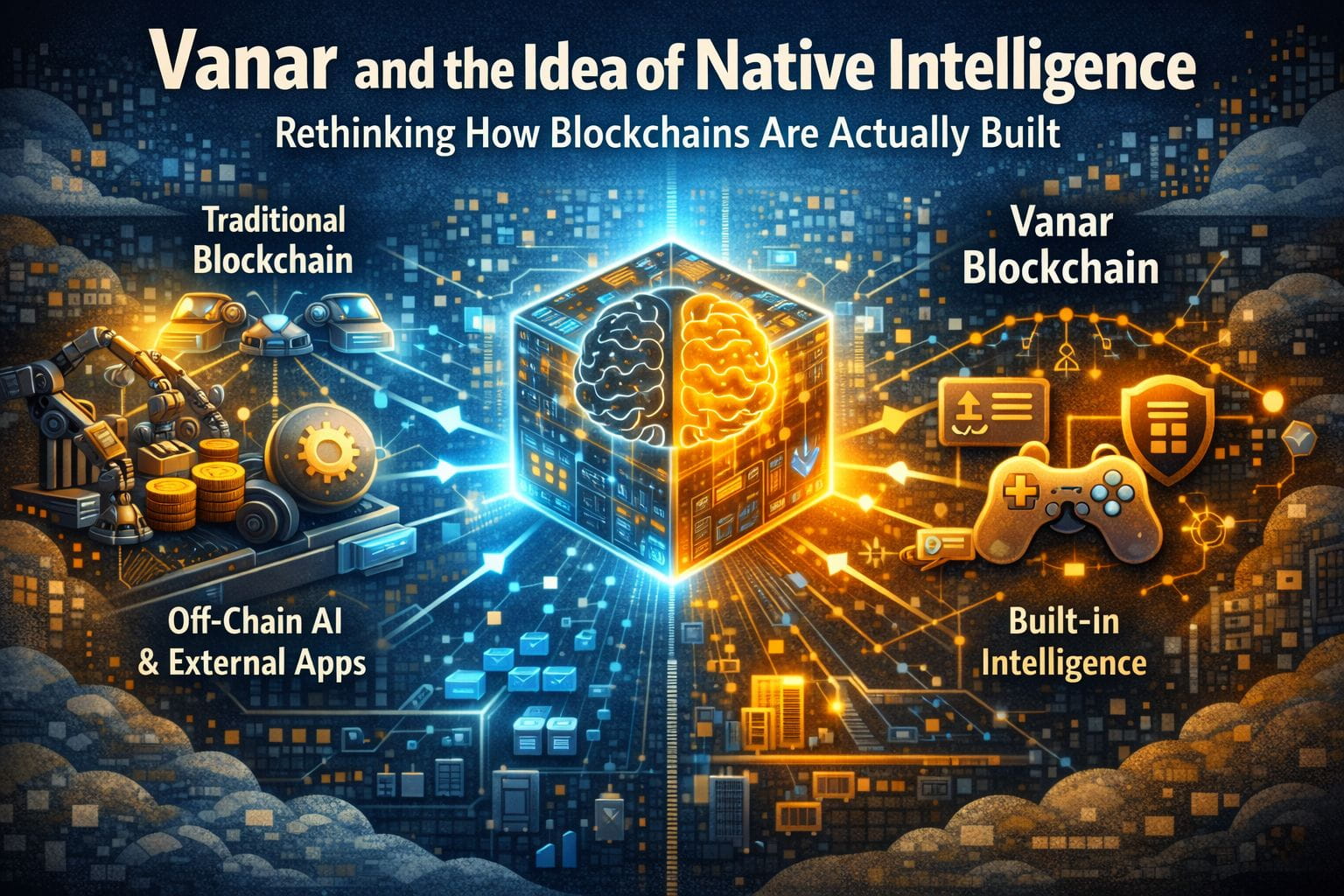
 The phrase “native intelligence” sounds like marketing at first glance, but in blockchain architecture it points to something much deeper than AI buzzwords or smart automation. It asks a foundational question: should intelligence live on top of a blockchain as an add-on, or should it be woven directly into the chain’s core design? This is the question Vanar places at the center of its architecture, and understanding it requires unlearning how most blockchains have been built over the last decade.
Traditional blockchains are deliberately dumb at their core. They run instructions deterministically, verify state transitions, and verify result reproduction on nodes. All intelligence, whether decision-making, adaptation, or context logic, is moved outside into applications, bots, or services that are off-chain. This separation was intentional. Early blockchains optimized for neutrality and predictability, not understanding. However, as the applications grew from mere money transfers to gaming, media, metaverses, and interactive digital worlds, the shortcomings of this approach became apparent. A system that is completely dependent on external intelligence will become fragmented, brittle, and inefficient.
Vanar’s native intelligence approach begins with the rejection of the blockchain as a passive ledger. This does not mean the blockchain “thinks” like a human or replaces developers. It means that core functions identity handling, asset behavior, execution logic, and interoperability are designed to be aware of how applications actually behave in the real world. Intelligence in this case is architectural, not artificial.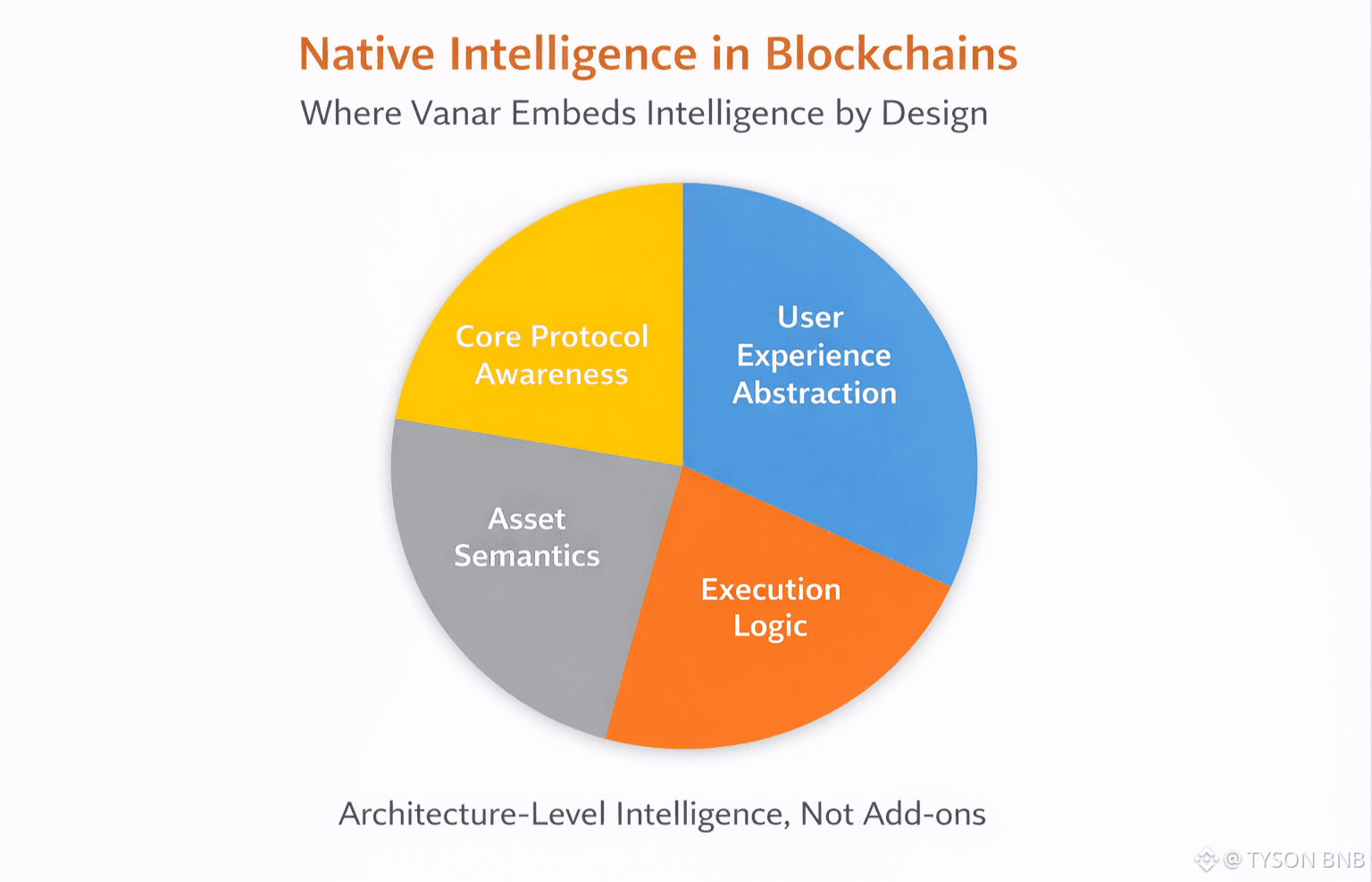
One way to think about this transition is to examine how most blockchains support complex applications today. Games, entertainment platforms, and interactive applications need fast state updates, complex asset logic, and dynamic user interactions. On generic blockchains, this logic is either shoehorned into smart contracts that weren’t built for this kind of work or pushed off-chain, destroying composability and trust assumptions. Vanar tackles this problem by integrating application-aware primitives into the base layer.Instead of forcing every developer to reinvent execution logic, the chain provides intelligent defaults that understand common patterns in consumer-facing applications.
Native intelligence also shows up in how Vanar treats assets. On many blockchains, tokens are interchangeable blobs of state with minimal semantic meaning. Any advanced behavior must be programmed manually on top. Vanar’s architecture considers digital assets as expressive objects from the beginning, which have the ability to convey metadata, permissions, and behavior that the chain itself understands. This allows assets to interact with applications in a more natural way without requiring very complex contract logic. The intelligence is not in predicting the outcome but in removing friction between intention and action.
Another critical dimension is scalability. Most chains scale by offloading complexity rollups, sidechains, or off-chain computation layers that handle “smart” behavior elsewhere. Although this is an effective method, it does come with a cost of coordination and trust assumptions. The native intelligence model of Vanar is trying to overcome this fragmentation by dealing with more complexity in a coherent manner within the main architecture. Through understanding the patterns of execution on the protocol level, the chain is able to optimize resource allocation, validation, and throughput without putting the developers through a puzzle of external dependencies.
This architectural intelligence also affects the user experience. In many blockchain systems, users are exposed to raw mechanics: gas fees, failed transactions, unclear states. These are not features; they are artifacts of low-level design choices. Vanar’s philosophy suggests that a blockchain should abstract complexity by default, not export it. Native intelligence makes it possible for the protocol to handle execution flows in a more elegant manner. This makes it possible to create an environment where applications are less like experiments and more like products.
It is worth noting that native intelligence does not imply centralization. Vanar does not rely on hidden operators making subjective decisions. The intelligence is encoded in deterministic rules, optimized execution paths, and protocol-level awareness. Validators still agree on state. Rules are still enforceable. What changes is that the chain understands why certain operations exist and can support them natively rather than treating everything as arbitrary bytecode. This distinction preserves decentralization while expanding capability.
There is also a philosophical shift embedded in this design. The early blockchains took a minimalist approach as a way of being as safe as possible: do as little as possible at the base layer and let the ecosystem sort out the rest. Vanar disputes this by saying that as systems become more complex, minimalism can become negligence. Real-world infrastructure evolves by internalizing common patterns. Operating systems, databases, and networking stacks all became more intelligent over time, not less. Blockchains, if they want to support billions of users, may need to follow the same path.
Critically, native intelligence changes how developers think. Instead of fighting the chain’s limitations, they build with its strengths. Rather than stacking workaround upon workaround, they use primitives that are designed with their task in mind. This does not mean that creativity is removed from the equation; it simply means that it is refocused. Programmers spend less time working around infrastructure oddities and more time crafting experiences, economies, and interactions. In that sense, native intelligence is as much about human efficiency as machine capability.
Viewed from a distance, Vanar’s architecture feels less like a reaction to existing blockchains and more like an evolution. It acknowledges what blockchains have been good at trust, determinism, decentralization and asks what they have been missing. The answer is not faster blocks or cheaper fees alone, but awareness. Awareness of how applications behave, how users interact, and how digital value actually moves in cultural and commercial contexts.
In the end, “native intelligence” is not a slogan about futurism. It is a statement about maturity. It suggests that blockchains are moving out of their experimental phase and into an era where architecture reflects real-world complexity rather than avoiding it. Vanar’s contribution lies in making that complexity manageable at the protocol level, quietly embedding intelligence where it belongs not on top, not outside, but inside the system itself.