
When I first looked into Dusk Network I did not see a project trying to be the loudest name in crypto. I saw something quieter and more deliberate, as if the team had stepped back and really listened to what modern finance actually needs. They are building a Layer one blockchain that gives banks, exchanges, asset managers and even serious builders a place to operate on chain without being forced to expose every last detail of their activity. Instead of chasing every possible trend, they are focused on one clear idea. Dusk is meant to be infrastructure for institutional grade applications, compliant decentralised finance and tokenised real world assets such as securities and funds. I am drawn to it because they are not just building for traders, they are building for markets and institutions that have strict responsibilities toward their clients.
At a technical level the design feels like it was shaped by those responsibilities. Dusk uses a modular architecture where one part of the system takes care of consensus and data availability, another part runs applications in an environment similar to the Ethereum virtual machine, and an additional layer handles privacy. Transactions can be confirmed quickly while cryptography keeps amounts and identities hidden from the general public. Techniques such as zero knowledge proofs and selective disclosure make it possible for a regulator or auditor to check that trades and settlements follow the rules, even when the underlying data is not visible to everyone. If you imagine a trading venue or a bank that wants to move activity on chain, it becomes easy to see why that matters. They can shield sensitive positions and order flow, but still show that everything is correct when it has to be checked.
The native token DUSK sits inside this design in a very natural way. It is not there just to be listed on an exchange, it is part of how the protocol functions day to day. Users pay fees in DUSK whenever they transfer assets or interact with applications. Validators stake DUSK to join the consensus process, propose and confirm blocks, and keep the chain secure, earning rewards for doing so honestly. Application teams can also design markets where DUSK serves as collateral, a fee currency or an incentive for participants. Because settlement, security and application activity are all linked to the same token, the economics of the system are tied closely to real use rather than only speculation. When I think about healthy token design, that alignment between usefulness and value is exactly what I want to see.
From the start the team has treated legal and regulatory alignment as a central part of the project, not an afterthought. They are clearly positioning Dusk as a home for regulated finance, with a strong focus on European frameworks and securities rules. The protocol is built so that things like security tokens, tokenised shares or structured products can be issued, traded and settled in line with existing laws. If a licensed exchange or a bank wants to experiment with tokenisation, Dusk aims to give them a chain where tools for compliance, reporting and identity checks can live close to the core protocol rather than bolted on at the edge. I appreciate that they are willing to do the hard work in this space, because it is very different from running a purely experimental blockchain.
Trust in this kind of network does not only come from legal thinking, it comes from the quality of the infrastructure itself. The consensus protocol used by Dusk is designed to give strong finality and resistance to many forms of attack, while still respecting the privacy model. Validators are selected using cryptographic methods that help avoid concentrating visible power in a small group of obvious targets. Stake based security and clear reward rules encourage participants to behave honestly over long periods. For a financial institution, the promise that blocks will be confirmed reliably and cannot be reversed easily is critical. I like that Dusk treats predictable settlement and uptime as first class requirements rather than optional features.
Around that infrastructure a community is forming that feels very different from the usual noise. We are seeing developers who are interested in confidential smart contracts and regulated markets, researchers who care about real world asset tokenisation, and practitioners from finance who understand why privacy and compliance must work together. The foundation and core contributors share roadmaps, explain design choices and announce upgrades in a fairly open way, which makes it easier to follow the progress of the project. Documentation, examples and integration guides are available so that a developer who already knows how to build on Ethereum style systems can move into Dusk without starting from nothing. For institutions, that familiarity can be comforting. It means they can experiment without throwing away their existing knowledge and tools.
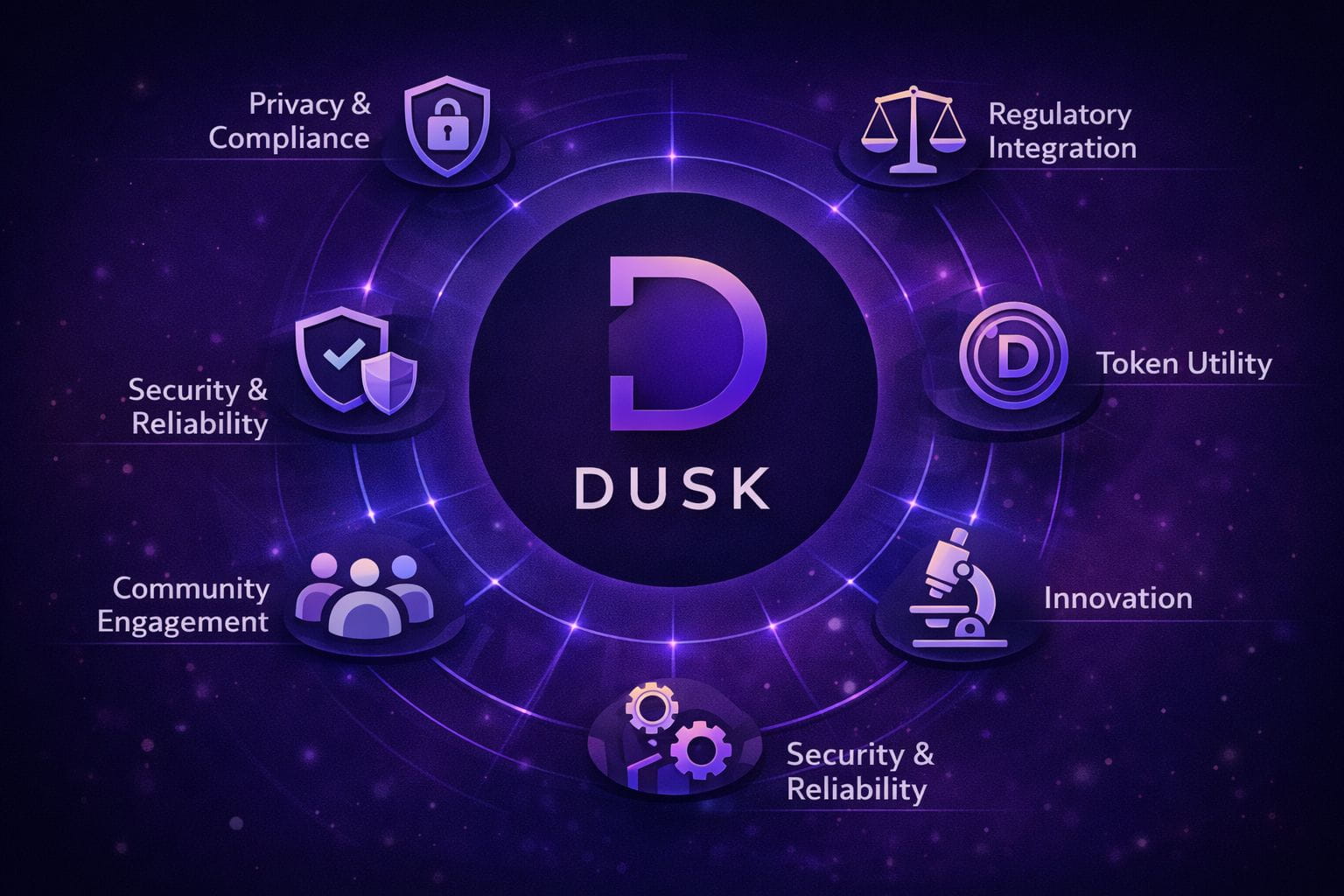
Scalability and integration are also built into the design. Because consensus, execution and privacy are separated into different layers, the team has room to optimise each part as demand grows. Execution environments can be tuned for higher throughput, and cross chain bridges or messaging systems can help Dusk connect to other networks and established enterprise systems. This makes it realistic for Dusk to sit alongside core banking or trading infrastructure instead of demanding that everything be replaced in one step. At the application level, smart contracts and privacy settings can be tailored so that each product chooses how much information is hidden or revealed. That flexibility allows the same base chain to support a simple consumer product on one side and a tightly regulated security offering on the other.
Innovation inside Dusk tends to look thoughtful rather than flashy. The team spends its time refining privacy schemes, transaction models and ways to automate compliance while still respecting user confidentiality. They are not running with a move fast and break things mentality, which I actually find reassuring in this context. We are seeing steady research into how to make private transactions cheaper, how to support new kinds of financial instruments, and how to keep the system usable for both developers and regulators. The long term vision is fairly clear. Dusk wants to be a stable base layer where tokenised securities, funds, bonds and other regulated products can live on chain with strong guarantees around privacy, compliance and auditability. If that vision holds, the chain becomes a background utility that most everyday users may not talk about directly, but that powers a new generation of markets.
What really sets Dusk apart for me is the way several difficult things come together in one place. It is privacy first but still invites regulators in, instead of shutting them out. It is focused on regulated finance and real world assets rather than trying to be everything to everyone. It offers an architecture that feels familiar enough for existing developers, which makes adoption more realistic. And it is being built for quiet, reliable use in institutional settings rather than for constant attention. If they keep going in this direction, Dusk could become one of the rare networks that truly bridges traditional finance and decentralised technology in a way that feels safe, compliant and respectful of the need for financial privacy. As someone who cares about both innovation and responsibility, I find that combination not only impressive but genuinely hopeful for the future of on chain finance.
