

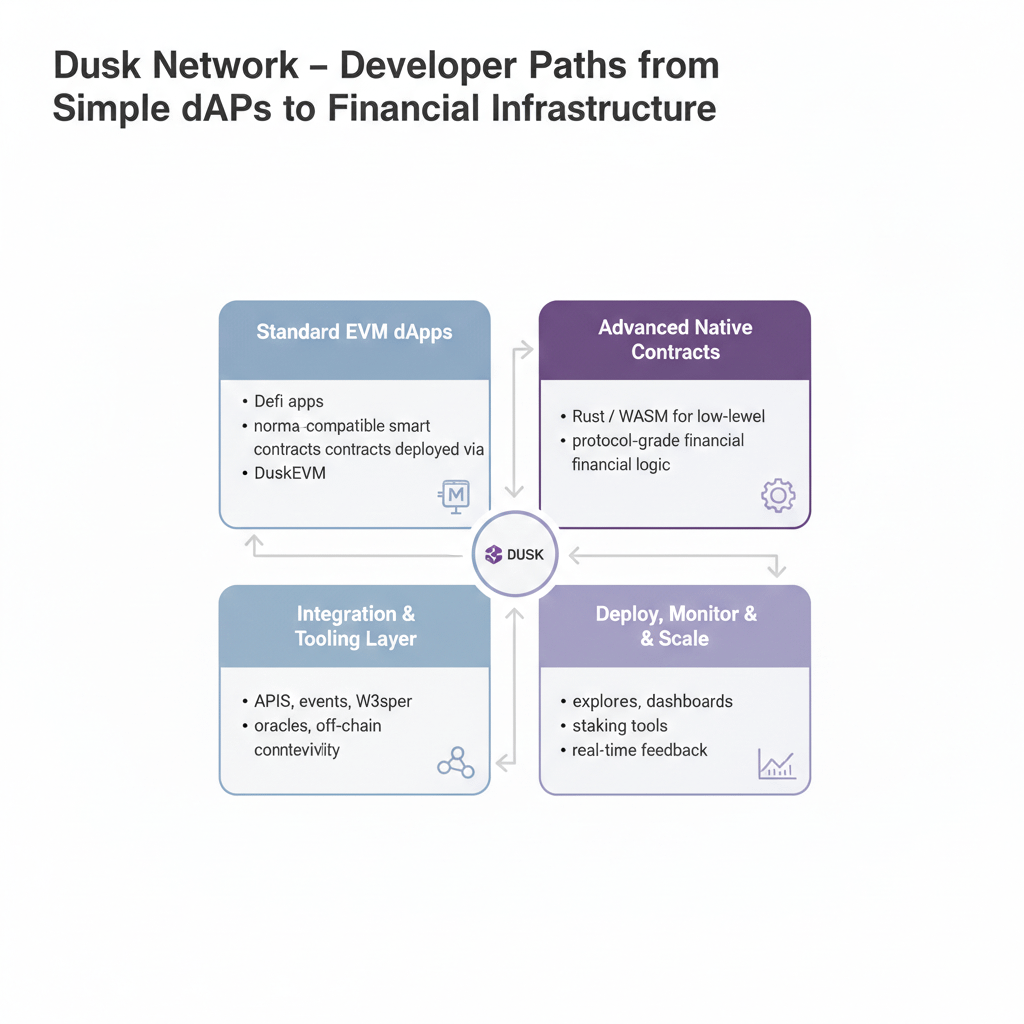
Viewing Dusk Network solely as another Layer-1 would be somewhat misleading. This network has been designed from the beginning with developers in mind — especially for those builders who want to create privacy-preserving and regulation-aware applications without having to relearn their entire tech stack. One thing is clearly understood from the official developer overview: Dusk's focus is not on theory but on real-world deployment.
Dusk's architecture is modular, with the roles of the two main layers very clearly defined. On the base is DuskDS, which serves as the settlement and data layer. Here, consensus, transaction finality, and core settlement logic are handled. This layer ensures that transactions can be settled quickly, reliably, and in a privacy-aware manner — which is critical for regulated finance use cases.
On top of this comes DuskEVM, which is the execution layer. This layer is fully EVM-compatible, meaning that developers can write smart contracts in Solidity or Vyper, just like they do on Ethereum or any other EVM chain. Hardhat, Foundry, wallets — all familiar tools work here. The biggest benefit of this approach is that developers do not have to sacrifice their entire development workflow for privacy or compliance.
Due to this layered design, Dusk provides developers with flexibility. Most applications are deployed on DuskEVM, just like any other EVM chain. However, if a project requires deeper settlement-level control — like custom financial logic, confidential workflows, or protocol-level primitives — direct interaction with DuskDS is also possible.
Developer documentation also explains that there are multiple paths to building on Dusk. For normal dApps and DeFi-style applications, the EVM route is the simplest and most recommended. However, for advanced builders, the option of native contracts is also open, where low-level logic can be written through Rust and WASM. This option is valuable for teams that want to build not just surface-level contracts, but also core financial infrastructure.
Not only contracts, but Dusk has also provided tooling for integrations. APIs, event systems, and tools like W3sper help developers connect wallets, backends, and off-chain services with on-chain activity. This makes Dusk not just a 'smart contract chain' but a complete application platform.
The strongest point of this developer model is that Dusk does not treat privacy and regulation as a separate domain. These aspects are integrated into the protocol's base. This means that if you know Ethereum-style development, you can create privacy-aware and compliance-ready apps without any new language or paradigm. This reduces friction and makes adoption realistic.
This approach is also reflected on the ecosystem side. Tools like Sozu simplify staking, Pieswap has brought DeFi activity to DuskEVM, and Chainlink integration supports oracles and cross-chain messaging. Together, these provide developers not just with the option to build, but also a proper environment to deploy, test, and scale.
Explorers and dashboards provide developers with real-time feedback — it becomes easy to monitor stakes, contracts, and network activity. This shortens the build-to-production cycle, which is important for any serious application.
Overall, Dusk Network's developer strategy gives a simple message: there is no need to reinvent. Work with the tools you already know — and the protocol will handle complex requirements like privacy, compliance, and regulated finance. This is why Dusk does not feel like just an experimental chain, but rather a platform where real, privacy-aware blockchain applications can actually be built and shipped.