

Dusk started from a simple, uncomfortable truth that most people feel but rarely say clearly, because when money becomes fully public, life becomes easier to judge, easier to track, easier to pressure, and that kind of exposure does not feel like freedom for long. Dusk, founded in 2018, positions itself as a Layer 1 blockchain designed for regulated financial infrastructure with privacy built into the foundation, and what makes that idea different is that it does not treat privacy as a rebellious extra or a dark feature that exists to dodge responsibility, because the goal is confidentiality that can still stand up to audit, proof, and oversight when needed. I’m describing it this way on purpose, because the project is not trying to win attention by being loud, it is trying to win trust by being usable in the places where rules exist, where institutions demand certainty, and where people want protection without feeling like they have to disappear to be safe.
At the center of Dusk is the belief that privacy and regulation can live together without one destroying the other, and that is where the emotional pull comes from, because most financial systems force a painful choice between being visible enough to be accepted and being private enough to feel secure. Dusk aims for selective disclosure, which means you can keep sensitive details hidden while still proving the things that matter, and that one idea changes the whole shape of a blockchain, because instead of every transaction turning into a public confession, the system is meant to let participants prove compliance conditions without exposing everything about themselves. They’re not building a world where nobody can be held accountable, they’re building a world where accountability can be satisfied without turning privacy into collateral damage, and If you have ever felt the pressure of having to overshare just to access basic services, you can sense why that design choice is not just technical, it is human.
The way Dusk is evolving technically also reflects that same realism, because regulated finance is not a toy environment, it is a landscape full of integrations, legacy expectations, operational risk, and slow moving decision makers who will not gamble on fragile infrastructure. Dusk has been moving toward a modular architecture where the base layer focuses on consensus, data availability, and settlement, while an execution environment can serve developers more flexibly, and the reason this matters is not because modularity sounds modern, but because it helps keep the settlement foundation stable while allowing execution features to grow without constantly threatening the network’s core security assumptions. This is also why EVM compatibility matters in Dusk’s direction, because adoption is not only about having elegant cryptography, it is about whether builders can ship applications with familiar tools while still benefiting from privacy and compliance primitives that are native to the network’s mission, and when developers can build without feeling trapped in a niche ecosystem, the chain has a better chance of becoming a real platform instead of a beautiful concept.
A regulated financial blockchain also lives or dies on settlement confidence, because in serious markets, “probably final” is not final enough, and uncertain settlement is how systems lose credibility in a single bad day. Dusk’s consensus approach is designed to be a Proof of Stake style system built for reliability and finality properties that can support financial use cases, and the specific mechanics matter less to most people than the consequence, which is that a system designed for financial infrastructure must behave like solid ground, not like a surface that shifts when it is stressed. This is where It becomes clear why Dusk keeps emphasizing institutional grade design, because if you are dealing with tokenized assets that represent real obligations and real value, then predictable settlement is not a feature you celebrate, it is the minimum requirement for trust.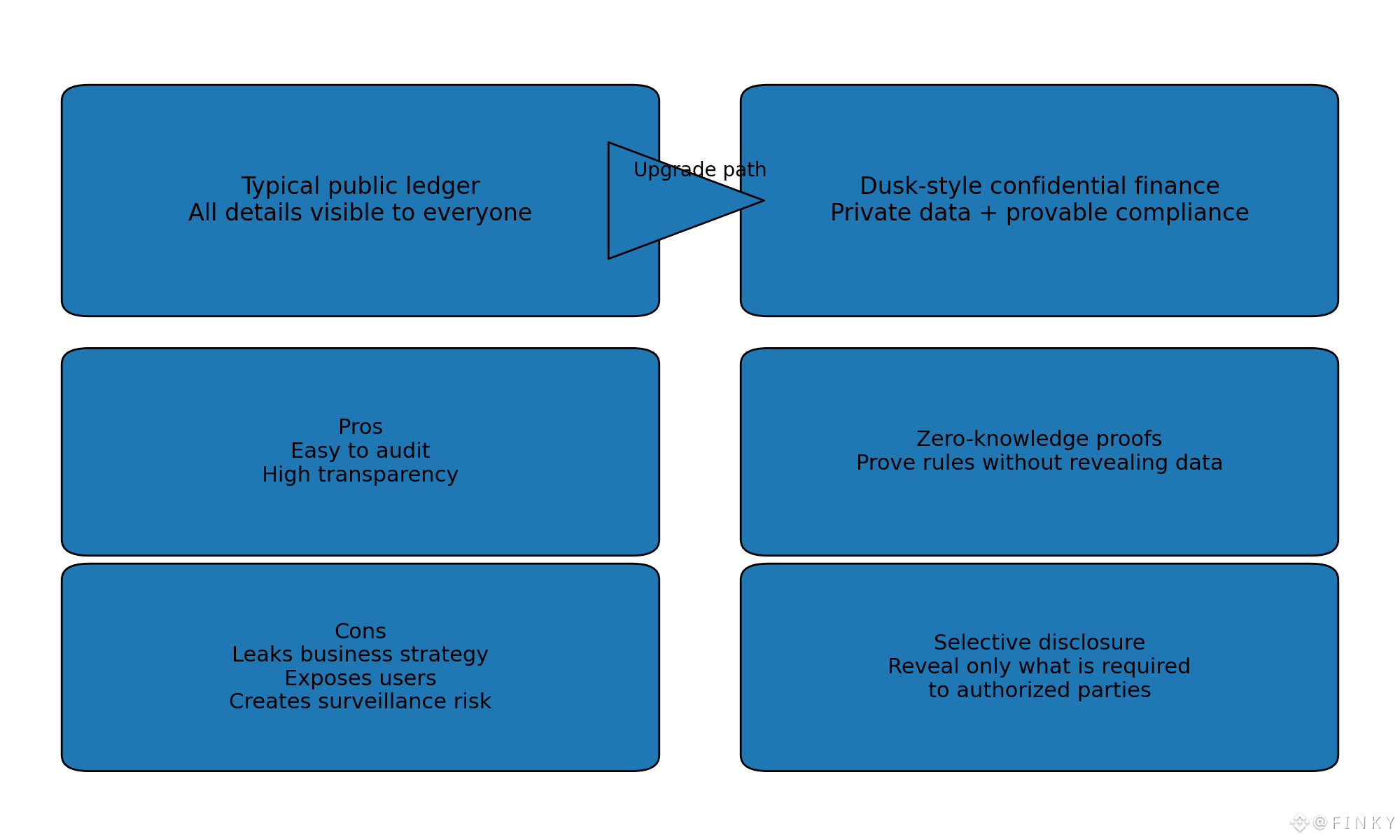
When people talk about tokenized real world assets, it is easy to make it sound like a future that arrives automatically, but in reality it is one of the hardest tests a blockchain can face, because real world assets come with law, reporting, identity expectations, eligibility rules, and the kinds of oversight that do not care about hype cycles. Dusk’s broader thesis is that tokenization can scale into regulated markets only when privacy and auditability can coexist, because institutions and users both need protection, just in different ways, and the network tries to support a world where compliance can be proven without turning every participant into a transparent object. If the ecosystem succeeds in creating workflows where sensitive financial details can stay confidential while authorized parties can still verify required conditions, then the promise stops being a slogan and starts becoming infrastructure, and We’re seeing the industry gradually accept that this balance is not optional if on chain finance wants to grow up.
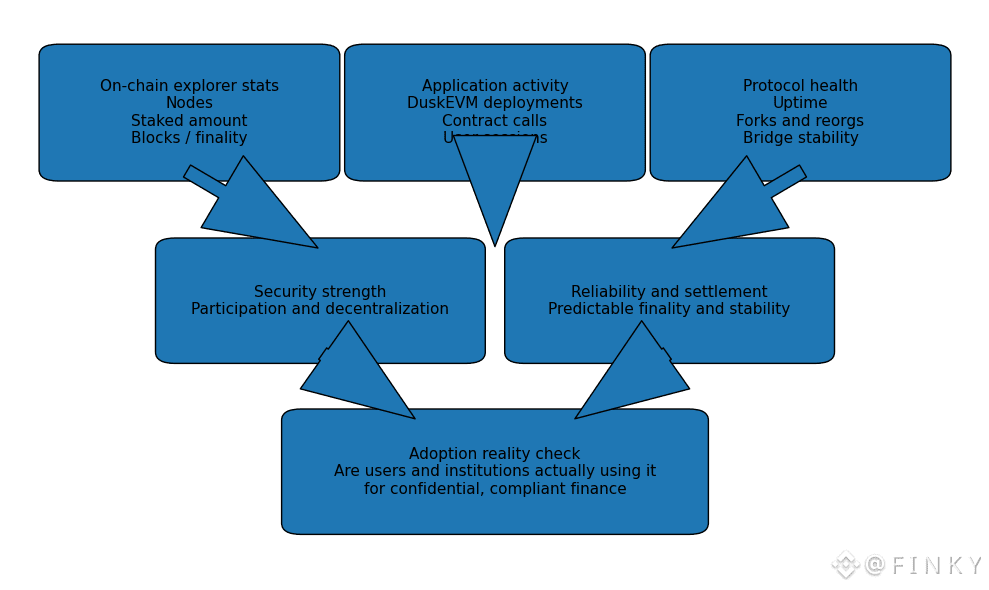
If you want to understand Dusk in a way that cuts through noise, you look at metrics that reflect trust rather than mood, because price can rise while a network stays empty, and price can fall while the foundations quietly get stronger. You pay attention to security participation through staking health, decentralization of participation, and the stability of validator activity over time, because a network that depends on a tiny group is always one crisis away from losing legitimacy. You also watch reliability signals such as consistent block production, finality behavior under load, and the smoothness of real user operations like bridging and application usage, because the moment financial infrastructure feels unreliable, institutions step back and users lose faith. The most important behavioral metric is whether privacy preserving patterns are actually used for real needs rather than treated as a branding label, because a privacy first chain only proves itself when people use privacy because it protects them, not because it sounds impressive.
There are also real risks that could challenge Dusk, and being honest about them is part of taking the project seriously rather than romantically. Regulatory frameworks can shift, and even a chain designed for compliance still has to adapt as expectations evolve, which is why the idea of selective disclosure is powerful, since it can fit different policy requirements without demanding constant exposure. Technical complexity is another risk, because privacy systems raise the cost of mistakes, and even small implementation flaws can damage confidence, so the project’s long term credibility depends on careful engineering discipline, security review, and conservative rollouts that value safety over speed. Adoption friction is the quiet killer, because institutions move slowly and users move impatiently, and if onboarding feels heavy or development feels difficult, the ecosystem can stall even if the thesis is strong, which is exactly why modular architecture and familiar execution environments matter, since they reduce friction while keeping the network anchored to its mission.
The far future Dusk is chasing is not a world where everyone becomes anonymous and unaccountable, and it is not a world where regulation dominates and privacy disappears, because the real ambition is a middle path that feels mature, lawful, and humane. In that future, a business can operate on chain without leaking strategy, an institution can comply without collecting unnecessary mountains of sensitive data, and a regular person can participate in modern finance without turning their private life into a permanent public record. If Dusk keeps building toward that balance, then It becomes more than a chain that runs transactions, because it becomes a foundation for markets that respect people while still respecting the rules that protect society, and that is the kind of progress that does not scream in the moment, but changes everything over time.
I’m ending with the part that matters most, because technology is only meaningful when it changes how people feel and what they are able to do without fear. Dusk is trying to prove that the future of finance can be faster without being invasive, transparent where it must be without exposing what it should not, and compliant without becoming a machine that strips dignity as the cost of entry. They’re building in a direction that treats privacy like safety and compliance like structure, and If they keep delivering that balance through real infrastructure, real reliability, and real usability, then We’re seeing the beginning of a standard that many people have needed for a long time, because a financial system that respects you is not a luxury, it is the future we should demand.
