Recently, the crazy rise of gold and silver has led many to see only 'safe-haven'.
But what truly drives this round of market activity is not panic, but a migration of global wealth anchor assets.
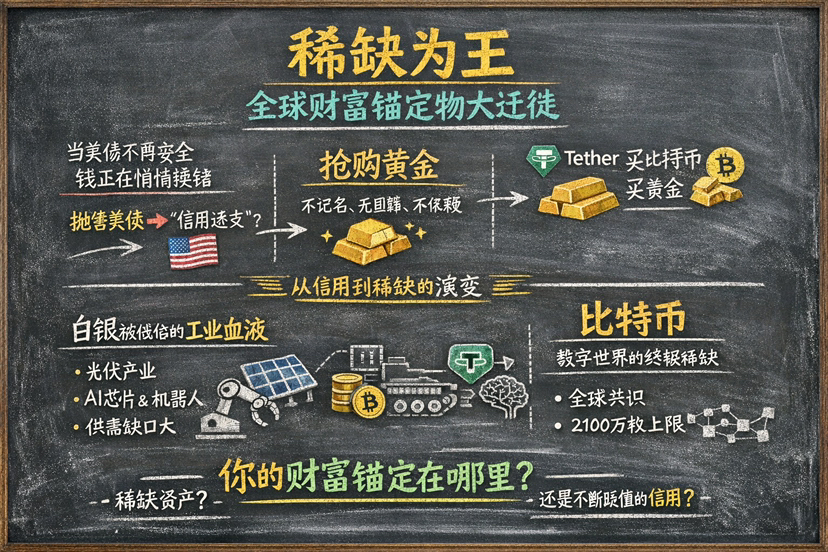
When central banks around the world reduce their holdings of U.S. Treasury bonds, they are not exchanging for dollars, but for an asset that does not need to be redeemed.
In extreme environments, credit can be weaponized, but gold requires no commitments.
It is anonymous, stateless, and has no counterparty.
The surge in gold prices is essentially a 'vote of no confidence' against the U.S. dollar credit system.
Let's look at another detail: What is Tether doing?
As one of the largest stablecoin issuers globally, they are both allocating Bitcoin and continuously accumulating gold, with holdings exceeding 116 tons, even surpassing many national central banks. This is not speculation, but risk hedging.
When the 'shadow system of the dollar' begins to back itself with physical gold and digital gold, it is itself an attitude.
History has always been very clear:
Things recognized globally can all become money.
From gold, to the dollar and oil, to technology and military strength.
And today, this anchor is being concretized as: the internet, artificial intelligence, and the energy and key materials that support their operation.
Why is scarcity the real pricing power?
Because in an era of continuous expansion of fiat currency, only things that 'others do not have, but I have' give you a voice.
This is also why silver, despite being restricted and undervalued for a long time, still shows strong price performance.
It is no longer just a precious metal, but a 'ticket' for future industries: photovoltaics need it, AI computing systems need it, and Musk's Optimus robot and autonomous driving hardware also cannot do without it.
Demand is inelastic, and supply is similarly inelastic (mostly by-product minerals), which determines that the value of silver is not just a financial narrative.
In this structure, Bitcoin's position is also very clear:
It is not a central bank asset, but the ultimate scarcity of the digital world.
There is no global central bank buying, but there is global consensus and a hard supply cap.
So, perhaps the real question should not be:
Can gold and silver still rise?
But rather:
Is your wealth continuing to anchor on depreciating credit, or on assets with hard scarcity attributes?
Finally, leaving one question:
In your view, what is the next 'scarce asset' likely to be anchored by global consensus?