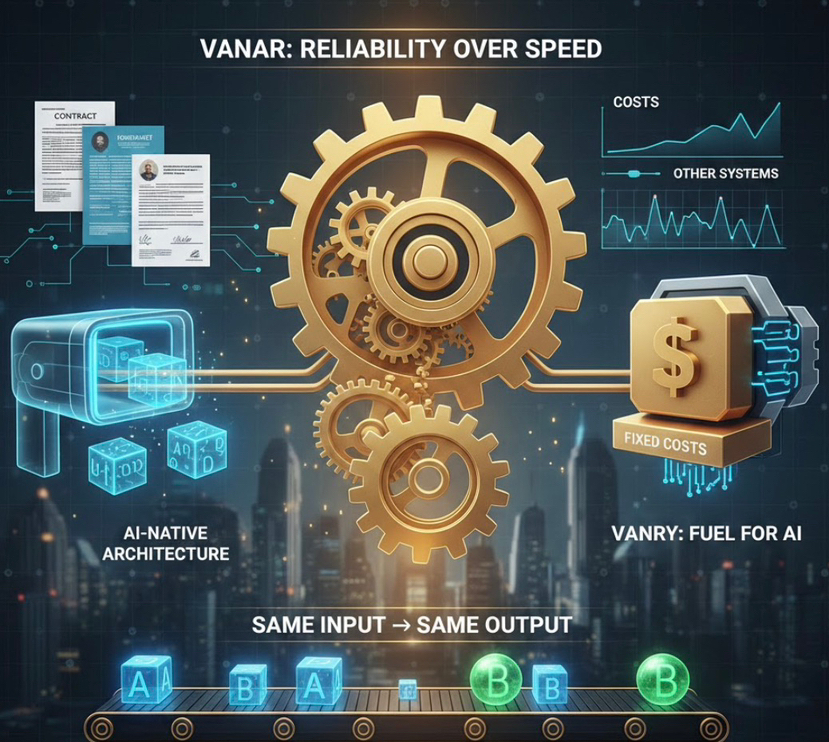
Vanar: trust above speed🔧
There is a significant misunderstanding about blockchain—
The real issue is believed to be merely speed.
But the fact is that when blockchain is applied to actual business and enterprise systems, the biggest problem is not slow speed, but uncertainty.
If the same input produces different results,
If the transaction results are unclear,
The costs of correction, recalculation, and arbitration will grow exponentially.
And Vanar takes a different approach.
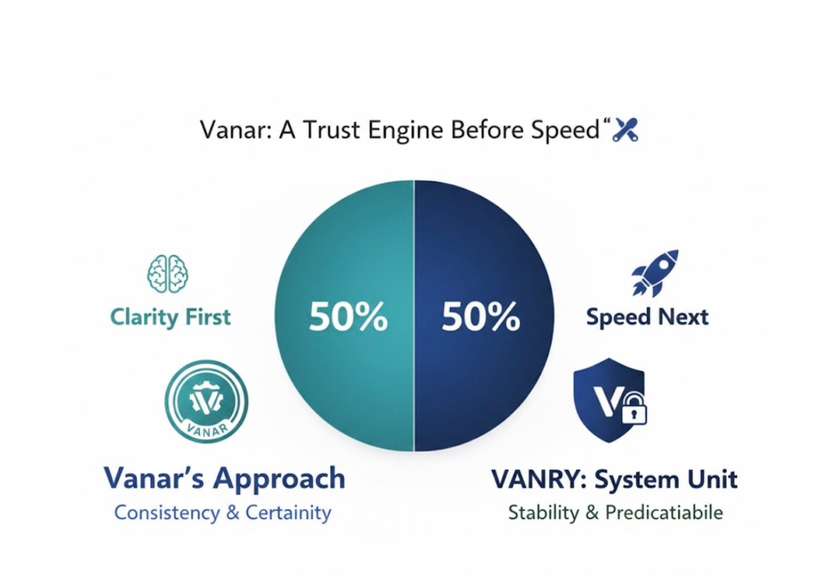
Vanar's idea: clarity first, then speed🧠
Vanar is based on a very clear idea:
👉 Do not push the blockchain with 'incomplete information'
👉 First ensure the accuracy, clarity, and structuring of data
Vanar adopts a multi-layer AI architecture.
This AI transforms contracts, certificates, and financial data into structured units, which:
Can be executed directly on-chain
Does not rely on the repeated 'meanings' of external systems
Same input each time, same output
Results:
Higher consistency
Better traceability
Easier auditing and compliance
This is exactly what RWA, automated computation, and enterprise-level processes need 📑
VANRY: Not a token, but a system measurement unit 💠
It is a mistake to view VANRY merely as a 'payment token'.
In the Vanar ecosystem, VANRY acts as a system measurement unit:
Used to leverage network resources
Used for AI-based reasoning and data contributions
Used to balance computation load
It does not operate based on hype or additional incentive models,
But is based on the rules within the network.
Its greatest advantage:
👉 The long-term operational costs of the network can be calculated in advance
👉 Enterprises and organizations need not worry about unexpected situations
Stability first, speed second 🚀
Today, many public chains pursue the ultimate performance of TPS (transactions per second).
Vanar adopted a more pragmatic strategy:
Fixed cost model
Secondary output, but execution remains consistent
More powerful computing + AI collaboration
For enterprises:
Rather than having a system that is fast but often inaccurate, it is better to have a system that can provide clear answers every time.
Conclusion 🎯
@Vanarchain does not position itself as a 'blockchain race'.
It positions itself as an on-chain engine -
Value comes from consistency, not noise.
The value of VANRY does not come from the narrative,
But comes from every decision
These decisions can be executed repeatedly -
No manual intervention required.
This is true on-chain stability.
Vanner: What blockchain needs is reliability, not speed
Introduction: Where is the true test of blockchain?
In the blockchain field, people often ask one question -
"What is TPS?"
But when the blockchain integrates with real-world business, banking, legal systems, supply chains, or real-world assets (RWA), the issues change:
Can the same input produce the same result every time?
Can outputs be audited?
Three years later, can the same system run normally without any changes?
Can its operating costs be predicted in advance?
This is exactly the starting point of Vanner's thinking.
Vanner does not aim to be the 'fastest blockchain'.
Vanner positions itself as an on-chain engine aimed at eliminating uncertainty.
Part One: Speed vs. Consistency - The Real Contest
Most public blockchains are based on this idea:
"If we can provide higher TPS, everything will be fine."
But in enterprise systems, more dangerous than speed is - uncertainty.
If:
Smart contracts return different results on different nodes
Data needs to be re-extracted each time
Corrections need to be made after transactions
Total costs far exceed transactions per second (TPS).
Vanar recognizes this fundamental issue:
In the real world, what systems need is predictability, not speed.
Part Two: The Foundation of Vanar - Preventing 'Fog' from Entering the Blockchain
While the foundation of Vanar is weak, it is very solid.
Vanar does not assume:
"Data is clean when it reaches the blockchain."
But is:
"Data must be clean before reaching the blockchain."
This is why Vanar adopts a native AI architecture. The AI:
Transform raw contracts
Legal documents
Certificates
Financial statements
Translate into structured language units, which:
With clear meanings
With clear boundaries
With clear execution results
Part Three: Why is 'One Input, One Output' so important?
The most expensive thing on the blockchain is conflict.
If the same input:
Generate different results
Lead to different interpretations
Require different corrections
So:
Increases legal risks
Increases auditing costs
Lower trust levels
Vanner's design eliminates these issues.
In Vanner:
👉 Same input → Same output
👉 Always the same
👉 The same at every node
This is why Vanner:
👉 Easy to trace
👉 Easy to audit
👉 Can be safely scaled
Part Four: Why Vanner is Crucial for RWA and Enterprises?
Real-world assets are not just tokens. They are closely related to the following aspects:
Rules
Computation
Timeline
Term
Liability
If a blockchain cannot handle all these elements clearly, it does not deserve to have RWA.
And this is exactly where Vanner excels.
It is not just a 'storage layer'; it also has the following functions:
Automated computation
Rule-based execution
Enterprise-grade processing
Support.
Part Five: VANRY - Thinking Beyond Tokens
In most networks, tokens are used for:
Pay fees
Provide incentives
Generate heat
But the role of VANRY is different.
In the Vanar network, VANRY:
Measure resource usage
Balance computation load
Powering AI-based reasoning
It does not rely on a 'mining competition',
But runs based on the rules within the system. This:
Network costs are predictable in advance
Easier for business planning
Support long-term operations
Part Six: Fixed Costs - The Greatest Boon for Enterprises
Enterprises worry about the uncertainty of costs.
If:
Today's fee is X
Will it rise to 10 times tomorrow?
No enterprise would trust such a system.
Vena's fixed cost model:
Stabilize costs
Ensure secure scaling
Makes long-term use possible
Part Seven: Speed Second, Reliability First
Vena does not think speed is unimportant.
Vena said:
"First provide the correct result, then pursue speed."
Therefore:
There is a second-level output
But the consistency of execution will not be affected.
For Vena:
A fast but inaccurate system is of no use.
A slow but inaccurate system can be very useful.
Vena's goal is:
👉 Correct + Fast = Sustainable System