
Just now, Huang Mao announced the new Federal Reserve Chairman. Focusing on three core questions: "Who is the new chairman? How will the policies change? How will the cryptocurrency market react?", I will use relatable analogies to explain the impact.
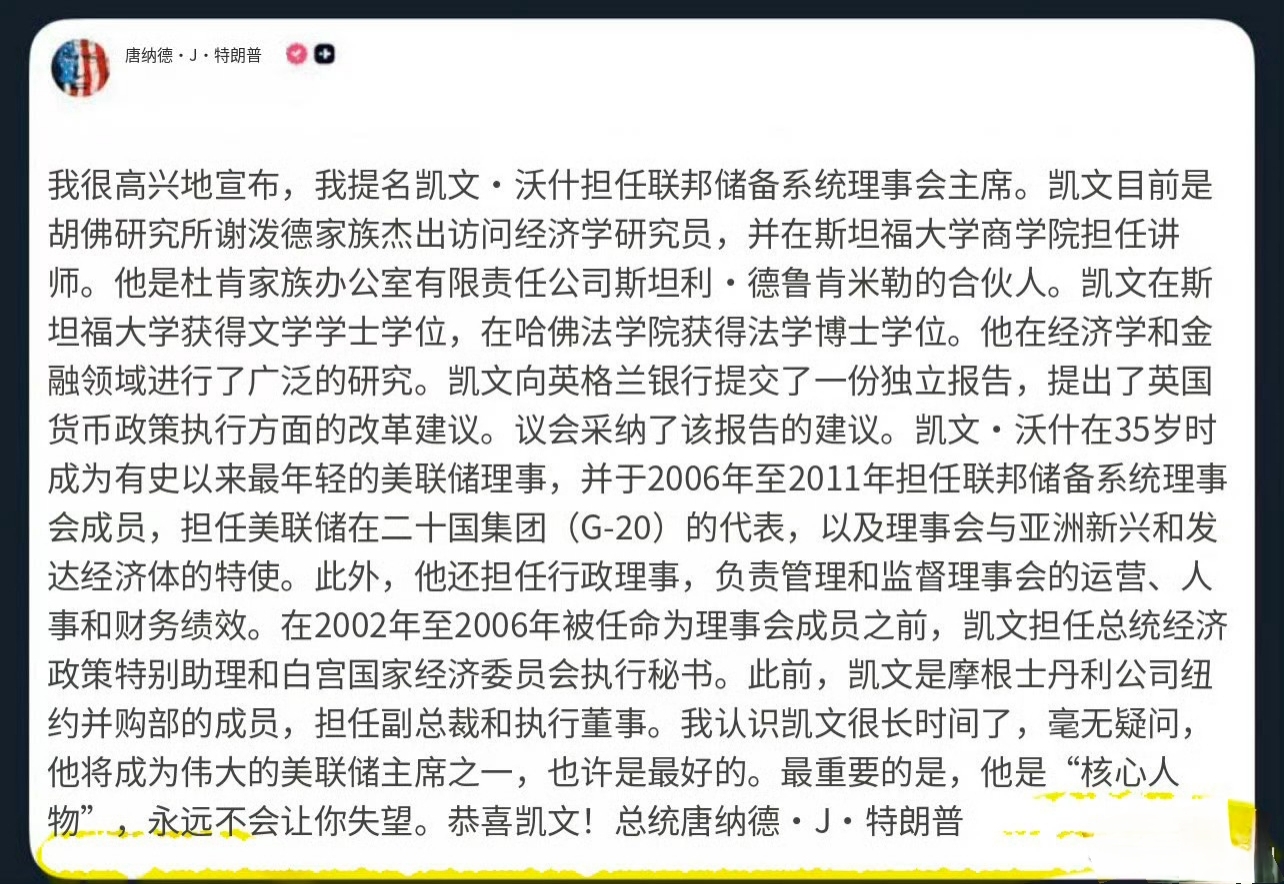
First, we need to understand: Who is the new chairman?
The Federal Reserve is about to change its "head," with the newly nominated chairman being Kevin Warsh. This man has two key characteristics that will directly determine the fate of the cryptocurrency world:
First, he is "frugal"—particularly opposed to reckless spending and printing of money. Previously, the Federal Reserve printed large amounts of dollars and injected them into the market to rescue the economy (called "quantitative easing"). With nowhere else to go, much of this money flowed into the cryptocurrency market, driving up the prices of Bitcoin and Ethereum. But Warsh believes this is "reckless monetary easing" and that after taking office, he might quickly "drain" the money (called "balance sheet reduction"), taking back the money that had been previously injected.
Secondly, he is "not opposed to the cryptocurrency circle"—unlike his previous attitude of condemning cryptocurrencies, he believes that blockchain is a good thing, and he also has dealings with big capital in the cryptocurrency circle. He advocates setting rules for the cryptocurrency circle instead of killing it outright.
Simply put, this is a new chairman who "wants to tighten the purse strings while also setting rules for the cryptocurrency industry." His appointment has directly plunged the cryptocurrency industry into a dilemma of "fear and anticipation."
II. Impact on the cryptocurrency market: Focus on these two things
1. With less money available, the price of the coin may drop first.
The cryptocurrency market is notorious for being "built up by money"—the more spare cash there is in the market, the more people will buy cryptocurrencies like $BTC , $ETH , and various altcoins, and prices will naturally rise; if there is less money, no one will have the funds to speculate on cryptocurrencies, and prices will easily fall.
What Walsh really wants to do is "pump and dump" (balance sheet reduction), taking back the excess dollars from the market. It's like how before, if everyone had $100 in spare cash, they could use $50 to trade cryptocurrencies; now, if they only have $50 left, they might only dare to use $10. Moreover, many people in the crypto world borrow money to trade (using leverage). Once their cash decreases and the cost of borrowing increases, these people will be forced to sell their cryptocurrencies to repay their debts, which could trigger a chain reaction of price drops.
For example, on the day the nomination was announced, Bitcoin rose slightly, then fell by 4%. This was because people were hoping for looser regulations on the cryptocurrency market, but were also worried about him taking a cut of liquidity. The more they thought about it, the more panicked they became, and some people sold their shares as a precaution.
2. The rules are changing; the "crooked path" is no longer viable, and the "right path" is easier to follow.
Previously, the cryptocurrency market was like an unregulated "farmhouse," with people selling counterfeit goods (worthless cryptocurrencies) and engaging in fraud, while regulators could only address the issues afterward. With Walsh taking office, he may be setting rules for this market:
- Negative impact: "air coins" that have no practical use and rely solely on speculation, as well as fraudulent exchanges, will be the focus of crackdowns and will find it difficult to survive in the future;
- Positive impacts: Legitimate crypto projects (such as those using blockchain for cross-border transfers and supply chain management) and compliant exchanges will be protected. Furthermore, large institutions like banks and funds, which previously hesitated to engage with cryptocurrencies due to regulatory risks, may now be more willing to enter the market, bringing more legitimate capital to the crypto space.
Simply put, cryptocurrency trading can no longer rely on "gambling on luck"; instead, investors must assess whether projects are truly valuable and compliant with regulations.
III. How should ordinary people view this? Don't panic, focus on the core issues.
Short term (1-6 months): Price fluctuations are possible; avoid using leverage.
The new chairman still needs to go through the procedures before taking office. During this period, the market will be constantly debating whether he will first withdraw liquidity or first establish rules, and the price of the coin may fluctuate greatly.
Ordinary people should not follow the trend of borrowing money to speculate on cryptocurrencies (using leverage), and should also avoid those small coins with strange names that they have never heard of – these coins have poor liquidity, and once the market crashes, they may not be able to sell them and will lose everything.
Medium to long term (1-3 years): The cryptocurrency market will undergo a "reshuffle," and only the reliable ones will remain.
Once the new chairman stabilizes and implements policies, the cryptocurrency industry will gradually become more standardized: projects that rely on hype and lack real value will be eliminated, while mainstream cryptocurrencies like Bitcoin and Ethereum, as well as projects that truly use blockchain to solve problems, will gain increasing recognition.
In the future, cryptocurrency trading may no longer be a get-rich-quick scheme, but more like buying stocks, where you need to consider the project's technology, compliance, and practical use. For ordinary people, it's either best to only use spare cash to buy a small amount of mainstream coins, or simply observe from the sidelines and not be swayed by short-term price fluctuations.
at last
With the arrival of the new Federal Reserve Chairman, the core changes in the cryptocurrency market are twofold: first, there may be less money in the market, leading to greater short-term volatility; second, regulations will become stricter, making "reliability" more important than "speculation."
Don't panic excessively, but also don't be blindly optimistic. Remember these three rules: "Don't borrow money, don't touch altcoins, and invest with spare cash." This will help you avoid pitfalls in the ever-changing cryptocurrency market.
I'm sure everyone, especially those holding spot positions, is feeling numb to the current market conditions. Many are opting to participate in airdrops to maintain their returns. I vaguely remember the peak of the airdrop at the end of September last year (@Plasma $XPL ! 200,000 people averaged over 200 USDT each. As a leading stablecoin project, it shouldn't be so stagnant. May XPL break through the shadows, rise from the ashes, and continue its former glory! #Plasma #下任美联储主席会是谁?