

Recently, I saw some interesting things happening on #Plasma that everyone discussed together.
@0xStableFlow protocol officially launched on the Plasma platform, which is not just a technical integration but a significant breakthrough in large-scale capital movement.
As a high-performance Layer 1 blockchain focused on stablecoin payments, Plasma is gradually establishing itself as the 'destination chain for stablecoins,' and the addition of StableFlow amplifies this point directly.
Subsequently, the @WildcatFi protocol launched its first market on Plasma, further enhancing its institutional-grade credit layer potential.
Let’s analyze how these developments reshape the stablecoin ecosystem and look forward to their future impact.
First of all, the launch of StableFlow marks a leap for Plasma in cross-chain liquidity.
StableFlow is a protocol designed for large stablecoin transfers, allowing users to seamlessly settle assets like USDT or USDC from networks like Tron and Ethereum to Plasma with very low fees, almost close to zero.
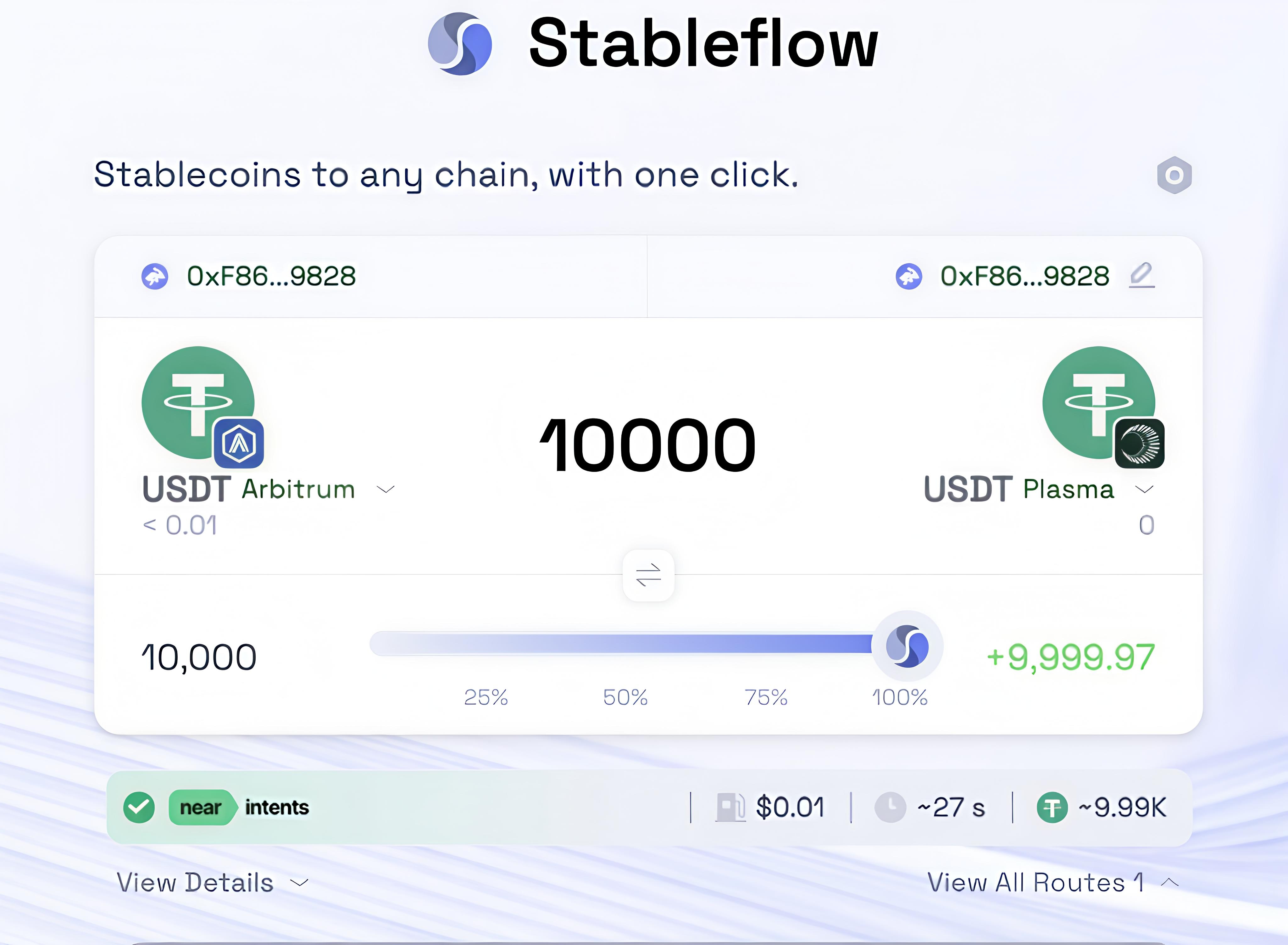
The key lies in its 'most competitive cross-chain stablecoin exchange rate'—users can handle transactions of up to 1 million dollars with zero slippage.
This is not a retail-level 'small play', but an optimization aimed at institutional and whale-level players. Imagine this: on traditional cross-chain bridges, large transfers often face the dual pain points of high slippage (price deviation) and gas fees. StableFlow achieves CEX-level pricing and execution efficiency through the integration of NEAR Intents technology.
Why is this significant for large-scale capital flows?
In the crypto market of 2026, the total supply of stablecoins has approached a historical high, with USDT as the dominant force, seeing explosive growth in global transfer demand. The original intention of Plasma's design is to tailor it for stablecoins like USD₮ (USDT0): zero gas fee transfers, sub-second finality, and EVM compatibility.
These features, combined with StableFlow's cross-chain capabilities, mean that developers can build more complex applications, such as real-time payment gateways or institutional-level settlement systems.
Next, let's look at the @WildcatFi protocol.
The first market launched on Plasma, this is an open USDT0 financing market provided by Wintermute, targeting a scale of up to 10 million dollars, with an annual interest rate of 9%.
The characteristics of this market are very attractive to institutional funds: the minimum deposit amount is only 1000 USDT0, with a 24-hour withdrawal cycle, a 48-hour grace period (an additional 5% interest during the grace period), a 0% reserve requirement, and soul-bound debt tokens (non-transferable).
WildcatFi is essentially a configurable non-collateralized credit protocol that allows borrowers to customize terms, while lenders decide to participate based on trust.
This implementation on Plasma marks a shift from 'over-collateralized lending' to 'institutional-level credit markets'. Traditional DeFi like Aave relies on over-collateralization to control risks, but WildcatFi introduces more flexible credit assessments through soul binding and grace mechanisms, suitable for short-term financing or T+0/T+1 settlement scenarios.
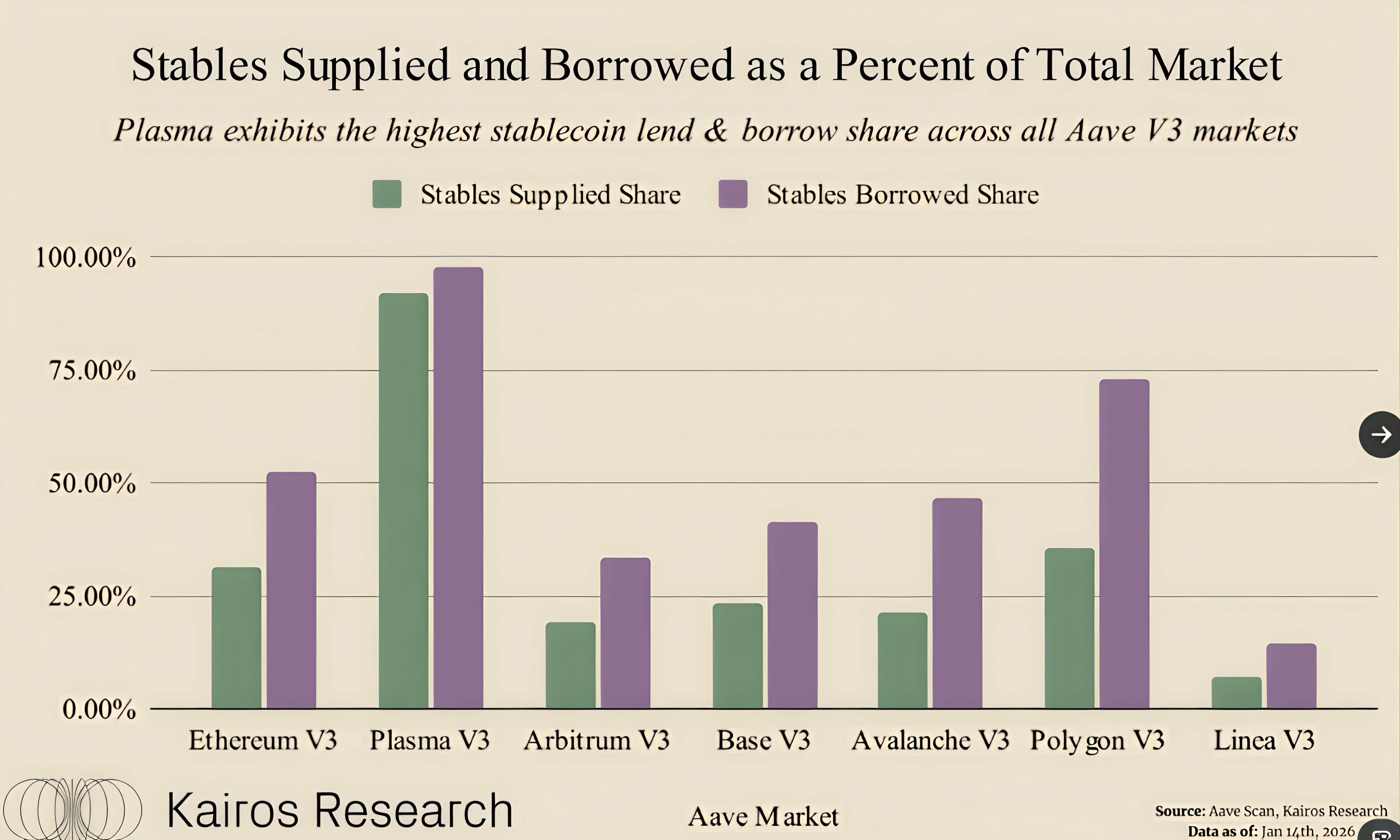
The scale of this market is not small—the 10 million dollar target has already shown strong demand in the launch phase. According to Aave's data on Plasma instances, Ethena's sUSDe PT capacity has exploded from a few hundred million dollars a few months ago to a 1.2 billion dollar cap, with institutional funds clearly flowing in.
Wintermute, as a top market maker, provides USDT0 financing, not only injecting liquidity into Plasma but also strengthening its positioning as a credit layer. Why is Plasma suitable for WildcatFi? Because Plasma's Bitcoin anchoring security (through rETH staking) and high-performance consensus (PlasmaBFT) ensure the reliability and low latency of large transactions.
With top endorsements from figures like Peter Thiel and Tether CEO Paolo Ardoino, Plasma's 24 million dollar financing and 2 billion USDT cold-start liquidity have made it stand out among many L1s.
From a deeper perspective, these integrations are driving Plasma's evolution from a 'payment chain' to the 'king of stablecoin infrastructure'. StableFlow addresses cross-chain pain points, and WildcatFi injects credit depth, together making Plasma a 'dedicated highway for stablecoins'.
By 2026, the narrative around stablecoins is shifting from 'store of value' to 'global payment infrastructure'.
In summary, the launch of StableFlow and WildcatFi is not an isolated event but a systematic upgrade of the Plasma ecosystem. It is quietly reshaping the liquidity and credit ecology of stablecoins, bringing on-chain dollars from concept to everyday use. Developers, businesses, institutions—who will be the next beneficiaries?
If you are already using Plasma One or StableFlow, feel free to comment and share your experience! Let's witness the rise of this dark horse together.#Plasma $XPL

