This title seems a bit strange at first glance: power consumption, how can it become an asset?
But if you really follow Plasma's security model, compliance logic, and the audit demands of the real world, you will find that this is not a conceptual gimmick, but a very Plasma way of thinking - turning 'invisible consumption' into 'proof that can be underwritten by the mainnet.'

First, let me state a premise: Plasma was never a technology born for 'unlimited expansion'; it was born for moderation.
It assumes that computing power, bandwidth, and trust are all expensive, so it chooses to keep most things off-chain, only bringing evidence to the mainnet when necessary. This design is inherently tied to the issue of 'energy efficiency.' How much resources you consume, whether it is worthwhile, and whether it can be proven - Plasma is asking these questions.
And once you put Plasma into today's compliance context, things start to get interesting.
In the traditional world, energy consumption is often a cost item that needs to be compressed, explained, and rationalized. But in regulatory, auditing, and ESG systems, precisely recorded, traceable, and verifiable energy consumption becomes an asset—it proves what you did, how much you did, and whether there was any fraud.
@Plasma Especially good at doing this.
Because the off-chain execution of Plasma is essentially a process consumption that can be adjudicated afterwards. The number of state updates you ran off-chain, how many transactions you processed, and how many online services you maintained will not immediately go on-chain, but they will periodically be compressed into block headers, Merkle roots, and state commitments. These commitments do not directly show the process but provide an 'accountable anchor point' for the process.
In other words, Plasma does not record how every kilowatt-hour is used, but it does record:
If you didn't use this electricity, you couldn't have produced this result.
This is very important in audit logic.
Traditional IT audits often rely on logs, reports, and third-party systems to piece together evidence; whereas under the Plasma structure, off-chain computational consumption is implicitly bound to the on-chain state commitments. Once questioned, you either provide complete data to prove the state is correct or the system allows the other party to challenge the issue by exiting or contesting, bringing the problem to the mainnet for adjudication.
Thus, electricity consumption is no longer just an 'operating cost' but becomes a necessary investment to maintain the credibility of the state.
This is the true meaning of 'energy efficiency equals compliance':
It’s not that you use less electricity to be compliant, but that every bit of electricity you use can be tied to a verifiable, auditable, and disputable result.

The role of Plasma here is not the energy-saving technology itself, but rather the accounting system between energy consumption and results.
Looking further, if you put Plasma into a modular architecture, this relationship will be amplified.
Execution in Plasma, data availability at the DA layer, and final adjudication on the mainnet. Each layer consumes energy, but the consumption of each layer corresponds to a clear boundary of responsibilities. During an audit, you don't ask, 'How much electricity did you use?' but rather, 'Did you consume beyond what was necessary to maintain this part of trusted execution?'
In this model, efficiency becomes an asset.
Because low energy consumption, low redundancy, and low complexity mean a smaller attack surface, lower challenge costs, and clearer allocation of responsibilities. All of these can be quantified, compared, and written into compliance reports.
You can even think a bit more radically:
Future compliance-type applications could completely treat the state commitments of Plasma as 'proof of operation.' It's not about proving how fast you compute, but about proving that you only computed what was necessary.
This is exactly the opposite of the logic of PoW.
#PoW It's 'I consumed a lot of electricity, so I am trustworthy';
#Plasma more like 'I didn't waste electricity, so I am easier to audit.'
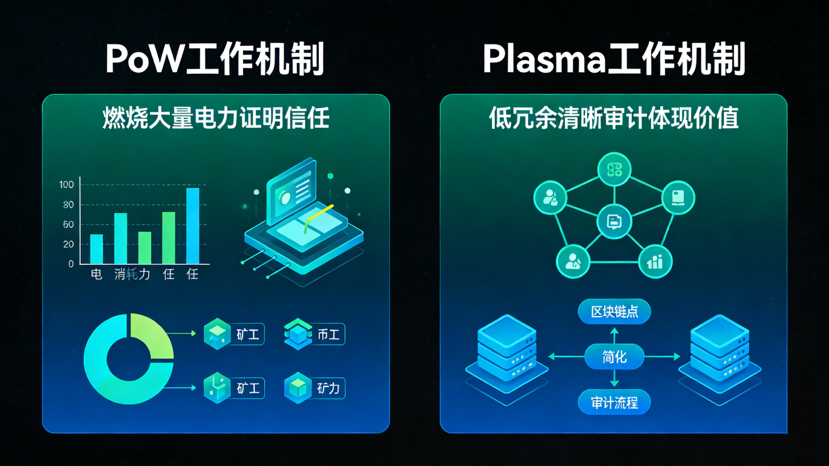
So, when we say #Plasma transforming electricity consumption into assets, what is truly being transformed is not the electricity itself, but the relationship between electricity and responsibility.
The energy you consume is compressed into a verifiable state;
the energy you save is reflected in lower compliance costs and stronger accountability.
Perhaps this is one of the reasons Plasma is becoming interesting again today.
When blockchain is no longer just 'faster and cheaper' but is required to be 'clearer, more restrained, and better explained,' the seemingly conservative design of Plasma becomes an advantage.
Not all technologies need to burn more energy to prove their existence.
Some technologies only need to prove: I did not waste.