
Over the past decade, the cryptocurrency industry has been continuously reshaping its brand image.
Sometimes it's 'decentralized finance', sometimes it's 'Web3', sometimes it's 'world computer', and sometimes it's 'digital gold'.
Every new chain is selling the same dream - higher transactions per second (TPS), lower fees, and a token that will change everything in the future.
But to be honest, these promises mean little to the average user.
People don't wake up in the morning thinking about which Gas token to use.
All they want is:
Funds arrive quickly
Prices remain stable
And easy and convenient transfers
This is where stablecoins <extra_id_1> transcend the entire cryptocurrency industry.
Stablecoins: a practical application case quietly adopted widely
Stablecoins like USDT and USDC are no longer experimental.
They have already:
Become a medium of global trade
Become a means of remittance
Become the pillar of exchanges, over-the-counter trading, and on-chain settlements
Trillions of dollars in transactions flow through them every day.
However, the problem is that the blockchain they rely on to operate was not born for them.
Ethereum:
Gas fees are hard to predict
High transfer fees during peak times
Tron:
Low fees, but there are limitations in centralization and user experience
Solana:
Fast speed, but network stability remains questionable
This means stablecoins have become the dollar of the internet,
But their infrastructure is still not perfect.
The story of Plasma begins with its fundamentals.
@Plasma does not attempt to be “another blockchain.”
It also does not position itself as an NFT, gaming, or DeFi hub.
The goal of Plasma is very clear:
“If stablecoins are the currency of the internet, then we need a blockchain optimized for stablecoin transfer needs.”
This is why Plasma is designed as a native stablecoin Layer 1.
Stablecoins are here:
Not secondary tokens
Not experimental
But rather the core of the network
Free transfers for USDT: architecture rather than marketing
When people hear that USDT transfers on Plasma are free,
They would think it’s just a promotional gimmick.
But that’s not the case.
The design philosophy of Plasma is based on the following criteria:
Users should not have to think about gas fees every time
The payment experience should be as simple as sending a WhatsApp message
Therefore, the network model of Plasma is designed to
Make transfers of stablecoins like USDT a core feature of the network.
This is not an additional feature, but a fundamental function.
EVM compatibility: old tools, new thinking
Although Plasma is a new chain, it does not require developers to learn everything new.
It:
Fully compatible with EVM
Supports tools like Solidity, MetaMask, and Hardhat
This means the entry threshold for developers is low,
But the mindset is vastly different.
The question here is not:
“How much TVL is locked?”
But rather:
“How much capital can be transferred without friction?”
$XPL XPL: Backbone of the Plasma ecosystem
This is where XPL comes into play.
XPL is not a token designed for speculation.
It is the economic coordination layer of the Plasma network.
The functionality of XPL:
Ensure network security
Incentivizing validators and infrastructure
Smooth stablecoin transfers
This means users send USDT,
But the backend is powered by XPL.
This separation is implemented to:
Protect users from price volatility
And maintain the sustainability of the network
Argument: Cryptocurrency hype ≠ mass adoption
History shows:
The most eye-catching technology does not always end up as the ultimate winner,
But only the technology with minimal friction can survive.
Email is better than fax,
UPI outperforms bank cards,
Stablecoins outperform traditional remittances.
Plasma is the next step in this evolution.
It does not claim:
“We will change everything.”
But rather:
“We will improve the parts that already work.”
In the future: when blockchains are no longer visible
The ultimate vision of Plasma is:
Users may not even realize they are using blockchain.
In simple terms:
Remittance
Instant settlement
Price remains stable.
When this happens,
Networks like XPL and Plasma will continue to operate in the background,
but real value will be created there.
Conclusion
@Plasma is not part of the hype cycle.
It stems from a very practical problem:
“Since the world is already using stablecoins,
Shouldn't we build the right infrastructure for them?”
$XPL and Plasma is the answer to this problem.
Less noise,
More practical action,
And a tangible step towards true internet currency.
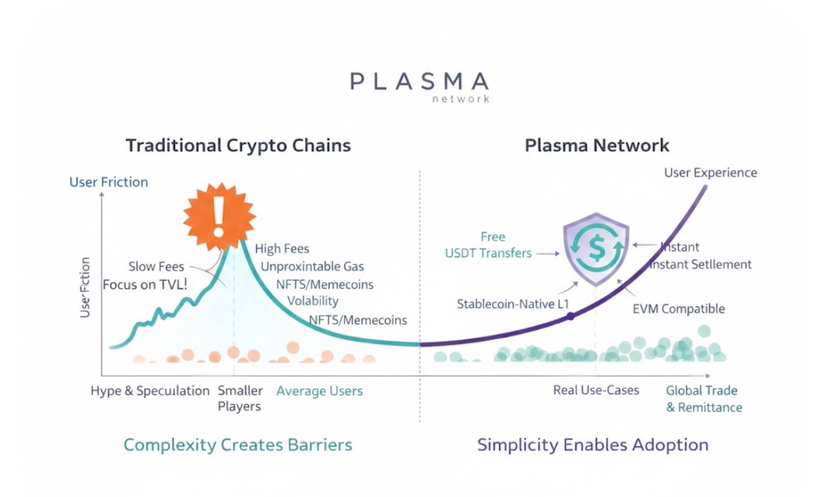
We have explained why Plasma is a must-have and why a blockchain philosophy prioritizing stablecoins is needed.
The question now is:
If Plasma really exists,
How will it change the cryptocurrency industry and the real world?
1. Remittances: the network, not banks, is the winner
Even today, millions of people from the following regions face:
Middle East → Asia
Europe → Africa
United States → Latin America
Face the following issues:
5-10% transaction fee
2-5 days settlement time
Exchange rate losses
Stablecoins improve these issues, but the infrastructure has not.
In networks like Plasma:
USDT<extra_id_1> becomes part of the network
No need to worry about gas fees
No need to worry about “network congestion”
This difference is significant.
It's like the difference between email and post offices. 2. Commercial payments: the quiet revolution of B2B
Nowadays, national-level B2B payment systems:
Slow speed
A plethora of paper documents
Rely on banks
But many companies are now:
Make vendor payments through stable connections
Invoice settlements
Over-the-counter trading
Payment methods are also becoming stable.
The problem still exists:
These systems do not exist.
Plasma:
Predictable transfers
Stable settlements
Backend
Users do not need to understand blockchain,
Just make the payment
3. Applications
Cryptocurrency made a big mistake:
Every blockchain begins to claim to be the “home of applications.”
But the expansion of the internet does not depend on applications, but on infrastructure.
TCP/IP
HTTP
SMTP
No one knows them,
But everyone is using them.
Plasma: The same goes for it
Not flashy
Not hyping NFTs
No 100x marketing
There’s only one question:
“Will value flow freely?”
4. What is XPL?
The biggest revelation of XPL:
View it as a “speculative token”
“When will the price surge” plugin
But
Network security
Validator economy
Stable Bitcoin transfer engine
For example:
Users will not remember gas prices,
But cars run on gasoline.
XPL belongs to this category.
5. When blockchain becomes invisible
The true victory of cryptocurrency will be:
Application users may not even know
They are using blockchain
Fees, TPS, gas
All become backend costs
Plasma:
“User experience is paramount,
Blockchain is secondary.”
When Acerogh appears,
The noise on cryptocurrency Twitter will decrease,
But true mass adoption will begin from then.
Conclusion
Plasma is not an “Ethereum killer.”
Next is Solana
“If the world is already using stablecoins,
Should they get the right infrastructure?”
In the first part, we explored the reasons.
In the second part, we explored
Say less, do more…
This is the true essence of @Plasma Plasma.
:
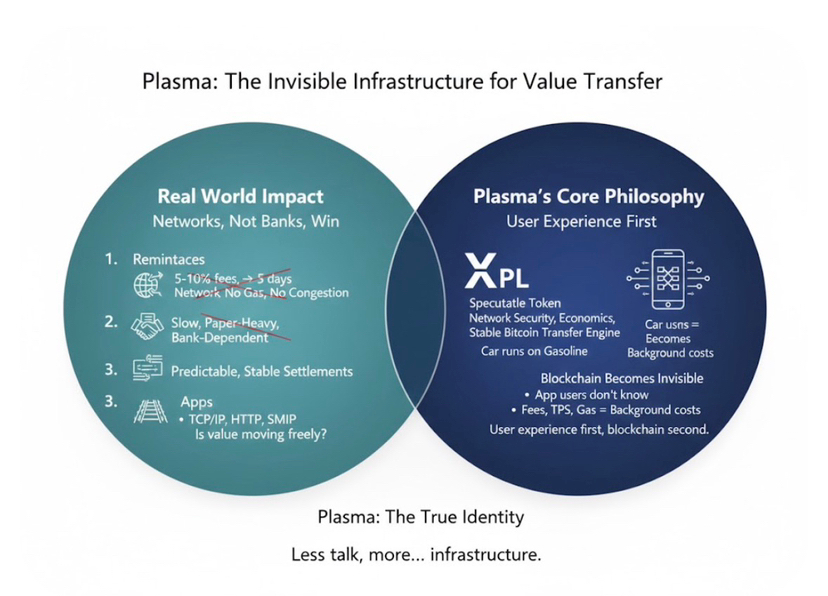
Transactions, liquidity, and stablecoin economics: the true test of Plasma
So far, we have discussed:
The reason for Plasma's creation
How does it provide infrastructure prioritizing stablecoins
Now, let’s get to the core of cryptocurrency:
Transactions and liquidity
This is where each network is truly tested.
1. The biggest truth about trading:
What traders fear is friction, not technology
For active traders, the biggest issue is not TPS or block size.
The real question is:
Gas fees when transferring funds
Delays in on-chain transfers at exchanges
Uncertainty in the costs of stablecoin trading
When the market fluctuates,
Speed is crucial,
The concept of blockchain is equally important.
This is exactly where Plasma trading strategies come into play.
2. Stablecoins ≠ merely “anchored assets”
Nowadays, traders use stablecoins simply to:
Lock in profits
Avoid volatility
Wait for the right timing to enter
But if every transaction is accompanied by:
Sometimes high transaction fees
Sometimes the network speed slows down
Sometimes bridging risks
Traders will be repeatedly obstructed.
In Plasma, stablecoins:
Not “auxiliary assets”
But rather the main flow of the network
That is to say, the liquidity of USDT is not an extra burden,
But rather the natural operation of the network.
3. The invisible enemy of on-chain transactions: settlement risk
Many traders do not realize:
Every slow settlement = hidden risks
Missed arbitrage opportunities
Slippage in over-the-counter trading
The gap between centralized exchanges (CEX) and decentralized finance (DeFi)
The model of Plasma has obvious advantages in this regard:
Stablecoin transfers = predictability
No need to worry about “What is today's transaction fee?” This is not about:
Liquidity flows smoothly
This is especially important for the following parties:
Over-the-counter traders
Market makers
High-frequency stablecoin trading
4. XPL and trading: wrong expectations, right roles
Here’s a crucial clarification.
It is wrong to view XPL as the following behavior:
“The next 100x trade”
“High-frequency trading on daily charts.”
The role of XPL is:
Network security
Economic balance
Support stablecoin traffic
From a trading perspective:
$XPL The value derives from network usage
And not just speculative trading volume
That is to say:
As stablecoin traffic increases,
Network demand will also increase.
Although slow,
But sustainable.
5. The next phase of liquidity:
“Reduce noise, increase transaction volume”
In the cryptocurrency market, people often say:
The louder the noise = the greater the risk
The quieter the system = the higher the transaction volume
Stablecoin trading belongs to this category.
This is where Plasma stands:
Reduce marketing noise
Reduce “breaking news”
But increase real capital flows
For traders, this means:
Fewer surprises,
More control.
6. Future trading architecture: even exchanges will experience delays
If blockchains like Plasma can scale,
In the future, we may see:
Settlement independent of exchanges
Direct transaction flow from wallet to wallet
Market structure driven by stablecoins
Among them:
Fast transaction speed
Settlement costs are low and reliable
But blockchain is just the backend
The final conclusion for traders
Plasma does not tell traders:
“We will make you rich.”
It simply says:
“We will make your transaction infrastructure more convenient.”
The fact is:
The profits from trading come from strategies,
But losses often stem from infrastructure.
@Plasma is dedicated to alleviating this disadvantage.
Reduce friction,
Clear settlements,
And strategies prioritizing stablecoins.
This is its true trading advantage.#Plasma

