

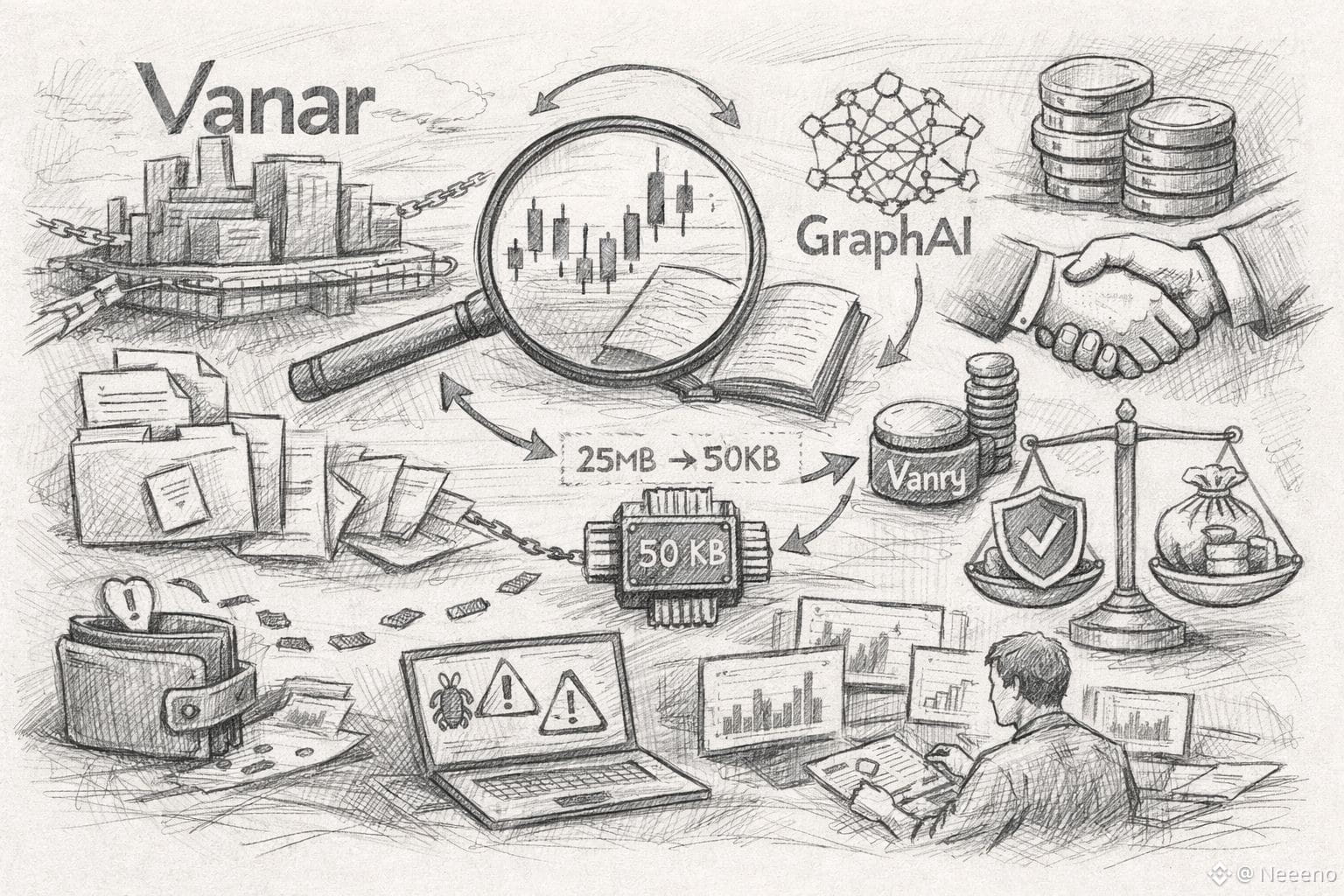
@Vanarchain has always carried an awkward truth that people outside the room don’t notice: the chain produces far more “meaning” than it produces “answers.” Blocks and transactions are easy to point at, but they don’t naturally become something a human can hold in their mind, especially when emotions run hot. The GraphAI integration matters because it treats that gap as a first-class problem. It’s Vanar admitting that truth isn’t only about what happened, but about whether ordinary builders, communities, and observers can reach the same conclusion without collapsing into rumor. Vanar’s own announcement frames this work as turning on-chain activity into something you can ask questions about, rather than something you can only inspect if you already know where to look.
Inside the ecosystem, you feel the need for this most clearly when trust gets stressed. A token moves unexpectedly, a contract behaves strangely, a wallet is accused, and suddenly the conversation becomes a battle over fragments. People don’t just want facts; they want emotional safety, which in crypto often means “show me the evidence quickly enough that fear doesn’t win.” Making the chain searchable in a human way doesn’t remove conflict, but it changes who has power during conflict. It reduces the advantage of the person who can overwhelm everyone with technical noise. It gives Vanar a chance to be fairer under pressure, not by being kinder, but by being more legible.
The tricky part is that “search” can become its own kind of danger. People confuse what is easy to retrieve with what is true. They confuse the first clean-looking answer with the whole story. That’s why the deeper promise isn’t convenience; it’s discipline. Vanar can’t prevent people from believing the wrong narrator, but it can reduce the space where narrators thrive by making it harder to hide behind complexity. When Vanar ties itself to a knowledge layer, it’s also tying itself to a responsibility: the system has to keep provenance intact, keep context intact, and avoid turning messy reality into a single neat sentence that feels true only because it’s readable.
This is where Vanar’s approach to data starts to matter more than most people realize. Vanar has been publicly pushing an idea that large, real-world information can be transformed into something small enough to live on-chain, with a headline claim that a typical 25MB file can be reduced to about 50KB. If you take that at face value, it sounds like marketing. If you’ve ever watched an integration fail because a document link died, or because evidence lived off-chain in a place nobody could agree on, it feels like something else. It feels like Vanar is trying to move “proof” closer to the chain’s heartbeat, so the system doesn’t depend on someone’s cloud folder staying alive when the stakes get uncomfortable
Vanar’s real test is not whether compression is impressive. It’s whether Vanar can preserve meaning when meaning is contested.Real-world data often clashes. An invoice might not match a receipt, a person’s identity may be uncertain, and timestamps can disagree. When that happens, most chains act like cold mirrors: they only show the clean, clear parts and leave out the messy human context.Vanar is trying to narrow that gap by making information easier to carry and easier to interrogate, so disagreements can be resolved with shared reference points instead of endless interpretation. The GraphAI path fits into that: it’s an attempt to make “what the chain knows” accessible without turning every dispute into a custom dashboard and a week of analysis. 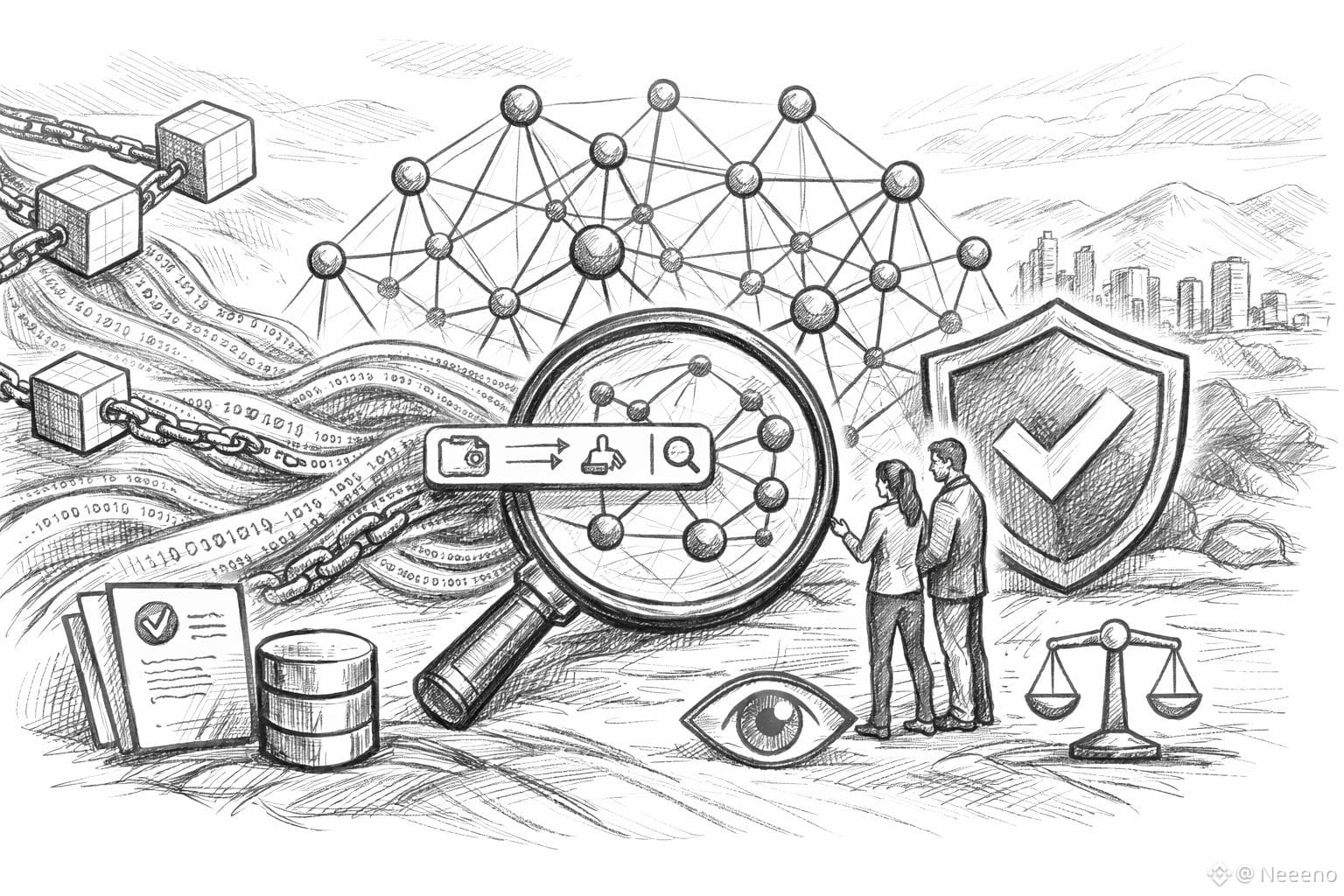
None of this works if incentives reward attention more than honesty. That’s the part many people skip because it’s less romantic: someone has to maintain the knowledge surface, keep the indexing accurate, keep the representations consistent, keep the questions from being gamed. That work is invisible until it’s missing. If the economics only pay during hype, the knowledge layer decays during quiet months, and then fails exactly when you need it—during an exploit, an audit, a governance dispute, or a slow-moving fraud. GraphAI’s own framing emphasizes that a knowledge layer is not only a UI problem; it’s a living system with incentives tied to tokens and participation.
This is why Vanar’s token story belongs inside the same conversation, not in a separate “tokenomics” section that people skim. VANRY has a stated max supply of 2.4 billion, and a live circulating figure around 2.256 billion on major trackers. Those numbers aren’t just trivia. They are part of the background emotional weather of the ecosystem. When circulating supply is already high relative to the cap, the community’s fears and expectations shift. People become more sensitive to unlock narratives, more alert to distribution fairness, and more demanding about what “value” means beyond price. A chain that wants to be trusted as a knowledge surface has to survive those moods without becoming defensive or opaque.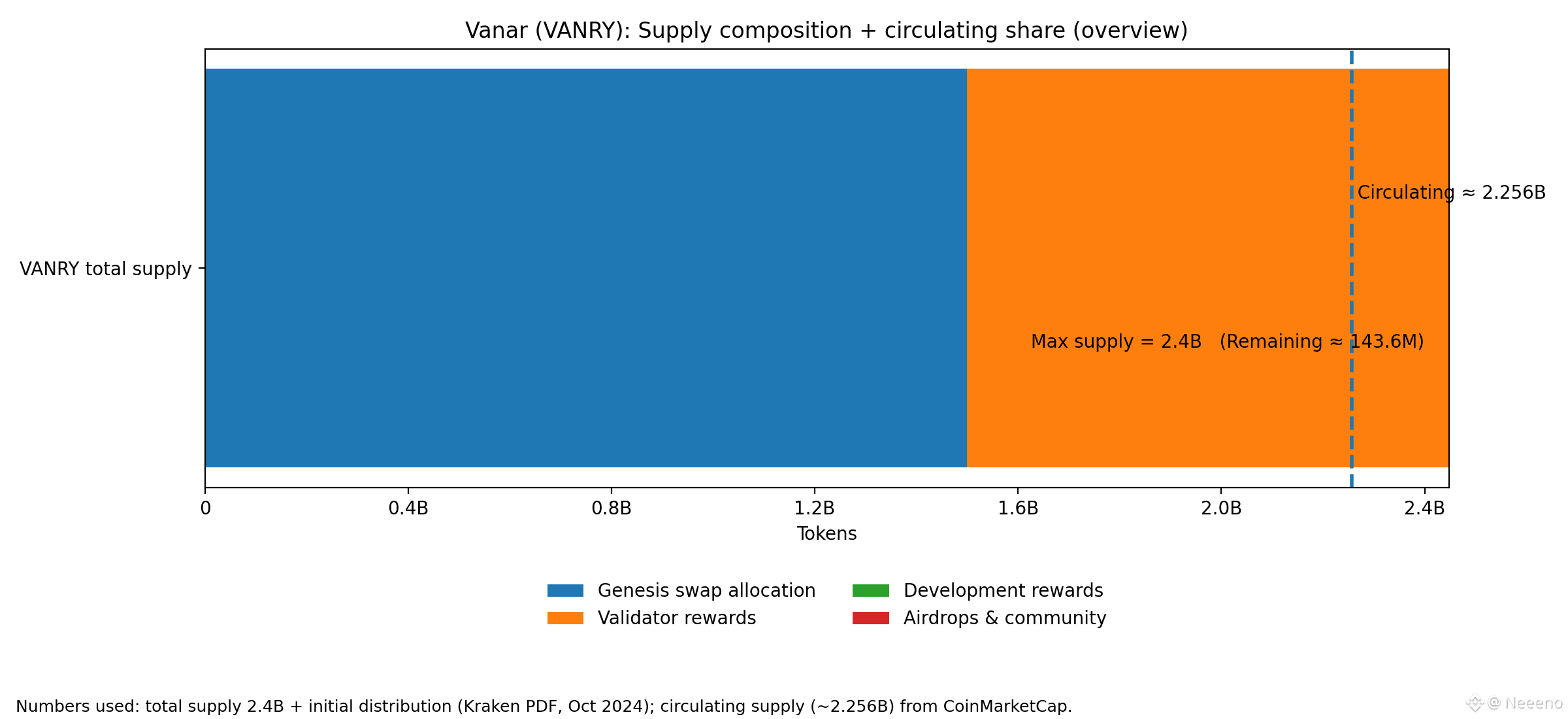
Vanar’s own documentation is unusually direct about the long arc: it describes VANRY token inflation averaging about 3.5% over 20 years, while noting the early years are higher to support ecosystem needs like development and airdrops. This matters because it signals what kind of behavior Vanar is trying to buy over time: participation that doesn’t collapse when headlines fade. If the chain is going to support searchable knowledge that people rely on in crises, it needs a steady social spine—validators, builders, and contributors who don’t disappear the moment the market stops paying them to care.
When you look at Vanar through that lens, the GraphAI integration isn’t a separate “partnership story.” It’s a stress-test story. It’s Vanar investing in the ability to reconstruct events quickly and fairly, to answer questions in a way that reduces panic, and to do it without requiring the user to become a specialist. Under volatility, people reach for shortcuts.People often believe whoever speaks the loudest. Vanar’s best protection isn’t a big promise—it’s a routine: making it simple to check the truth, even when you’re anxious and don’t want to dig through raw data.Of course, there’s a fine line between clarity and control. If searchable knowledge becomes centralized in practice—if only one index, one lens, one “official” interpretation dominates—then the chain can become emotionally unsafe in a different way.
People can become afraid that information is being shaped behind the scenes. The only strong path forward is to keep things visible and verifiable: several routes to the same facts, and a community norm of “prove it and show the process.” GraphAI’s broader writing about live knowledge graphs points toward this idea of structured interpretation layered on top of raw activity, which is powerful only if it stays auditable and contestable. 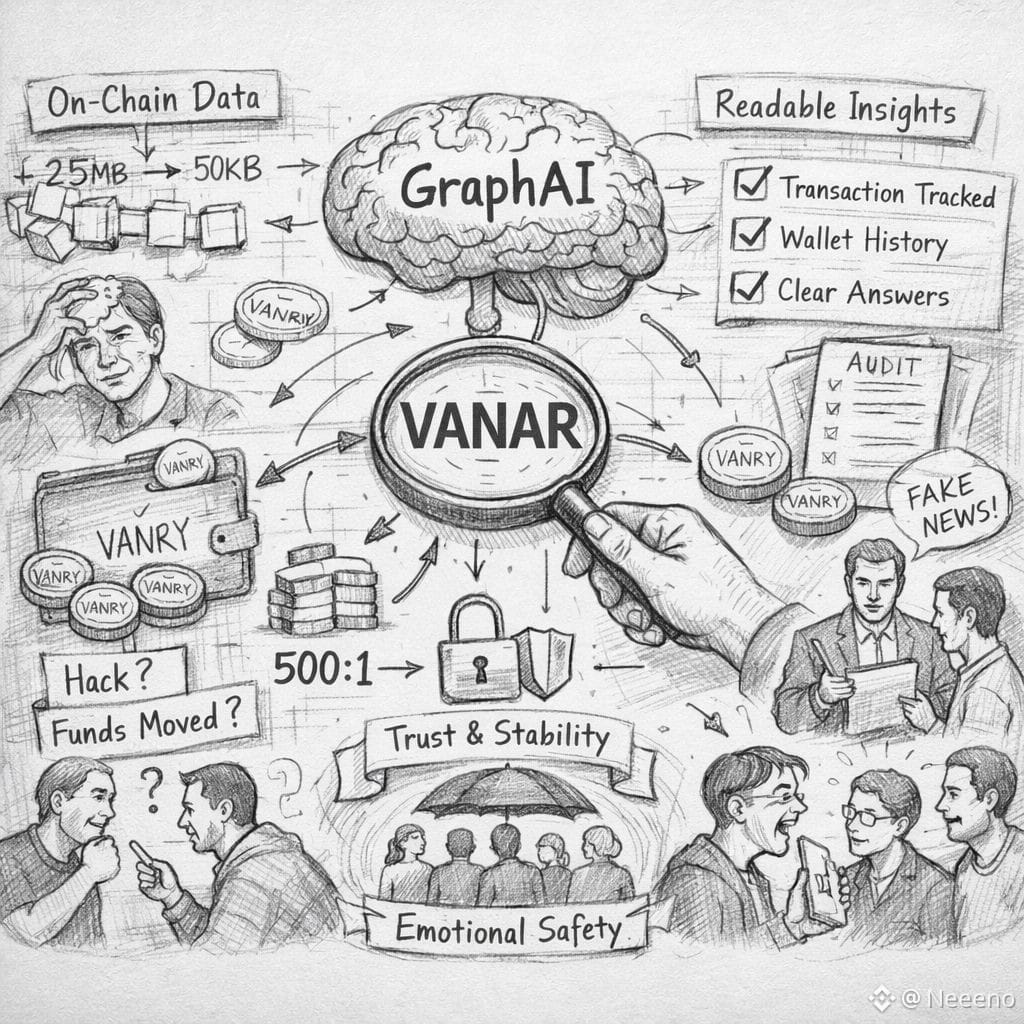
The most honest way to describe what Vanar is doing here is also the least dramatic: it’s trying to make the chain behave well when humans behave badly. It’s building for the moments when people are rushed, when accusations are unfair, when mistakes happen, when the market is moving too fast for careful thinking. If Vanar can make on-chain activity easier to question and harder to misrepresent, then it becomes quieter in the best way. Not silent, not hidden—just dependable. VANRY’s long issuance arc, the high-but-not-total circulating supply, and the public emphasis on making data more portable and verifiable all point to the same ethic: responsibility without spectacle.
In the end, the strongest infrastructure doesn’t beg to be noticed. Vanar doesn’t need applause for making knowledge easier to reach; it needs consistency, so builders can ship without dread and communities can disagree without unraveling. The real win is when nothing “exciting” happens because the system quietly prevented confusion from becoming panic. That kind of reliability is a form of care—quiet responsibility, invisible infrastructure, and the steady choice to prioritize what holds up when things go wrong over what looks impressive when everything is calm.
