

If you understand AI's capabilities as 'how smart one-time reasoning is', it's easy to overestimate the model itself and underestimate the system environment. However, when AI enters real operational scenarios, what truly determines whether it is 'usable' is not the quality of instantaneous outputs, but whether it can maintain consistent context over time. In other words, whether AI has sustainable memory is far more important than how nice its single response is.
The reason I emphasize this point repeatedly is that in the vast majority of AI demonstration scenarios, 'memory' is treated as a mere accessory at the application layer. Session caching, external databases, and temporary context stitching are sufficient during the demonstration phase, but once it enters long-term operation, fundamental issues arise: memory instability, unverifiable states, and context transfer difficulties. These issues are merely experiential flaws for human users, but they pose existential risks for AI systems.
When AI is no longer just called upon once, but needs to take on tasks for the long term, memory is no longer a question of 'whether it exists' but rather 'where, who maintains it, and how it is validated'. If memory stays at the application layer, it inherently relies on single-point systems; if it stays off-chain, it cannot be settled and audited; if there is no stable carrying layer at all, AI's behavior can never be seen as continuous. This is not a matter of technical purity, but an engineering reality.
It is in this context that the significance of myNeutron becomes clear. It is not intended to showcase a 'smarter AI', but rather attempts to answer a more fundamental and difficult question: can semantic memory exist as infrastructure? Once this question is positively answered, the way AI exists will change. It will no longer be a tool that is awakened repeatedly, but a system component with continuous context.
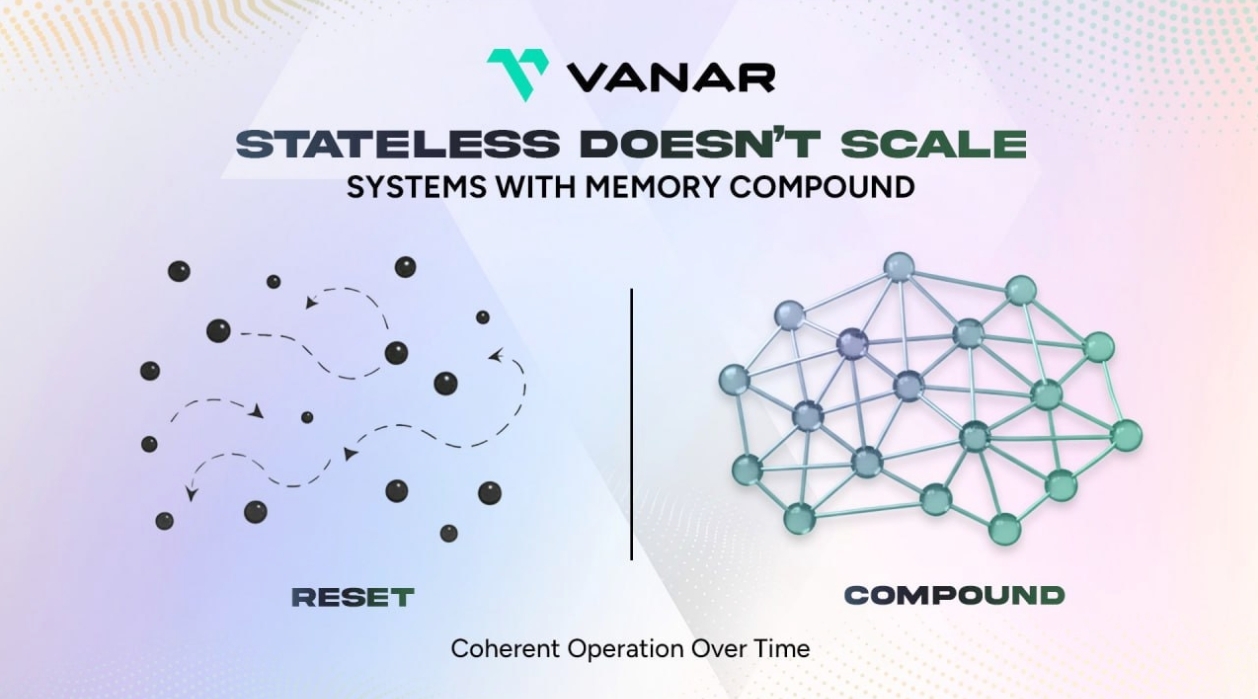
Sinking memory down to the infrastructure layer means what? First, it means that the state is no longer maintained by a single application, but carried by a more stable hierarchy. This allows AI's context to exist across applications, cycles, and even environments. Second, it means that memory itself can be verified, referenced, and constrained, thus entering the rule system. Finally, it also means that the maintenance and invocation of memory need to be settled, because any long-term existing state cannot be 'free'.
It is precisely at this point that the position of VANRY begins to become indispensable. When memory becomes an infrastructure capability, it is no longer a byproduct of sporadic behavior but a continuously existing system resource. The system must bear the cost of this existence and hope that this cost is predictable and manageable. Otherwise, the long-term operation of AI cannot be incorporated into any serious architectural design.
Many people underestimate the importance of 'predictable costs' here. They think that as long as memory can be stored and read, the problem is solved. But for long-term systems, whether it can be budgeted and planned is often more important than the technical feasibility itself. If you cannot know in advance the cost of maintaining a segment of AI memory, then you cannot confidently allow it to exist long-term. This is not a technical issue but a risk management issue.
When I put this logic together with myNeutron, I found that it does not try to prove anything with dazzling features, but rather validates a cooler hypothesis: if AI is to truly become a part of the system rather than just a plug-in tool, its memory must become infrastructure, just like storage and settlement. This mindset naturally sacrifices the appeal of short-term narratives, but reserves space for long-term operation.
This also explains why many AI applications that seem 'very strong' ultimately struggle to move beyond the demo stage. They solve the question of 'can it think?' but do not address the issue of 'can it remember long-term?'. Once the complexity of the scenario increases and the context spans lengthen, these applications become fragile. And once fragile, the system will not be trusted, let alone adopted in the long term.
Bringing the perspective back to VANRY, you will find that it is not the product of a single-point innovation, but a natural result after a series of assumptions hold true. If you assume that AI will exist long-term, make continuous decisions, and execute repeatedly, then memory must stably exist; if memory stably exists, it must be settled; if it is settled, there must be a consistent value scale. VANRY emerges in this chain, rather than being forced in.
From the perspective of investment and long-term observation, this path is often underestimated. Because the market is more likely to price 'immediately visible features' rather than the ability to 'avoid future failures'. But in the world of systems, the latter is often more important. Whether a system will still exist two years from now rarely depends on how dazzling it is at the moment, but rather on whether it was prepared for long-term state management from the very beginning.

When the use of AI shifts from 'demonstration' to 'operation', from 'assistance' to 'undertaking', the issue of memory will move from behind the scenes to the forefront. At that point, whoever solves this problem at the infrastructure level is more likely to be the one chosen. The value of myNeutron gradually emerges in this process, while VANRY quietly plays a role as a prerequisite for the continuous use of this entire set of capabilities.
If I had to summarize this point in one sentence, it might be said this way: AI without infrastructure-level memory can only remain a one-time intelligence; when memory truly sinks down, the logic of value will also change accordingly.
For more background and technical paths regarding the project, further information can be obtained through the official channel @vanar. This article only represents my personal judgment formed based on publicly available information and long-term observation, and does not constitute any investment advice.@Vanarchain