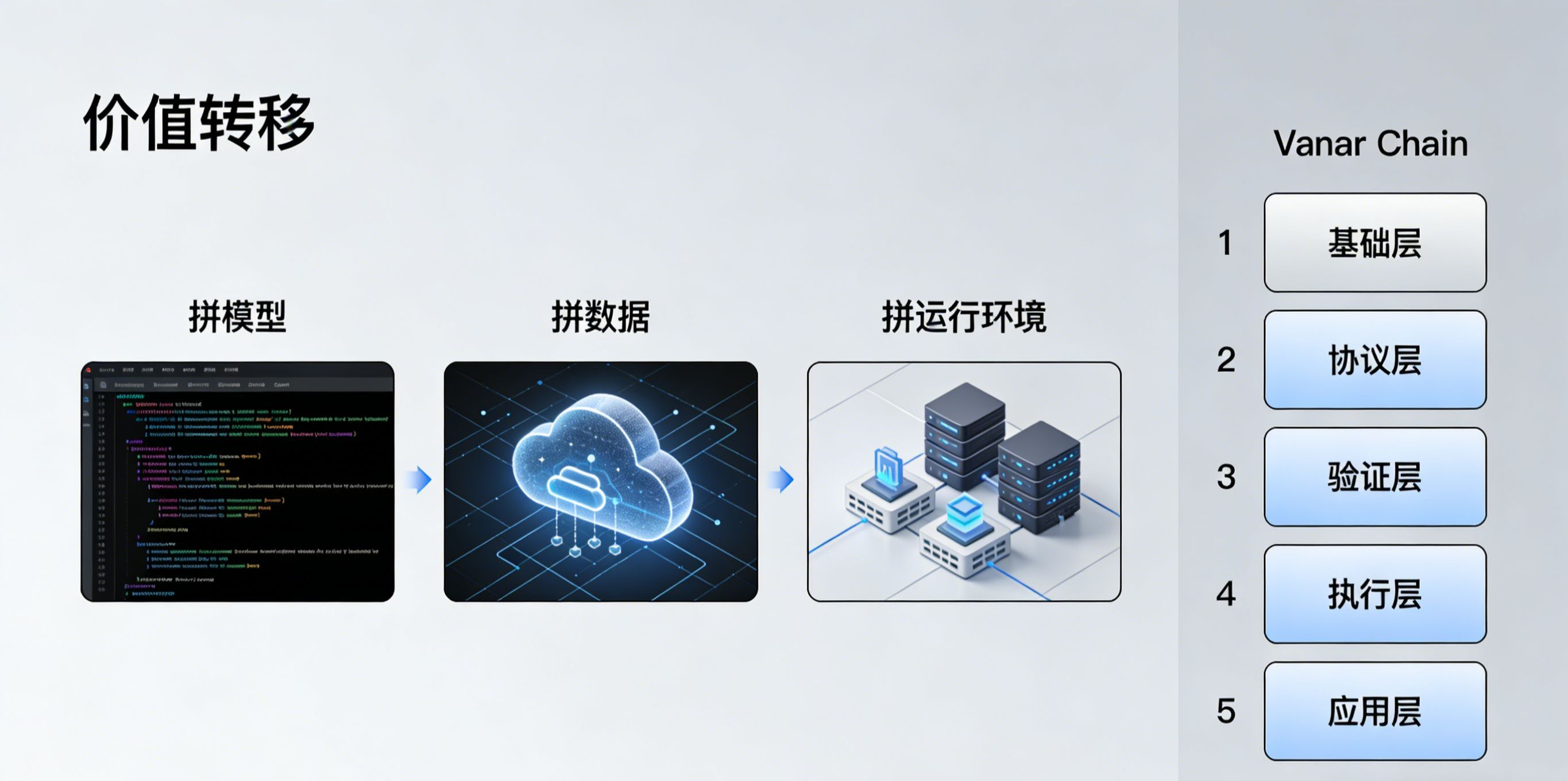
The narrative focus of the AI industry is undergoing a very quiet yet extremely critical shift.
From the early days of competing on model parameters and algorithmic intelligence, to the mid-stage arms race around data scale, when AI truly enters real business scenarios such as payments, finance, RWA, and automated execution, the core of the discussion has fundamentally changed:
👉 Can the system maintain stable collaboration in the long term?
👉 Can the status remain consistent and reproducible?
This is precisely the pivotal moment in the era that VANRY has accurately hit within the Vanar Chain.
🧠 Three stages, a shift in value focus
The evolution path of the AI industry is actually very clear:
Early stage: Competing model capabilities — Who is 'smarter'
Mid-stage: Competing data scale — Who has more 'fuel'
Current (AI-Native): Competing operating environment — Who can sustainably support complex systems
Models can iterate, data can accumulate,
But once the operating environment is unstable and the complexity of the system amplifies, state drift, execution forks, and collaboration failures will erupt in concentration ⚠️.
At this point, no matter how smart the AI is, it can only remain in the Demo stage.
📄 Where do most 'AI + blockchain' problems lie?
Currently, many projects are still essentially superficial integrations:
Blockchain is just a distributed ledger
After AI execution, the results are 'booked'
Belongs to a typical post-recording mode
This structure has almost no value for real-time business.
True AI-Native is not about 'chains recording results', but about:
🔁 The chain participates in the execution itself and can be verified
Vanar's path is precisely to complete this transformation from a structural level, which is also the underlying logic behind VANRY's 18.52% increase over 24 hours at the beginning of 2026.
⚙️ Vanar's approach: No show-off, just solving engineering problems
Compared to similar projects emphasizing extreme TPS and single-point performance,
Vanar's white paper is more like an engineering design document:
Is execution reproducible
Is cost predictable
Can the system run in the long term
Can developers integrate painlessly
There is only one core issue:
👉 Can it become the 'long-term core component' of AI systems?
And not a one-time integrated temporary add-on.
🧩 The three natural challenges of AI systems
Once AI enters real business, it will simultaneously face three types of complexity:
Multiple data sources → State synchronization is difficult
Long process chain → Execution stability requirements are extremely high
Cross-system collaboration → Requires verifiable trust anchors
Breaking it down, what is really needed is:
Unified confirmation point
Reproducible execution environment
Verifiable execution layer
🏗️ Vanar's 5-layer architecture is precisely targeting the problem
Vanar has not overturned everything and started over, but has deeply reconstructed the execution logic based on EVM:
🛠️ EVM compatible: AI teams do not need to start from scratch, low migration costs
🧬 Neutron semantic memory layer:
Original files → AI-readable Seeds
On-chain storage after compression
🔍 Kayon reasoning engine:
Direct on-chain query/verification
Does not rely on oracles
This step is crucial:
For the first time, blockchain is not just a ledger, but an execution component that participates in data processing and reasoning.
🔗 Fundamental changes in the role of blockchain
Traditional blockchain focuses on:
Transaction confirmation
Asset transfer
Vanar focuses on:
Trustworthy data storage
Semantic compression
Verifiable reasoning
Execution state consistency
When data can be continuously accessed, verified in real-time, and participate in subsequent processes,
Only then does blockchain truly embed into the 'central nervous system' of AI, rather than just being a peripheral recording tool.
🌐 The shift from 'fast' to 'stable' is inevitable
When the industry moves from Demo to production environment,
Stability always comes before extreme speed.
If execution is unstable once,
It could cause the entire AI workflow to collapse.
The path chosen by Vanar is not noisy, but extremely aligned with the evolution rhythm of real engineering systems:
Finding the long-term optimal solution between speed, cost, and compatibility.
🧱 My conclusion
The true threshold of AI-Native has never been in the model itself,
But in whether the underlying operating environment can keep up with the increasing complexity of business.
When the industry fully enters the 'system collaboration phase',
The value of infrastructure will be truly priced.
Vanar Chain is at this point in time.
And $VANRY

It carries not only token attributes,
But also bets on the infrastructure for 'stable execution' in the AI-Native era.
This is the core competitiveness that distinguishes it from conceptual projects.