Muon collider: the ambitions of science and technological limitations
What is a muon collider and why is it needed
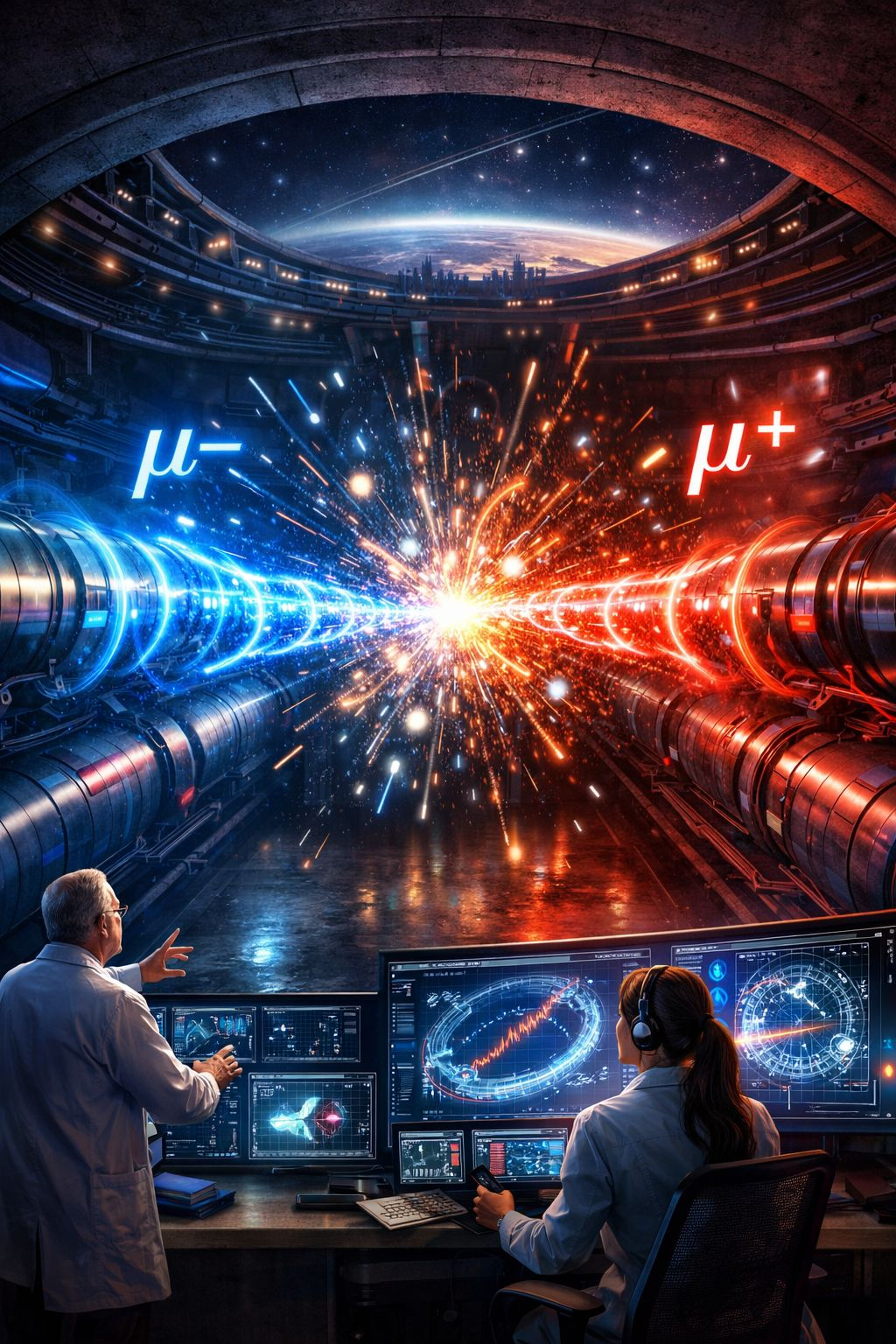
A muon collider is a concept for a particle accelerator in which counter-propagating beams of muons (μ⁺ and μ⁻) collide. Muons, like electrons, are elementary leptons, but they are about 200 times heavier than electrons. Because of this, they lose energy in the form of synchrotron radiation much less than electrons when moving in a circular accelerator, allowing for the construction of more compact rings with high collision energies.
This gives a potential advantage: at the same collider mass, muons could allow achieving significantly higher energies than electron-positron machines, and closer to energy scales only accessible to large hadron colliders.
The main motivation is to explore physics beyond the Standard Model: new particles, rare processes, and the expansion of the energy frontier of particle physics after LHC/HL-LHC.
Advantages of a muon collider
📌 1. High energy potential
Muons, being heavy leptons, lose significantly less energy in a circular accelerator due to synchrotron radiation compared to electrons. This means that a circular collider with collision energies of several tens of TeV can be built in a relatively compact tunnel.
CERN
📌 2. Combination of precision + discovery
Unlike protons, which are made up of quarks and gluons, muon collisions occur between fundamental particles, allowing for clean data across almost the entire energy range.
📌 3. More compact and energy-efficient configuration
It is assumed that the muon collider may have a shorter tunnel length and lower energy costs for operation than similarly powered projected proton designs.
📌 4. A new foundational tool for physics
It can serve as a comprehensive tool for both precise measurements (e.g., Higgs phenomena) and direct searches for new physics — akin to ideal "lepton collision machines on steroids."
Main problems and challenges
⚠️ 1. Short lifespan of muons
Muons decay extremely quickly: their average lifetime is ≈2.2 microseconds at rest, and even accounting for relativistic time dilation, this does not provide much time for capture, cooling, acceleration, and collisions — all of which need to be done at speeds close to the speed of light.
⚠️ 2. Production and cooling of beams
To obtain high-quality intense muon beams, it is necessary to solve the problem of so-called ionization cooling — rapid and effective "cooling" of the beam to reduce its spread. Despite progress, this remains one of the key technological puzzles.
American Physical Society
⚠️ 3. Background induced by decays (BIB)
Due to the decay of muons in flight, most products of these decays create a hard background around the collision zone, complicating detector operation and requiring new technologies to filter signal from noise.
Science Simple + 1
⚠️ 4. Challenges of magnets and materials
To control beams at high energies, superconducting magnets with high fields and large apertures are needed. R&D of these systems goes beyond the current level of technology and requires years of investment.
0Publishing
⚠️ 5. Huge costs and long implementation time
Although exact estimates are not yet ready, the project is likely to cost billions of dollars/euros, and implementation may take decades — making it a risky bet, especially in the absence of guaranteed discoveries of new physics.
Global efforts and prospects
International collaborations (IMCC) are working on evaluating concepts, including accelerators, cooling systems, detectors, and optimization schemes.
Projects such as experimental demonstrations of cooling systems and acceleration technologies are planned for the 2030s.
Interest in muon accelerator technologies is growing in China and other countries, reflected in national conferences and scientific discussions.
Conclusion
A muon collider is one of the most ambitious conceptual projects in accelerator physics. It combines a unique potential for exploring fundamental laws of nature with exceptional technological challenges. Implementation will require not only years of research and development but also significant financial investments, with no guarantee of scientific results.
Such a project is a bet on the long-term future of fundamental physics: an attempt to answer questions that ordinary accelerators can no longer solve, but only through decades of effort and international cooperation.