
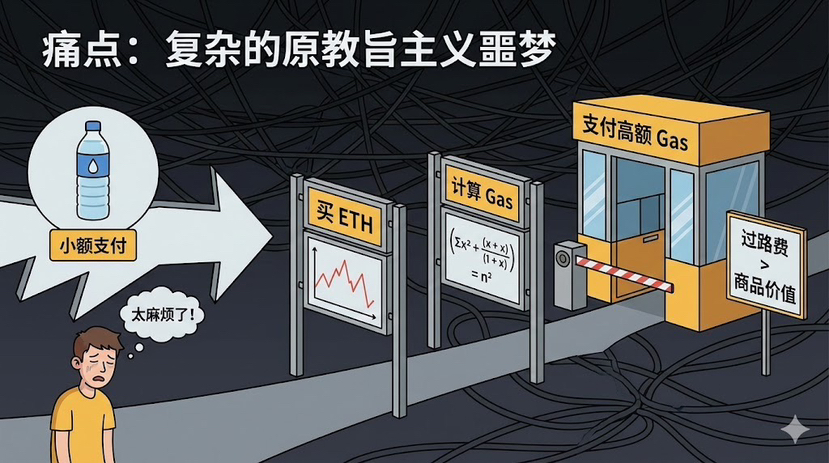
Have you ever experienced this kind of despair? You want to transfer 50 dollars worth of USDT to a friend, only to find out that the gas fee on the Ethereum network is a staggering 30 dollars! It feels like wanting to buy a bottle of water at the corner store, only to be told you first have to pay a 'toll fee' of 100 bucks, which is simply absurd.
This huge friction is the fundamental reason why Web3 has yet to be widely adopted. Plasma is trying to solve this problem in an extremely clever way.
🔴 Pain point: The 'toll fee' that eats people
Gas fees were originally designed to prevent network congestion, but have now become the biggest nightmare for regular users. They are not only expensive, but the prices fluctuate, and you never know how much you will spend in the next second. To make matters worse, you also have to buy native tokens (like ETH) to pay this fee. This whole process is enough to deter 99% of outsiders.
🟡 Magic: Plasma's 'Universal Gas Account'
The solution of Plasma is nothing short of genius. It has created a 'Universal Gas Account'. You can think of it as a 'transport prepaid card'. You no longer need to buy a ticket for each trip (transaction) separately; instead, you can preload a little money onto the card, and then all trips will be 'free'. The system will take care of everything in the background, and you just need to enjoy the smooth experience of 'swiping the card and going'. You can even completely avoid holding the native token K of Plasma, XPL, and pay directly with stablecoins.
🟢 Inspiration: Returning to the original intent of 'electronic cash'
When Satoshi Nakamoto created Bitcoin, he wanted it to be 'peer-to-peer electronic cash'. The core characteristic of 'cash' is the absence of transaction friction. Plasma's zero Gas model brings us infinitely closer to this dream for the first time. When transfers no longer have costs and thresholds, micro-payments, cross-border remittances, creator rewards... countless scenarios we once imagined truly have a foundation for realization.

Inspiration for ordinary people:
'Zero fees' is a very powerful signal; it indicates whether a project is truly serving 'users' rather than 'speculators'. When examining a new project, it is worth asking: what actual problem does it solve? Does it make things simpler or more complex? If a project can leave the complex backend to itself and provide a minimalist experience for the user, it deserves a closer look. Of course, it is also important to consider whether this model is sustainable and how the project covers costs.

