

@Walrus 🦭/acc Web3 has spent years using the word decentralized as a stand-in for readiness. If something is distributed enough, permissionless enough, or cryptographically elegant enough, it is assumed to be prepared for the future. In practice, decentralization often masks a lack of preparation. Systems work as long as conditions are favorable, and struggle the moment reality becomes ordinary instead of exciting. This is the lens where Walrus begins to feel less like a storage protocol and more like an admission that decentralization alone is not a plan.
Most decentralized storage systems are designed to survive attacks, spikes, or dramatic failures. Far fewer are designed to survive normal life. Hardware ages. Operators lose interest. Costs stop being subsidized by growth. Data stops being actively used but remains important. These are not edge cases; they are the default state of long-lived infrastructure. Walrus seems to start from this assumption. It doesn’t treat resilience as something that emerges from scale alone. It treats it as something that must be engineered into everyday behavior.
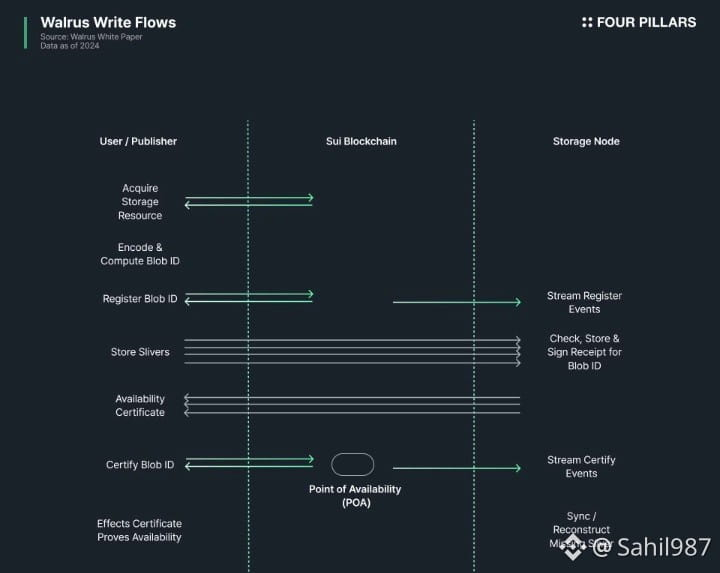
At the core of Walrus is a design that accepts impermanence without surrendering durability. Data is stored as blobs, fragmented using erasure coding, and distributed across a decentralized network so no single participant carries the full burden. Only a subset of fragments is required for reconstruction, which allows the system to tolerate churn without panic. This isn’t about pretending nodes won’t fail. It’s about assuming they will, and ensuring failure looks boring rather than catastrophic.
What’s quietly different is how Walrus treats time as a constraint rather than a footnote. Storage isn’t framed as a one-time action followed by assumed immortality. Writing data begins a relationship with ongoing cost and responsibility. Storage and write payments are aligned with duration, rewarding operators who remain reliable long after early incentives lose their shine. Users are nudged to think about whether data is worth keeping, not just whether it can be stored. This introduces friction, but it’s the kind of friction that prevents neglect.
The WAL token supports this preparation-first mindset without becoming a distraction. Instead of amplifying speculation, it coordinates staking, governance, and long-term alignment. Governance here is not about dramatic change; it’s about upkeep. Adjusting incentives. Preserving balance. Making sure the system continues to behave sensibly as conditions evolve. That kind of governance doesn’t trend, but it’s what separates infrastructure from experiments.
From experience, this feels like a response to a pattern Web3 keeps repeating. Systems launch with strong assumptions about participation and growth, only to discover that maintenance is harder than innovation. Storage networks feel this especially sharply, because their value compounds silently while their costs remain constant. Walrus appears to accept this asymmetry rather than trying to outrun it. It prepares for the long middle stretch where nothing breaks, but everything still needs attention.
There are still uncertainties. Operator participation must remain healthy without constant excitement. Governance must stay active without drifting toward centralization or apathy. Costs must remain understandable as data ages. Preparation doesn’t eliminate risk; it reshapes it into something manageable. Walrus doesn’t promise ideal conditions. It assumes ordinary ones.
What makes Walrus feel different isn’t that it claims to solve decentralized storage forever. It’s that it seems comfortable planning for a future where decentralization is not a novelty, but an expectation. A future where systems are judged less by how bold they are and more by how they behave when nobody is impressed.
If Walrus succeeds, it won’t be because it redefined decentralization. It will be because it treated decentralization as the starting point, not the finish line. In an ecosystem still learning that being distributed doesn’t mean being prepared, that may be the most quietly important distinction of all.