
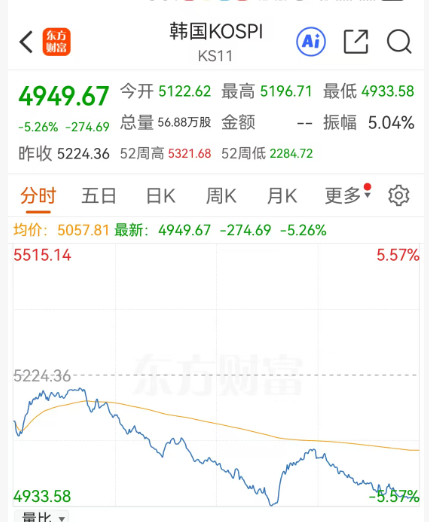
Asia-Pacific 'epicenter': The South Korean Composite Index (KOSPI) plummeted over 5.2%, triggering the Sidecar mechanism in an emergency during the session.
Hong Kong stocks lost ground: The Hang Seng Index closed down over 2%, and the Hang Seng Technology Index suffered a heavy decline. Although the market turnover was high, it consisted entirely of panic selling.
Precious metals 'tragedy': The once king of safe havens has collapsed. Spot gold fell nearly 10% during the session, while silver even plunged over 14%, with the global market value of gold and silver shrinking by over $3 trillion.
Cryptocurrency crisis: Bitcoin has fallen below the $80,000 mark, over 160,000 people have been liquidated, and the so-called 'safe-haven property' appears weak in the face of a liquidity tsunami.
When the doors of traditional finance are forcibly closed due to 'excessive volatility' (Sidecar), where should we look for a land of never-closing markets and zero-cost liquidity?
Since traditional assets are collectively settled, the #Plasma (XPL) based on stablecoin payments may be the overlooked 'ultimate exit.' Many people discuss Plasma, easily simplifying it to 'another execution chain,' but if one only sees the performance aspect, they may miss its true core. Plasma is more like answering a fundamental question: how should on-chain assets be used efficiently and sustainably under high security conditions.
The starting point of the project's design is not the frequency of transactions, but the state management of the assets themselves. Plasma decouples the asset settlement logic from the execution environment, allowing assets to participate in the system's operation in a form close to native, rather than relying on complex contracts wrapped layer upon layer. This structure reduces the coupling between protocols and minimizes the chain risks caused by settlement failures in extreme market conditions.
In the security model, Plasma emphasizes 'verifiable asset ownership' and 'deterministic settlement paths.' The ownership, liabilities, and settlement order of assets are explicitly expressed at the protocol layer, rather than being left to external coordination or human intervention. This is a prerequisite for any system attempting to handle large-scale funds, rather than a bonus.
Liquidity design also reflects the core orientation of Plasma. It does not pursue increasing capital efficiency through aggressive parameters but prioritizes ensuring the predictability of liquidity in different states. Whether in normal transactions or stress test scenarios, the system tries to avoid structural risks that appear 'safe' but are actually fragile.
The positioning of tokens within the Plasma system is relatively restrained. It primarily serves the functions of network security, settlement incentives, and system coordination, directly linked to asset operations, rather than existing as an external narrative. This design means that the value of tokens comes more from the actual usage intensity of the protocol, rather than short-term expectations.
Overall, Plasma does not attempt to tell a grand story but is reconstructing the basic order of on-chain asset operations. This direction may not be very lively, but it is foundational enough and difficult to replace.