

Most conversations about Web3 infrastructure still start from the same place: performance. How fast can a chain execute? How cheap are transactions? How much throughput can it theoretically handle if everything goes right? These questions are easy to measure and easy to market. They also miss the point where most real applications quietly fail.
Applications don’t usually break because they can’t process one more transaction. They break because the data they depend on stops behaving like something you can rely on. Images disappear. Game assets fail to load. Historical records become incomplete. AI datasets drift, decay, or quietly move back to centralized servers because that’s the only place teams feel safe keeping them.
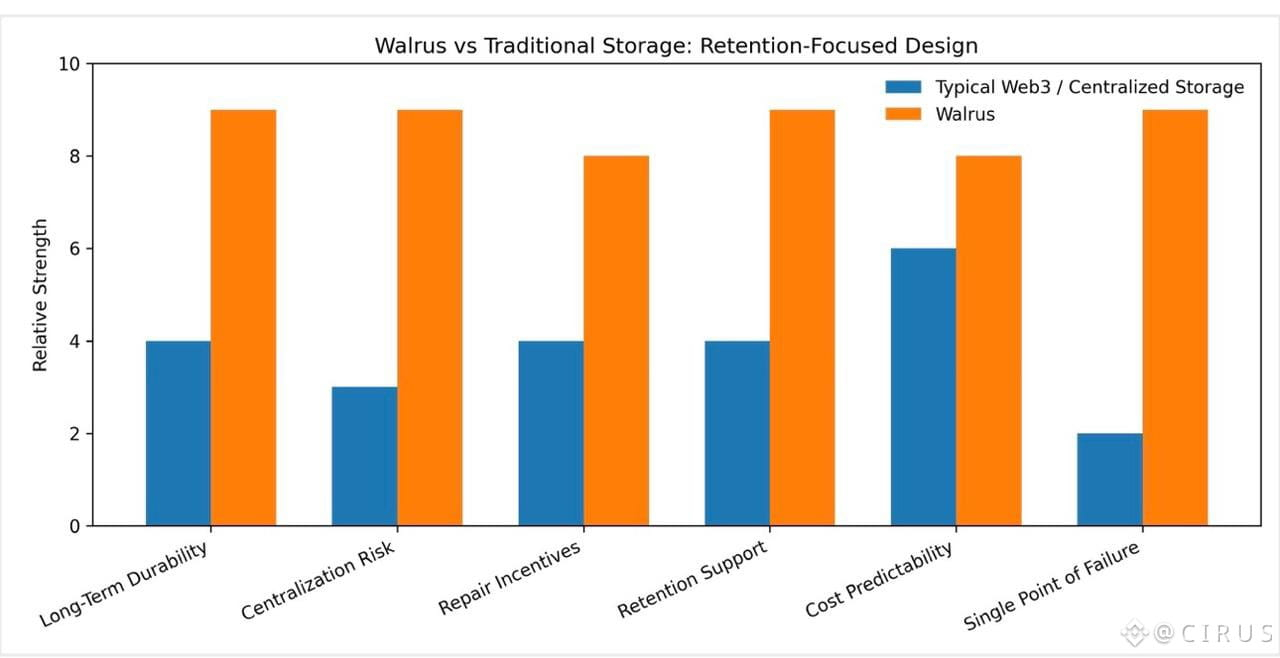
That is the retention problem. And it’s the real context in which Walrus makes sense.
Walrus is not interesting because it is “another storage layer.” It is interesting because it is designed around the phase of an application’s life that most systems ignore: the months and years after launch, when usage becomes routine, attention fades, and reliability matters more than novelty.
Retention Is the Constraint Nobody Markets
When a new app launches, teams optimize for speed and cost because that’s what early users notice. During this phase, centralization often looks like a reasonable shortcut. Assets go on a traditional server. Images get pinned through third-party services. Large files are cached offchain to keep costs down. Everything works well enough to ship.
The problem shows up later. A provider changes pricing. A service deprecates a feature. A link breaks. Suddenly, the app is still technically “onchain,” but the experience collapses. Users don’t frame this as an infrastructure failure. They experience it as unreliability. They stop trusting the product and quietly leave.
Walrus is built specifically around preventing that outcome.
Storage as an Economic System, Not a Side Effect
One of the most important design decisions behind Walrus is the separation of execution and storage. Instead of forcing large data directly onto a blockchain—where costs explode and scalability disappears—Walrus treats data as blobs that can live offchain while remaining cryptographically accountable.
This is not a compromise. It’s an acknowledgment that execution and storage have fundamentally different constraints and should be optimized differently.
Execution wants speed and determinism. Storage wants durability and redundancy. Mixing the two usually results in systems that are expensive, fragile, or both.
Walrus allows blockchains to remain lean coordination layers while storage becomes its own economic domain.
Why Erasure Coding Changes the Incentives
The technical backbone of Walrus is erasure coding. Data is split into fragments, distributed across many operators, and structured so that only a subset of those fragments is required to recover the original file.
The important part here isn’t the math. It’s the behavior this structure enforces.
No single operator holds the full file. No single failure destroys availability. Data resilience emerges by design, not by trust in any one party. This directly addresses one of the biggest weaknesses of both centralized storage and naïve decentralized alternatives: hidden single points of failure.
Because recovery does not require perfect participation, the system remains usable even when parts of it degrade. That is what real durability looks like.
How Durable Storage Changes Developer Behavior
Fragile storage shapes how developers think. When data feels unreliable, teams minimize reliance on it. They avoid long-lived state. They design experiences that can tolerate loss or re-fetching. This limits what applications can become.
Durable storage changes that calculus.
With Walrus, teams can design around persistence rather than fear. Instead of asking “what can we afford to store?”, they can ask “what needs to persist for this app to remain usable?” That shift unlocks richer experiences: evolving game worlds, long-lived AI models, historical governance records, and applications that don’t need to rebuild state every time something goes wrong.
This is not an abstract benefit. It directly affects retention. Apps that behave consistently over time feel trustworthy. Apps that require constant rebuilding feel temporary.
WAL and the Cost of Keeping Data Alive
The role of the WAL token only makes sense in this long-term frame.
WAL is not designed to extract value from speculation alone. It coordinates incentives between storage operators and users who need data to remain accessible over extended periods. Operators are rewarded not just for holding fragments, but for participating in repairs and maintaining availability as conditions change.
This matters because storage systems don’t fail loudly. They degrade quietly.
Many decentralized storage networks look robust in their early months because nothing has aged yet. Data is fresh. Attention is high. Incentives are exciting. The real test begins later, when the same data must still be retrievable, repair cycles continue, and the market has moved on to something else.
If incentives weaken at that stage, storage doesn’t crash. It frays.
Walrus is explicitly built to surface that pressure. Long-lived blobs don’t disappear. Repair eligibility keeps firing. Operators must remain engaged not because something is broken, but because nothing is allowed to break. Durability stops being a promise and becomes an operational responsibility.
Why “Boring” Is the Signal
From the outside, a functioning storage network looks unremarkable. There are no dramatic spikes in activity when things work as intended. Retrieval happens. Proofs pass. Data loads.
That lack of drama is the point.
Infrastructure that only looks impressive during stress is not infrastructure. Infrastructure that fades into the background during normal operation is.
Walrus is betting that the most valuable signal is not excitement, but consistency. If data loads reliably months after upload, users stop thinking about storage entirely. That’s when retention compounds.
The Importance of Sui as a Coordination Layer
Walrus is built on Sui, and that choice reinforces its philosophy.
Sui’s object-centric model allows Walrus to coordinate storage commitments, proofs, and incentives without bloating the base layer. The chain acts as a verification and coordination surface, not a dumping ground for data. This keeps costs predictable and performance stable even as storage demand grows.
In practice, this means applications can scale their data footprint without dragging execution performance down with it. That separation is critical for long-lived systems.
Competing With Expectations, Not Chains
Walrus is not really competing with other blockchains. It’s competing with cloud expectations.
Centralized cloud storage works because it is predictable. Files are there when you need them. Links don’t randomly disappear. For decentralized storage to matter, it has to match or exceed that baseline. Ideology alone is not enough.
Walrus starts from the assumption that users will not tolerate fragility in exchange for decentralization. Decentralization only matters if it comes with reliability.
This is why the real evaluation of Walrus will not come from launch metrics or early hype. It will come from behavior over time. Do applications continue paying for storage once incentives normalize? Do operators remain engaged when rewards feel routine rather than exciting? Does retrieval remain reliable under sustained, boring load?
If the answers are yes, WAL stops being “just a token” and starts representing something concrete: the ongoing cost of making decentralized data behave like dependable infrastructure.
The Quiet Compounding Effect
Most Web3 narratives are front-loaded. Value is promised early and justified later. Walrus flips that dynamic. Value accrues slowly as data ages without disappearing.
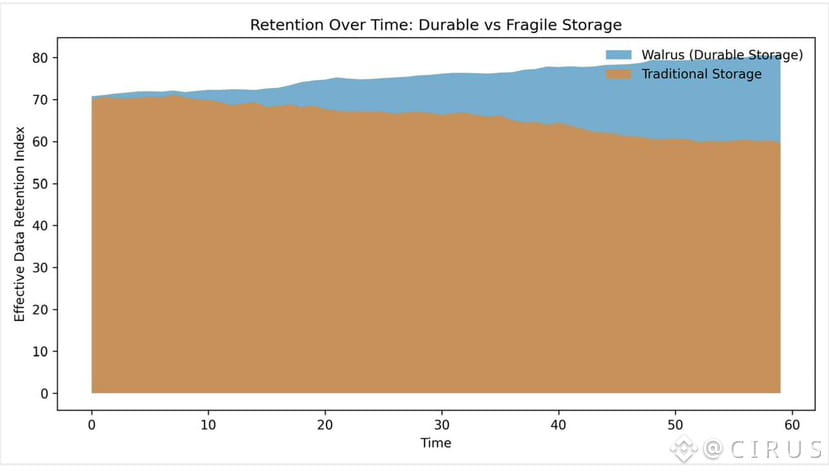
Retention compounds quietly. Each month of reliable storage increases trust. Each year of uninterrupted availability makes migration less attractive. Over time, the system becomes harder to replace not because it is flashy, but because it works.
That is a very different growth curve from speculative infrastructure. It is slower. It is less visible. It is also far more defensible.
Closing Thought
Walrus is built for the part of Web3 that rarely gets attention: the long middle of an application’s life, after launch excitement fades but before anyone is ready to rebuild everything from scratch.
By treating storage as an economic system, aligning incentives around long-lived data, and designing for repair rather than perfection, Walrus is addressing the real constraint that decides whether decentralized applications endure.
Not throughput.
Not composability.
Retention.
If Walrus succeeds, it won’t be because people talk about it more. It will be because data uploaded today is still there tomorrow, next year, and long after nobody remembers the launch.
That is what infrastructure is supposed to do.

