
Introduction: The Problem with Today's AI
Today's artificial intelligence often feels like magic, but it operates inside a "black box." As OpenGradient's founders note, "existing AI is a black box that lacks transparency and traps user data within closed platforms."
Imagine interacting with a magical chef. They can cook incredible meals on demand, but they refuse to share their recipes, and every time you visit, they forget your food allergies. You have to start from scratch with every single order. This is how most AI works today, creating two major problems for users:
Lack of Memory: Conversations with AI are fragmented and lack continuity. Each chat is a fresh start, forcing you to constantly repeat yourself and provide the same context over and over again.
Lack of Ownership: The data from your interactions—your preferences, questions, and personal details—isn't owned by you. It's controlled by the large corporations that own the platform, locking you into their ecosystem.
To solve these problems, OpenGradient isn't just offering a new product; it's building an entirely new, user-owned foundation for artificial intelligence.
1. The OpenGradient Solution: A New Foundation for AI
At the heart of the project is a simple but powerful idea, captured in the OpenGradient Manifesto: "The Future of AI is User-Owned." OpenGradient is building a new, decentralized foundation—The Layer 1 for Open Intelligence—to make AI more transparent, secure, and personal for everyone.
This vision has earned significant backing from industry leaders, securing $8.5 million in seed funding from heavyweights including Balaji Srinivasan (former CTO of Coinbase), Illia Polosukhin (co-inventor of the Transformer AI architecture and co-founder of NEAR), and Sandeep Nailwal (CEO of Polygon).
To achieve its mission, OpenGradient is creating a vertically-integrated platform built on a Layer 1 (L1) Network. Think of an L1 network like the fundamental road system of a city. But instead of cars, it's designed for AI traffic, ensuring every "toolcall, model inference, and API request" is open and verifiable, just like tracking a package on a public ledger.
The OpenGradient vision is built on three main goals:
User-Owned Data: "Individuals should control their AI interactions, with the ability to own their context across different platforms."
Verifiable and Secure: The network is designed for "enabling every AI agent toolcall, model inference, API request to be secure and verifiable on a decentralized ledger."
Open and Transparent: It moves AI away from the closed "black-box" model to create an open ecosystem where developers and users can build and interact with trust.
This new foundation is made possible by a few core technologies designed to give power back to the user.
2. The Core Technologies: How OpenGradient Works
OpenGradient uses several key innovations to bring its vision of user-owned AI to life.
2.1 MemSync: Giving AI a Perfect, Private Memory
MemSync is OpenGradient's direct solution to AI's memory problem. Its purpose is to transform your digital footprint into an AI-friendly memory database.
Think of MemSync as a secure, private diary that you give to your AI. This diary can be carried across different applications and helps the AI remember two key things about you:
Semantic Memory: Who you are, your interests, and your general preferences.
Episodic Memory: What you’ve done and the details of your past conversations.
The primary benefit for you is simple: you no longer have to re-explain yourself. With MemSync, your AI can finally "remember, learn, and grow alongside" you in a way that is completely secure and private.
2.2 BitQuant: A Personal Financial Genius for Crypto
BitQuant is a powerful, practical application built on the OpenGradient network. It is an "AI agent framework for quantitative DeFi analysis" that you can communicate with using simple, "natural language." As Subnet 15 on the Bittensor network, BitQuant serves as a real-world demonstration of OpenGradient's technology powering a decentralized network for financial intelligence.
Imagine having a super-smart financial analyst on-call, 24/7. You can ask this analyst complex questions about the crypto market, and it will instantly process vast amounts of data to give you clear, actionable insights in plain English. That's BitQuant.
Here are a few examples of questions you could ask:
"Analyze the price trend and calculate the max drawdown for SOL over the last 90 days."
"Evaluate my wallet’s portfolio volatility and identify the riskiest token holding."
"Search for trending tokens across various chains and display their top holders."
An agent like BitQuant becomes even more powerful when combined with MemSync, which would allow it to remember your specific portfolio, risk tolerance, and past queries across sessions for truly personalized analysis.
2.3 Decentralized Network: AI Run by the People, for the People
The term "decentralized" means that the network isn't owned or operated by a single company. Think of the difference between a single TV network that controls all of its shows versus the internet itself, where millions of people contribute to a global community.
OpenGradient's network operates on a similar community-run principle, with key roles for participants:
Miners: These are computers on the network that process user requests and run the AI analysis.
Validators: These participants check the work done by the Miners, ensuring all AI-generated responses are accurate and honest.
This structure keeps the network reliable and trustworthy without needing a central boss. The key benefit is that it fosters a "robust ecosystem for decentralized, AI-powered financial intelligence" that is transparent and serves the community, not a single corporate entity.
3. Why This Matters: The Future of Your Digital Life
OpenGradient is architecting more than just new technology; it's engineering a fundamental shift in power from large corporations back to you, the individual. This new model fundamentally changes your relationship with AI and your digital identity.
The table below shows a clear comparison between the old way and the future OpenGradient is building.
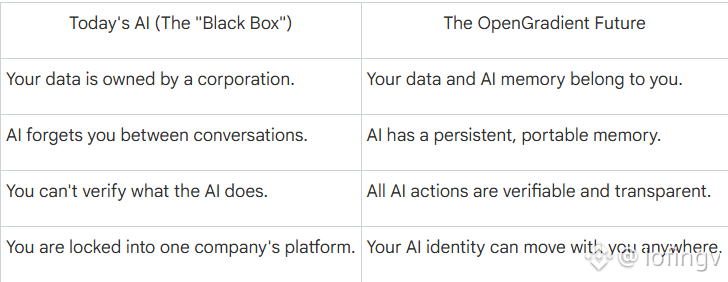
This isn't just a technical upgrade; it’s a vision for what it feels like to have a true digital partner. Imagine an AI that doesn't just answer your questions but understands your context, anticipates your needs, and learns from your unique perspective—acting as a trusted, private extension of your own mind.
This vision is best summarized by a powerful statement from the OpenGradient Manifesto:
"We don’t want to “opt out” of modern AI. We want to opt in — on our terms. With memory. With trust. With ownership."
4. Conclusion: An AI That Works for You
We are at the dawn of a new era for artificial intelligence. For too long, the promise of AI has been filtered through closed, corporate-controlled systems where users are the product. OpenGradient is building a different future.
By creating an end-to-end decentralized platform where models and data belong to the user, OpenGradient is ensuring that AI remains "always in service of human agency and autonomy." This is more than a technological revolution; it is the beginning of a movement to reclaim our digital lives, empowering every individual with an AI that works for them, remembers for them, and grows with them—on their terms.