
I have always believed that an AI system, no matter how advanced the technology, if locked in a small dark room (a single, isolated blockchain), its value would be zero. The core of AI is to process vast amounts of data and translate it into action, and this data, users, and money are concentrated in a few of the most active ecosystems.
Vanar has understood this point very early on. So it did not choose to bury itself in building an ecosystem, but made an extremely smart decision: to collaborate deeply with Coinbase's Base chain. This move directly transformed it from a 'potential stock' into a 'strong player'.
🔴 Why can't AI be an island?
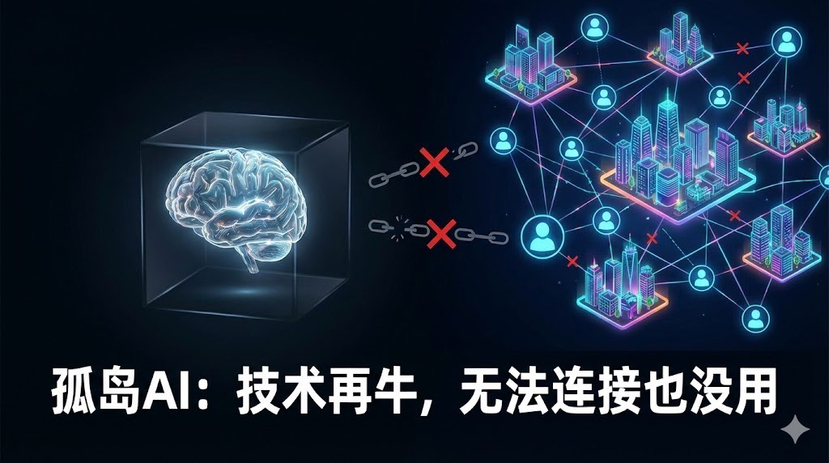
- An AI that can only read its own chain data is like a genius who can only understand the local dialect in the village; once out of the village, it becomes 'illiterate'. It cannot manage your assets on other chains, nor can it utilize data from the entire network to make decisions.
- For AI Agents, an isolated environment is fatal. They need to move freely in a vast world, calling assets and executing tasks to maximize their value.
🟡 'Smart Brain' + 'Traffic Heart' = ?
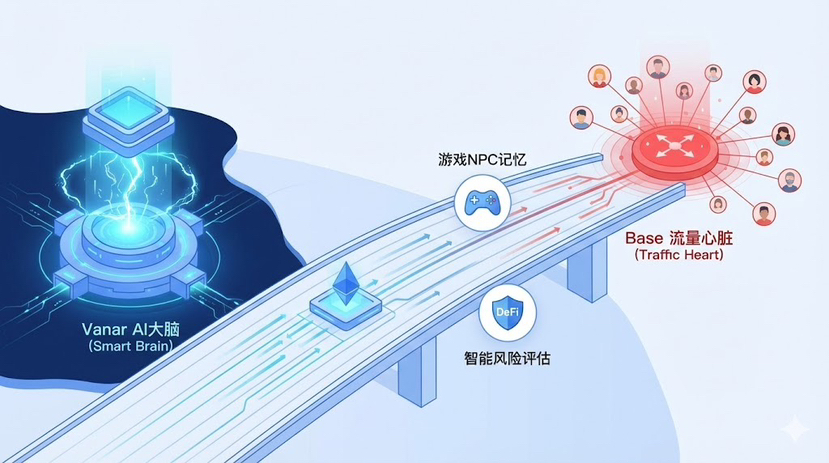
The cooperation between Vanar and Base is not just a simple asset cross-chain, but an extension of 'capabilities'.
1. What did Vanar gain? It directly gained access to millions of users behind Base and a seamless fiat deposit and withdrawal channel. Its AI capabilities finally have a place to be utilized.
2. What did Base gain? Developers in the Base ecosystem can now easily give their applications 'memory' and 'thinking' abilities just like calling a plugin. For example:
- A game on Base that can call Vanar's AI to give NPCs a lasting memory.
- A DeFi protocol on Base that can call Vanar's AI for smarter risk assessment.
3. The role of $VANRY has changed: It is no longer just the 'gas fee' of the Vanar chain, but has become the 'universal energy' for the entire cross-chain AI infrastructure. Any application on any chain that wants to call Vanar's AI services will need to use it.
🟢 Insights/Risk reminders that ordinary people can obtain
- Insight: To judge how big a project's landscape is, don't look at what it says about itself, but look at who it is collaborating with and whether it aims to solve an industry-wide problem. Projects that understand 'leveraging' and 'altruism' often go further.
- Risk: The announcement of cooperation is just the first step; the real challenge lies in implementation. Are developers on Base really willing to use it? Is the integration experience smooth? These all need time to verify.
- From a learning perspective: We can pay attention to the subsequent progress of this cooperation. Let's see if there are any benchmark cooperative projects that emerge. A successful cross-ecosystem cooperation case is far more valuable than ten fancy white papers.
\u003cc-35/\u003e\u003ct-36/\u003e\u003cm-37/\u003e\u003ct-38/\u003e