

@Dusk Builder growth on Dusk never really looks like the classic “ecosystem explosion.” It looks quieter than that, and more deliberate, which is exactly why it matters. If you’ve spent time around regulated finance, you learn that the most important systems rarely arrive with fireworks.They bring forms, checks, and long quiet stretches where nothing big happens—by design. That’s the kind of environment Dusk has been aiming for since mainnet went live and the first immutable block was made on January 7, 2025.The interesting question isn’t whether Dusk can attract developers. The interesting question is what kind of developers it attracts when the chain’s identity is tied to consequences. In most ecosystems, a hackathon is a weekend of optimism and demos. On Dusk, the energy is different. A builder isn’t just trying to ship something that “works.” They’re trying to ship something that won’t embarrass a user in a moment of stress, won’t leak sensitive information through a lazy assumption, and won’t collapse into excuses the first time reality shows up messy and contradictory. That changes what people build, and it changes how they build it.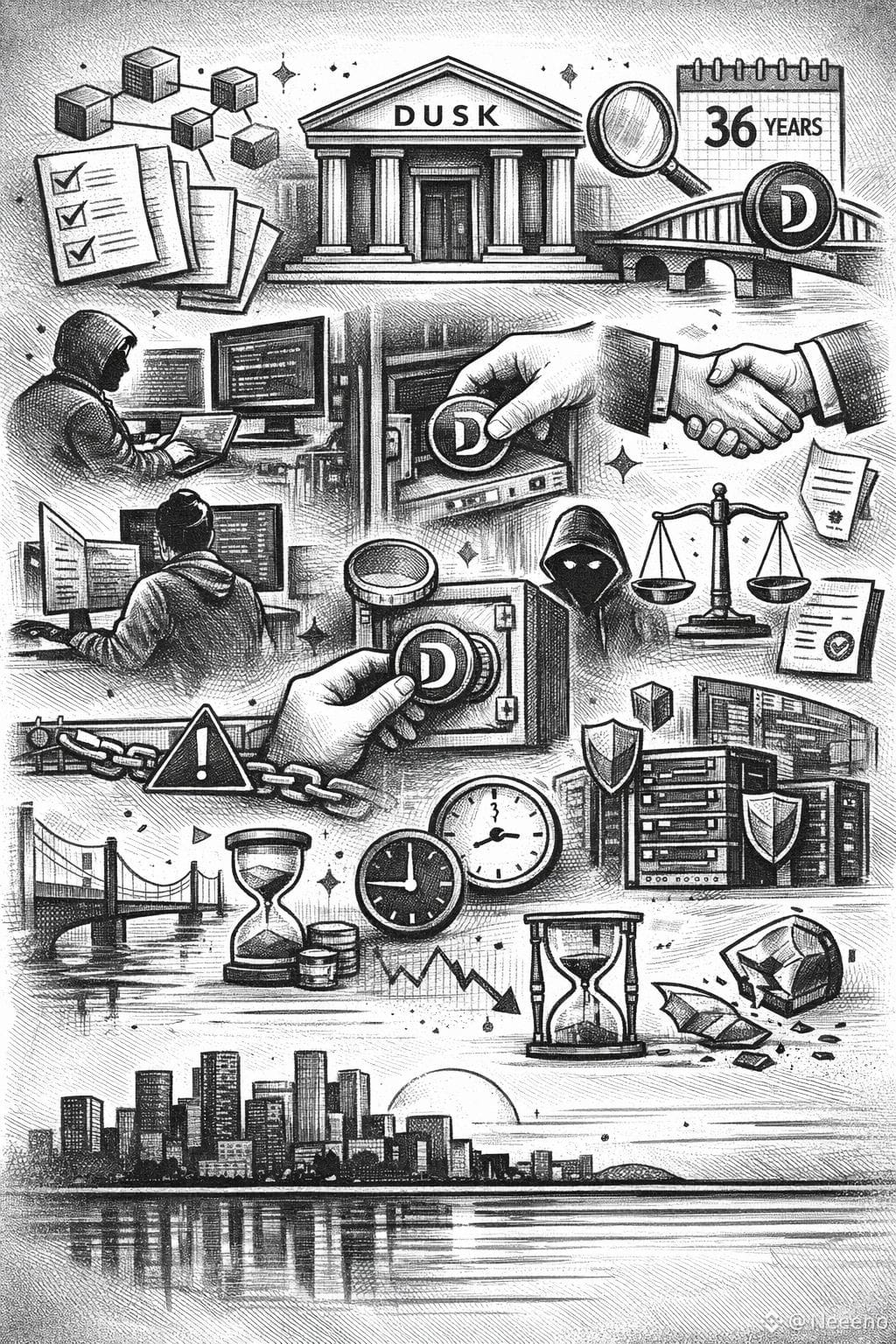
This is why grants matter more here than people casually admit. Dusk’s own grants documentation frames the program around funding work that strengthens Dusk as financial market infrastructure, explicitly pointing toward real-world asset workflows like clearance and settlement rather than “apps for apps’ sake.” That framing acts like a filter. It tells builders, in plain terms, that the chain is not rewarding attention. It is rewarding responsibility—responsibility that usually feels invisible until the day something goes wrong.
A grant, in practice, is not only money. It is permission to slow down. It’s time you can spend writing the boring parts: monitoring, failure handling, better defaults, clearer transaction flows, and user experiences that don’t punish people for not being protocol experts. The irony is that these are the parts users feel most intensely. Nobody remembers a flashy interface when markets are calm. People remember the moment they tried to do something important—move value, prove eligibility, settle a trade—and the system either carried them calmly or made them feel small and unsafe. Dusk’s grant posture nudges builders toward the calm path, and that’s rare.
There’s also a deeper economic truth underneath the builder story: Dusk is structured to keep builders and network participants honest over long time horizons, not just during launch cycles.The documentation explains it like this: 500 million DUSK exist at launch, and another 500 million can be minted gradually over 36 years for staking rewards, capped at 1 billion total. That “slow drip” supply changes the emotional tone of the network.It means the network is explicitly budgeting for security and participation across decades, not months. And when builders know the chain is thinking in decades, it becomes harder to justify building something disposable.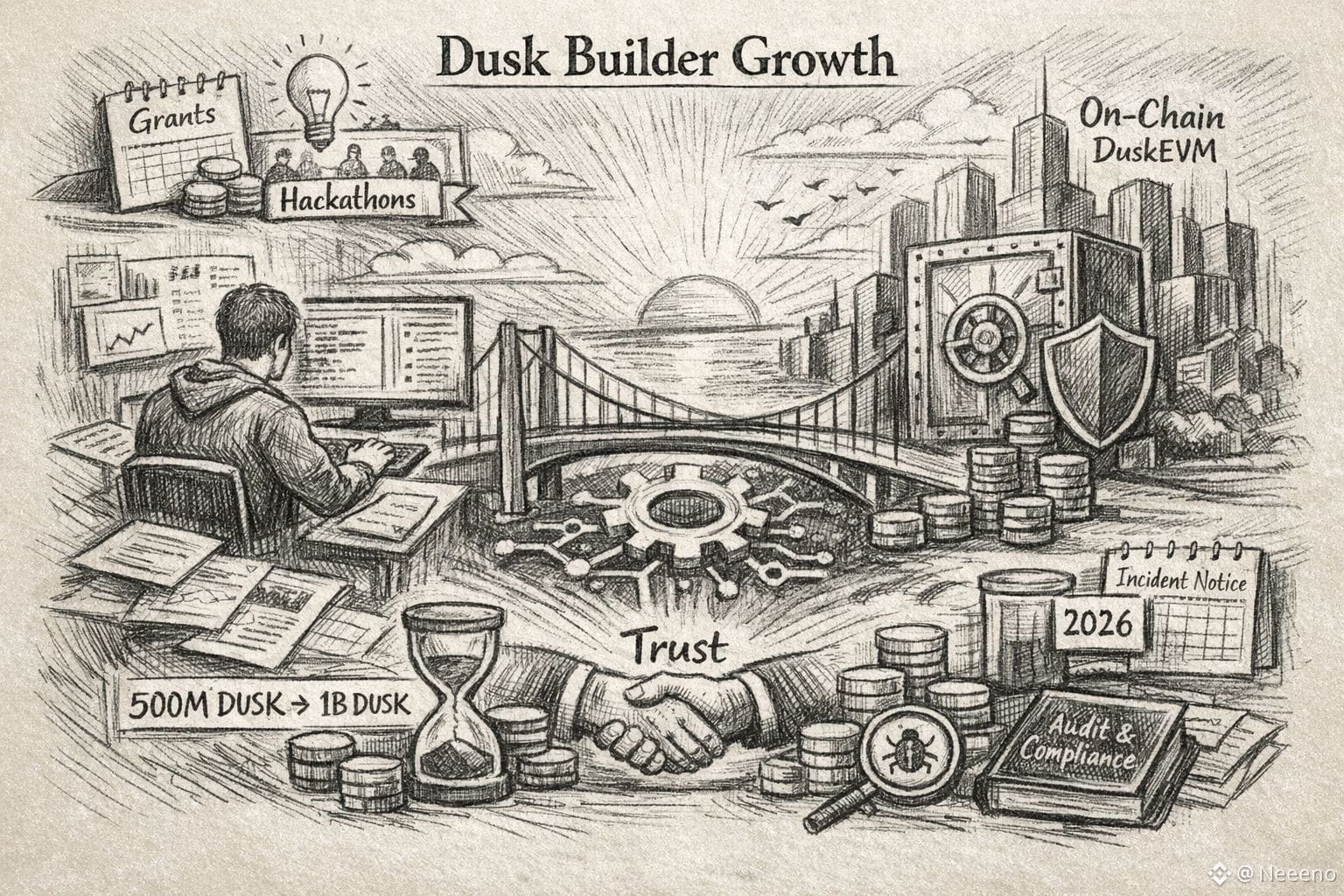
That token design also intersects with builder growth in a practical way: grants and hackathons are not happening on a chain with a “maybe” future; they’re happening on a chain with a clear token incentive loop and a live network that expects validators and stakers to keep showing up. The documentation also notes that DUSK has existed as ERC-20/BEP-20 representations and can be migrated to native DUSK now that mainnet is live.That kind of migration reality is where builder trust is either earned or lost. Because the moment you ask users to bridge value from one representation to another, you are asking them to trust your operational discipline, not just your code
And here is where “builder growth” becomes more than a developer relations slogan. Dusk has already had to communicate like an infrastructure operator under scrutiny. In mid-January 2026, the team shared an incident update saying they paused bridge services as a safety step while they strengthened things. They also said the mainnet wasn’t affected and kept running normally. Being that open does two things: it also pushes away builders who only want a perfect, trouble-free story.And it attracts builders who understand that the real job is building systems that can admit imperfect moments without becoming fragile.
If you’re a builder deciding whether to commit your time, those details matter more than marketing. Because you are not really betting on throughput claims. You are betting on operational culture. You’re betting that when something feels off at 3 a.m., the chain won’t pretend everything is fine until it’s too late. You’re betting that the people running the infrastructure will choose boring safety over public confidence tricks. The strongest ecosystems aren’t the ones that never face incidents. They’re the ones that face them early, clearly, and with the kind of humility that leaves room for learning.
Then there’s the other side of the builder growth story: DuskEVM is a bridge not just for assets, but for developer identity. Dusk’s documentation describes DuskEVM as an EVM-equivalent execution environment in a modular stack, and notes it uses the Optimism OP Stack architecture while settling directly using Dusk’s base layer instead of Ethereum. Even if you never touch the underlying architectural details, the human consequence is simple: builders don’t have to become different people to build here. They can keep their habits, their tools, their mental models—and still land on a system that is intentionally shaped around regulated-grade constraints.
But the more honest part is that this isn’t magic, and Dusk’s own documentation even acknowledges a temporary limitation: DuskEVM inherits a seven-day finalization period from the OP Stack design today, with the stated direction aiming toward one-block finality in future upgrades.This kind of candor matters. It’s exactly the kind of detail that changes what builders choose to build first. Some applications can tolerate delayed finalization. Others can’t. A mature ecosystem is one where builders understand those boundaries without being shamed for asking about them, and where grants and hackathons steer work toward the things that are safe to build now while the underlying system evolves.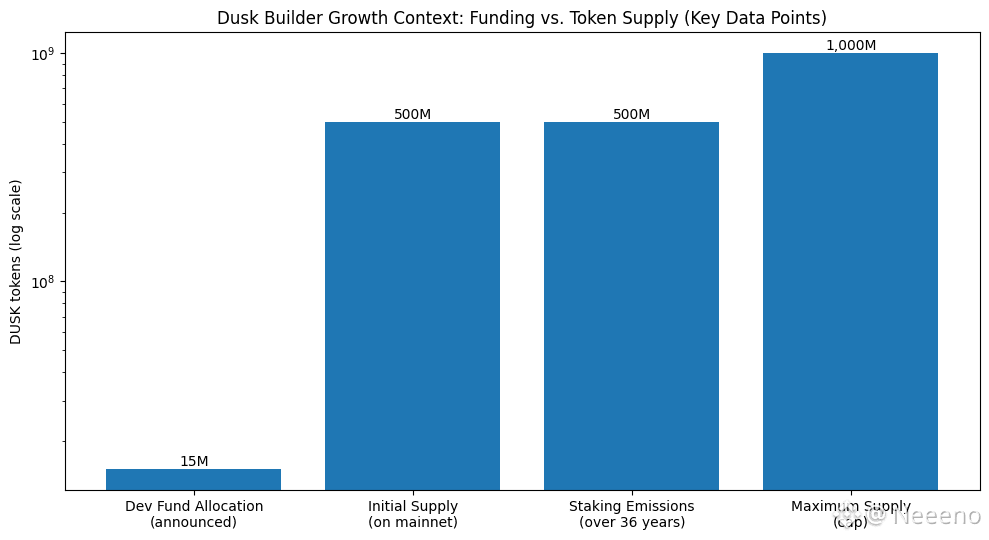
Hackathons, in that context, aren’t only about prizes. They’re about stress testing human assumptions. In a weekend sprint, teams don’t just reveal whether their idea is good—they reveal where they cut corners when tired, where they misunderstand risk, where they build a happy path and forget the failure path. Dusk has spoken historically about hackathons and related programs as part of the broader activity plan around its network rollout phases, positioning them alongside other mechanisms that bring builders in and harden the ecosystem over time.The value of a hackathon in a regulated-leaning environment is not the demo. It’s the discovery of hidden fragility while the cost of discovery is still low.
The best builder growth doesn’t come from recruiting as many teams as possible. It comes from creating an environment where teams feel safe enough to be honest about what they don’t know yet. Grants help with that because they’re a statement: “We expect this to take time, and we’re not pretending otherwise.” The Dusk Development Fund announcement made that statement concrete with a specific commitment—15 million DUSK allocated to attract and support teams and broaden the ecosystem. Numbers like that matter because they force accountability. A fund is a promise that can be checked later, and builders notice when promises are measurable.
It also changes how disagreement plays out. In every ecosystem, builders argue about priorities: should we chase user growth, or build deeper infrastructure; should we optimize for convenience, or for correctness; should we ship now, or wait. On Dusk, those arguments are shaped by a different baseline assumption: the chain is trying to be usable in environments where disputes are normal—where counterparties disagree, where auditors ask uncomfortable questions, where compliance teams require evidence, where “trust me” is not an acceptable interface. This pushes builders toward designs where the system itself carries some of the burden of proof, instead of dumping that burden onto users and hoping they won’t notice.
And finally, there’s the quiet but crucial role of the token in builder psychology. A maximum supply structure, a multi-decade emissions schedule, and a live network with ongoing staking incentives are not just “tokenomics.” They are signals about what kind of attention the ecosystem expects. Dusk’s token design, as documented, reads like a commitment to continuity: an initial 500 million base, another 500 million released over 36 years, and a path from earlier representations into the native asset on mainnet. For builders, that translates into something plain and human: the chain is trying to stay, not spike.
If you want a one-sentence summary of Dusk builder growth, it’s this: the ecosystem is growing by rewarding the kind of work that holds up under pressure. Grants and hackathons are simply the instruments, not the point. The point is the culture they create—one where builders are paid to think about failure before users are forced to experience it, one where operational incidents are treated as part of the job rather than a scandal, and one where the token’s long time horizon quietly encourages everyone to act like they’ll still be here when today’s excitement is gone.
In the end, the most responsible infrastructure is the kind you barely notice. Not because it’s invisible in a marketing sense, but because it behaves like a steady floor beneath people’s lives. That is what Dusk is asking builders to contribute to: quiet systems that keep working when emotions run hot, when information is incomplete, when somebody makes a mistake, when incentives pull people toward shortcuts. Getting attention is simple, and losing it is just as quick. Reliability is built over time, not praised much, and hard to fake. But when nobody’s watching and the transfer still has to clear, reliability is what carries you through.
