

Yesterday, while organizing the team's shared cloud drive, I was stuck on a simple question for half an hour: how to set the permissions of a folder so that colleagues in the finance department can view all reports but cannot modify them, project team colleagues can only upload weekly reports but cannot see the budget files, and external auditors can access specific folders in certain quarters, with all actions leaving unalterable records? Faced with layers of nested checkboxes and role groups, I suddenly felt that we are clumsily building a maze of permissions in the digital world every day. This made me realize a fact: the operation of our entire digital civilization is essentially about managing permissions of 'who can see what, and who can change what.' And the current mainstream blockchain offers an extremely primitive solution to this fundamental issue—a binary choice that is either completely public or completely private, just like a house that either removes all the walls or welds all the doors and windows shut.
This insight instantly helped me understand why projects like Dusk Network would choose such a difficult technical path. It is not blindly chasing the hot topics of 'privacy' or 'compliance', but attempting to respond to a more fundamental need: to rebuild a fine, dynamic, and verifiable 'permission' and 'access control' system on distributed, permissionless networks. What it wants to build is not an unguarded square, nor a locked room, but rooms equipped with 'smart one-way glass' and 'automatic recorders'—indoor activities are kept confidential from the outside, but administrators with specific keys can legally initiate review procedures, and every door opening record is permanently engraved.
1. From 'state transparency' to 'logic verifiability': paradigm shift in permission management.
The paradigm of traditional blockchains (like Bitcoin and Ethereum) is 'state transparency'. All nodes in the network synchronize and verify a global, public state ledger. Your 'permissions' are the addresses corresponding to your private keys, and the operations you can perform are to write transactions to this transparent ledger. This brings two fundamental limitations: first, any data you write (transaction amount, interaction parties) is exposed to the entire network; second, complex business logic (like 'only addresses that meet conditions A and B can perform operation C') is either difficult to achieve or incurs extremely high costs and is equally transparent.
The core breakthrough of Dusk lies in shifting the focus from 'state transparency' to 'logic verifiability'. It allows participants to prove that a certain computational process (business logic) has been correctly executed to the network without disclosing any input data (private state) by using cryptographic suites like zero-knowledge proofs. It is like a member of the team who does not need to show you all the files and computational processes on his computer, but only needs to submit a proof stamped by a trusted institution (cryptographic algorithm) stating, 'I have completed the audit of report Y according to Article X of the charter, all data is compliant.' You do not need to see the data, but you can absolutely trust the fact that 'compliance audit has been completed'.
This paradigm shift is the ultimate idea to solve my cloud drive permission predicament. In the 'rooms' built by Dusk:
· Privacy is guaranteed: Specific activities in the room (transaction details) are encrypted and not visible to the outside.
· Rules are executed automatically: The access and operation rules of the room (smart contracts) are encoded as verifiable logic. For example, 'Only addresses holding valid KYC certificates can enter', 'Asset transfers must be spaced 30 days apart'.
· Audit interfaces are retained: The room is equipped with a legally initiated 'audit window' (regulatory key mechanism), which allows authorized parties to verify whether indoor activities violate rules when legally required, without constant monitoring.
This directly transforms compliance and risk control from expensive, post-event manual processes to cheap, in-process, automated protocol features.
2. Engineering reality: Trekking between the ideal blueprint and code implementation
However, turning the blueprint of 'verifiable logic' into reality, every step treads into the deep water of engineering complexity. This explains why Dusk is 'slow'.
First, there is the heavy cost of 'circuits'. Translating complex financial or compliance rules (such as EU's MiCA regulation clauses) into 'arithmetic circuits' that zero-knowledge proof systems can understand is an extremely time-consuming and error-prone task. This is not like writing ordinary programs; it requires developers to be cryptographers, lawyers, and logicians at the same time. Dusk chose to self-develop the Piecrust virtual machine and deeply optimize zero-copy serialization, the fundamental purpose of which is to reduce the hardware costs and delays of executing such 'circuits' so that it can support high-frequency financial transactions. This is true 'heavy' industry.
Next is the challenge of on-chain 'identity'. My cloud drive permissions can rely on the company's existing AD domain account system. But on a permissionless chain, identity must be built from scratch. Dusk's Citadel framework attempts to create a portable, privacy-verifiable on-chain credential. This is not just a technology but a social experiment: who is qualified to issue these credentials (governments, licensed institutions)? How do credentials from different issuers recognize each other? This involves governance, legal, and business coordination that is more complex than just technical protocols.
Finally, there is the cost and benefit of 'compatibility'. Dusk chose to be compatible with the Ethereum Virtual Machine (EVM), which seems to be a 'shortcut' to lower the threshold for developers, but actually brings huge architectural challenges. How to make the EVM ecosystem designed for a transparent world run smoothly on the underlying layer designed for a privacy world (Piecrust VM)? This intermediate layer acts like a high-precision translator, with its stability and efficiency directly determining the prosperity of the ecosystem. The current 'silence' of the ecosystem is partly because developers are waiting for this translator to become more mature and friendly.
3. Confusion in market pricing: How to value 'certainty'?
The current market pricing of Dusk (and its token DUSK) has fallen into a typical confusion. The commonly used valuation models—based on transaction volume, user numbers, and fee income—are nearly ineffective here. Because the core value that Dusk provides at this stage is not these traffic indicators, but a financial-grade 'certainty'.
This certainty includes:
1. Settlement certainty: The second-level finality pursued by SBA consensus eliminates settlement risk.
2. Compliance certainty: Self-certifying compliance through code reduces legal risks.
3. Privacy certainty: Trade secrets are protected in complex transactions.
How to price 'certainty'? It's like pricing insurance or audit services, where the value lies not in how much flow has been created but in how many potential losses have been avoided (sometimes astronomical figures). In traditional financial markets, such 'certainty' services are provided by centralized institutions (clearing houses, custodians, law firms) and charge high fees. Dusk attempts to decentralize, protocolize, and significantly reduce the cost of these services.
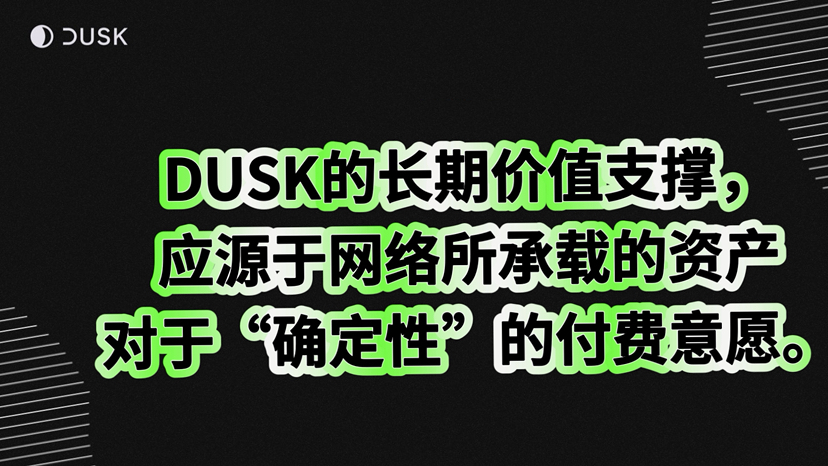
Therefore, the long-term value support of DUSK should stem from the willingness of the assets carried by the network to pay for 'certainty'. If in the future, hundreds of billions of euros in securities, bonds, and private equity circulate through the Dusk network, then even if the protocol charges a very low 'certainty service fee', its accumulated value will be considerable. But the premise is that 'using Dusk' can become the optimal choice for institutions in compliance, security, and cost. Currently, this is still a hypothesis that needs to be verified.
Conclusion: A long construction to rebuild the cornerstone of digital trust.
The frustration of organizing cloud drive permissions and the long feeling of observing the progress of the Dusk project essentially stems from the same thing: we are struggling to migrate from a mixed trust model of physical and legal to a pure digital and algorithmic trust model.
What Dusk is doing goes far beyond the scope of a 'privacy chain' or 'financial chain'. It attempts to define a new set of 'spatial norms' for high-value activities in digital chaos. It does not provide a quick-rich illusion but promises slow but solid engineering progress. Its success does not depend on how loud the slogans are in the next bull market, but on whether code submissions continue in the current bear market, whether the partner's test network is advancing, and whether that complex 'permission logic' is being meticulously compiled into circuits.
This road is destined to be lonely, as it goes against the market nature of pursuing instant gratification. However, the next stage of the digital world precisely requires such 'infrastructure obsessives'. When everything can be put on-chain, the complexities of real-world rules and permission relationships will inevitably reappear on-chain.
At that time, those chains that can only build transparent squares or closed rooms will be unable to bear real weight. Builders like Dusk, who have long silently installed 'smart one-way glass' and 'compliance audit interfaces' for every room, may find that they have quietly built the 'trust isolation layer' that is indispensable for the next generation of digital civilization. This layer of isolation is not a barrier but allows activities with different values and privacy requirements to coexist safely and efficiently on the same digital continent.

📣 The above analysis represents personal thoughts based on publicly available information and industry observations, and does not constitute any investment advice.