
 You’re building what you hope will become the future of finance. You’ve got the vision, the team, the whiteboard full of diagrams. But your blockchain? It remembers data like a vault… not like a mind. It stores everything perfectly, yet understands nothing.
Your smart contracts are “smart” the way a calculator is smart. Fast. Precise. Completely unaware of context.
That frustration is part of what gave birth to Vanar Chain — a blockchain that doesn’t just store information, but is designed to reason about it.
But beyond the architecture, beyond the AI layers and storage compression ratios, the real story is human. Because this isn’t just about code getting smarter. It’s about people getting better tools.
The Loneliness of Traditional Blockchains
Most blockchains today are like incredibly secure filing cabinets.They lock your documents away. They timestamp them. They ensure nobody can alter them.But ask them what the document means?
Silence.Ask them whether two pieces of data contradict each other?Not their problem.Ask them to apply a rule based on the contents of that data?You’re on your own.
For years, developers have been stitching together AI services off-chain, storage networks somewhere else, compliance engines in another layer, and smart contracts in yet another environment. It works — but it feels like building a spaceship with duct tape.
Vanar’s team looked at this complexity and asked something almost embarrassingly simple:
What if intelligence wasn’t an add-on?What if it was native?Intelligence by Design, Not DecorationVanar didn’t start by asking, “How do we make transactions faster?”It asked, “How do we make applications smarter?”
At its core, Vanar is an EVM-compatible Layer 1. That matters because it respects the developer journey. Builders familiar with Ethereum don’t have to relearn their craft from scratch.
But what makes Vanar different is what sits above that base layer.Instead of treating storage and reasoning as external services, Vanar integrates them directly into the chain’s architecture. It built layers that allow data to live on-chain in compressed, structured forms — and more importantly, be understood.Think about that for a moment.Not just stored. Understood.That shift changes everything.When Data Becomes Alive
Traditional blockchains often rely on external storage. If that service goes down, your “decentralized” system suddenly depends on a centralized failure point.
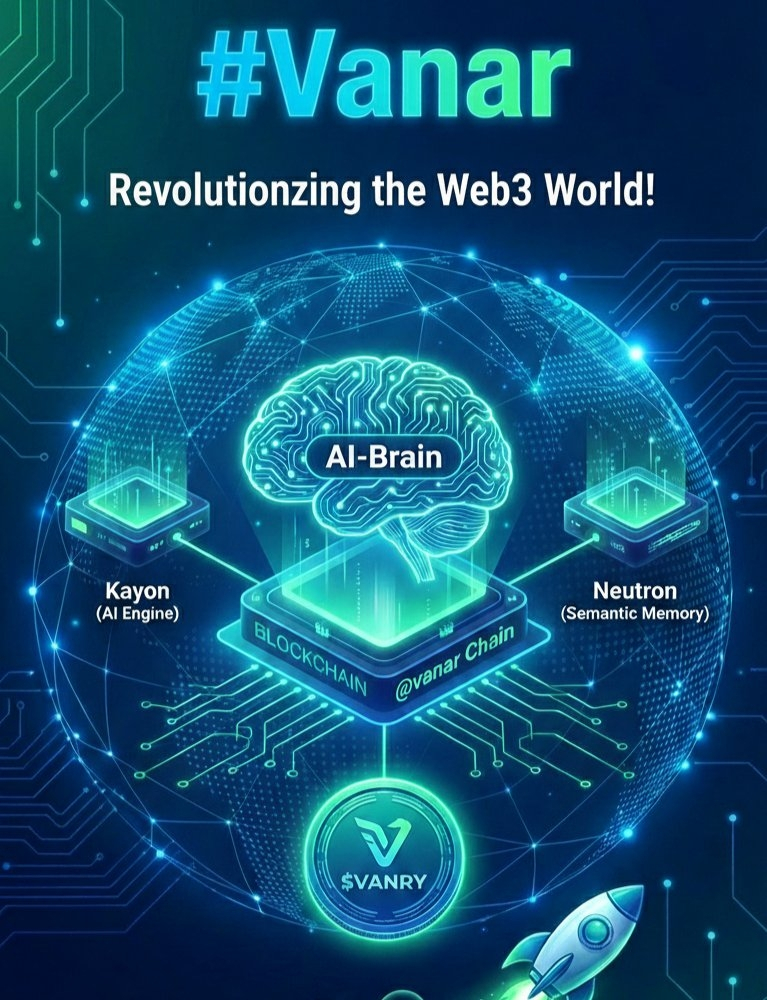
Vanar’s Neutron system changes that. It compresses documents dramatically and turns them into structured on-chain objects called “Seeds.” But these aren’t just files squeezed smaller. They are data entities designed for interpretation.
And then comes Kayon — the reasoning layer.
Kayon allows the blockchain to query, validate, and interpret the information it stores. If a document contains compliance requirements, the system can analyze them. If a transaction requires rule validation, it can apply logic in real time.This isn’t AI as a buzzword.It’s AI as infrastructure.
And when infrastructure becomes intelligent, applications stop feeling mechanical and start feeling responsive.
Real People, Real Use CasesIt’s easy to get lost in technical explanations. But the question that matters is simple:Who does this actually help?
The BuilderImagine a developer in Karachi or London building a payment solution that needs to verify documentation instantly. On most chains, they would need external APIs, third-party compliance checks, and off-chain AI services.
With Vanar, much of that logic can live within the same ecosystem.Fewer moving parts. Fewer vulnerabilities. Less stress.For builders, that means confidence.
The Business Owner
Gas fees in crypto can feel like roulette. One day your app costs cents to run. The next day, congestion turns profitability into panic.Vanar’s fixed, predictable gas model changes the psychology of building. Businesses can plan. They can forecast. They can scale without fear that tomorrow’s network traffic will wreck their margins.Stability isn’t flashy.But stability builds companies.
The Gamer
Gaming demands speed and high-frequency interaction. Many chains struggle under that load.
Projects like World of Dypians operate entirely on-chain within Vanar’s ecosystem. Thousands of players interacting, trading, moving assets — without the experience degrading into lag or absurd fees.
For gamers, this means immersion.For developers, it means freedom to design ambitious worlds.
The Climate-Conscious Enterprise
Blockchain’s energy narrative has been controversial. Vanar’s partnership approach — including carbon-conscious validator strategies — acknowledges that sustainability matters.
Companies entering Web3 increasingly face environmental reporting requirements. Infrastructure that aligns with carbon-neutral initiatives isn’t just ethical — it’s practical.Responsible infrastructure earns trust.
Growing Up: From Virtua to Vanar
Before it became Vanar Chain, the project was known as Virtua — focused largely on metaverse and digital entertainment. But on November 15, 2023, it rebranded, migrated its token from TVK to VANRY, and sharpened its mission.This wasn’t cosmetic.It was strategic maturity.
The team realized their infrastructure could support far more than virtual worlds. It could power intelligent finance, AI-driven systems, and enterprise-grade applications.Evolution is human.Projects grow the same way people do — by recognizing their bigger potential.
Technology That Feels Less Intimidating
One of blockchain’s biggest adoption barriers isn’t complexity — it’s intimidation.Wallets feel cryptic. Commands feel foreign. Gas feels confusing.
Vanar’s ecosystem tools aim to soften that edge. Natural language wallet interactions, smart assistants, intuitive interfaces — these details matter.Because mass adoption doesn’t happen when technology becomes more powerful.It happens when it becomes more understandable.
Why Intelligence on Chain Matters NowWe are entering a world where AI agents are becoming economic participants.They analyze markets. Execute strategies. Automate workflows.
But if AI is going to transact, it needs infrastructure that understands context. A blockchain that simply records transactions is not enough.
Vanar’s philosophy is that the next generation of blockchain must be cognitive by default.
Not reactive. Not patched together. But designed for intelligence from day one.That philosophy feels less like a feature list and more like a mindset shift.
Beyond Hype
Crypto is loud.Memecoins trend. Charts spike. Attention moves fast.Vanar’s differentiation isn’t hype-driven. It’s architectural.It focuses on something less glamorous but more enduring: integration.Storage + reasoning + transactions + predictable economics.
When systems work together natively, friction disappears. And when friction disappears, adoption becomes natural.
The Human Core
Strip away the layers, the AI engines, the compression ratios, and the validator mechanics — what remains?People.
The founder who believed blockchain could do more. The engineer debugging logic at midnight. The student deploying their first contract. The enterprise executive testing a pilot program. The gamer trading an asset inside a digital world.Vanar Chain is not just code running on distributed nodes.It’s coordination. It’s collaboration. It’s ambition.It’s an attempt to make blockchain feel less like a cold machine and more like a thinking partner.
