
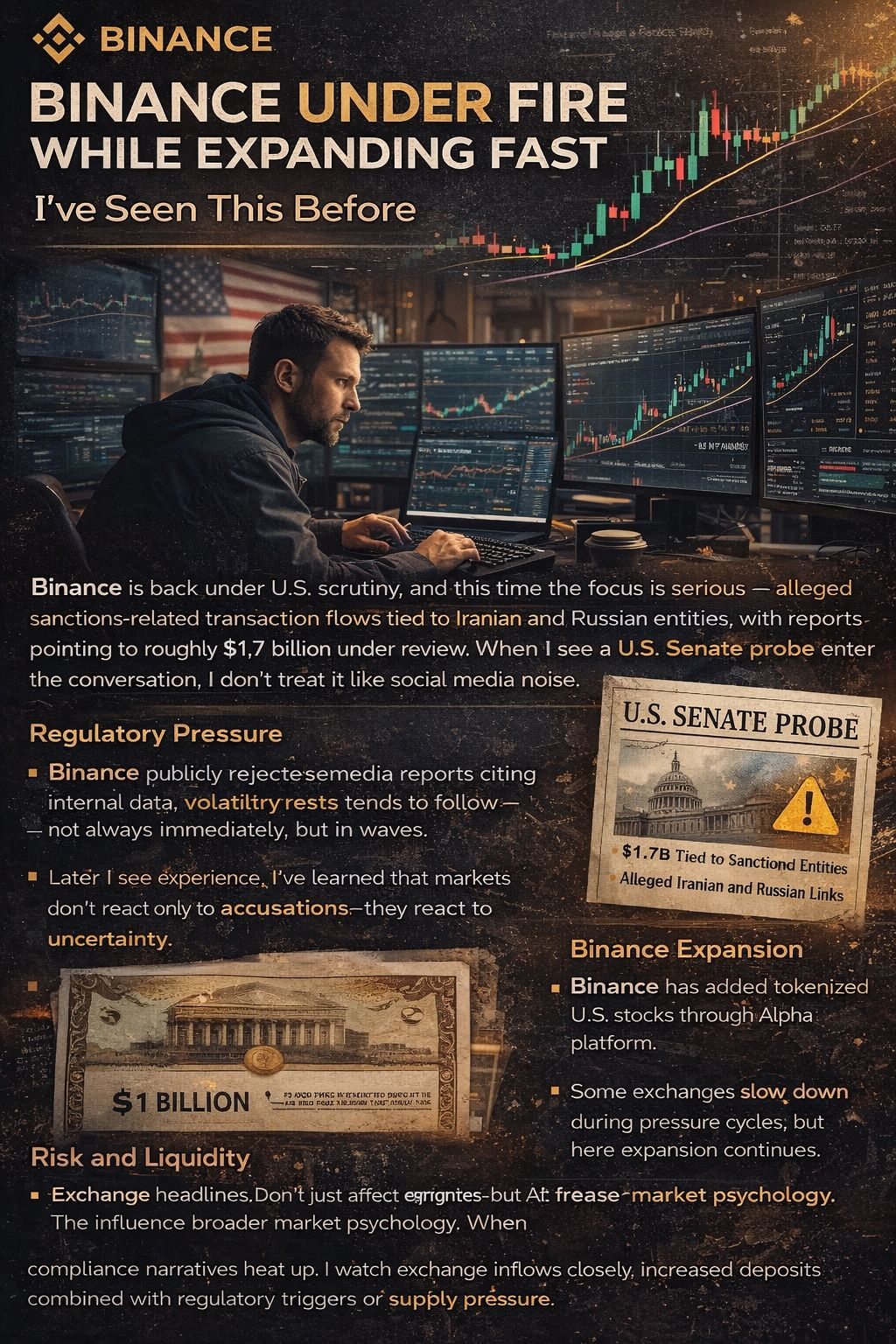
Binance is back under U.S. scrutiny, and this time the focus is serious — alleged sanctions-related transaction flows tied to Iranian and Russian entities, with reports pointing to roughly $1.7 billion under review. When I see a U.S. Senate probe enter the conversation, I don’t treat it like social media noise. I’ve traded through enough regulatory cycles to know that once lawmakers step in, volatility tends to follow — not always immediately, but in waves.
Binance has pushed back publicly, rejecting parts of the reporting and defending its compliance controls. From experience, I’ve learned that markets don’t react only to accusations — they react to uncertainty. Even if nothing materializes, the space between allegation and resolution creates hesitation in liquidity. Traders start tightening stops. Larger players reduce exposure temporarily. Sentiment shifts quietly before price reflects it.
What makes this situation interesting is the timing. While scrutiny increases, Binance is simultaneously expanding — adding tokenized U.S. stocks and ETFs to its Alpha platform. That’s not defensive behavior. That’s strategic growth. I’ve seen exchanges slow down during pressure cycles, but here expansion continues. That tells me Binance is positioning for long-term infrastructure dominance, not short-term survival.
From a trading perspective, exchange headlines don’t just affect Binance-related tokens — they influence broader market psychology. When compliance narratives heat up, I watch exchange inflows closely. Increased deposits combined with regulatory headlines often lead to sharper intraday swings. Not because fundamentals change overnight, but because positioning becomes cautious.
What I’ve learned over the years is that regulatory pressure rarely destroys strong platforms overnight. It compresses them. It forces adjustments. It tests resilience. The exchanges that survive these cycles usually emerge more structured and more compliant. But during the process, price action can become erratic.
Right now, I’m not reacting emotionally to the headline. I’m watching how liquidity behaves around key BTC and ETH levels. If volatility expands and order books thin out, that’s when the story starts impacting real trades. If price remains stable despite the noise, that tells me the market has already priced in a degree of regulatory risk.
This isn’t the first time crypto has faced government pressure, and it won’t be the last. The difference now is maturity. The market doesn’t panic the way it used to. It recalibrates. And as a trader, my job isn’t to predict the outcome of a Senate probe — it’s to read how participants adjust their behavior while it unfolds.