As artificial intelligence continues to scale, one foundational challenge is becoming increasingly visible: data storage. Large language models, generative AI systems, and on-chain applications require vast amounts of data that must remain accessible, verifiable, and cost efficient. While computation has advanced rapidly, storage infrastructure has struggled to keep pace.
Most AI and Web3 applications today still rely on centralized cloud providers.
These platforms offer convenience and performance, but they introduce long term risks related to cost escalation, data ownership, censorship, and single point failure. As decentralized applications mature, the need for decentralized storage solutions that meet enterprise level requirements is becoming more urgent.
Walrus is a decentralized storage protocol designed to address these challenges by combining mathematical efficiency, cryptographic security, and token based economic incentives. Powered by the WAL token and deeply integrated with the Sui blockchain, Walrus introduces a storage model optimized for both Web3 and AI driven workloads.
The limitations of traditional storage models
Centralized cloud storage platforms dominate the market due to their reliability and ease of integration. However, their underlying structure creates several limitations
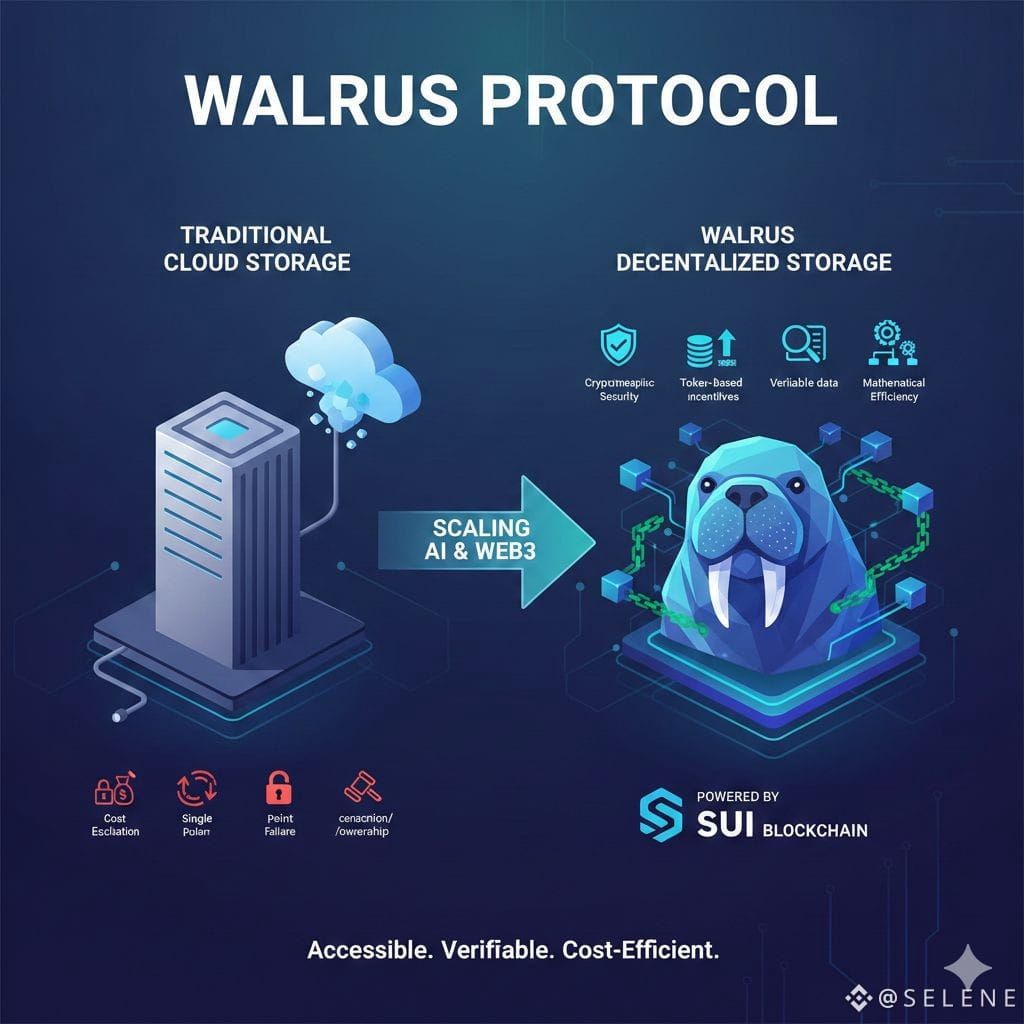
First is cost. As data volumes increase, storage expenses grow linearly or worse. Long term data retention, frequent access, and outbound data transfers significantly increase operational costs for developers and enterprises.
Second is control. Data stored on centralized platforms remains subject to platform policies, jurisdictional constraints, and account level permissions. Users do not retain sovereign control over access or availability.
Third is resilience. While centralized providers offer redundancy, outages, account suspensions, or policy changes can still disrupt access to critical data.
Decentralized storage networks emerged to counter these issues, but many rely on replicated storage. In this model, multiple full copies of the same data are stored across different nodes to ensure availability. While this improves fault tolerance, it dramatically increases storage overhead and costs.
Walrus takes a different approach.
Walrus storage architecture and RedStuff encoding
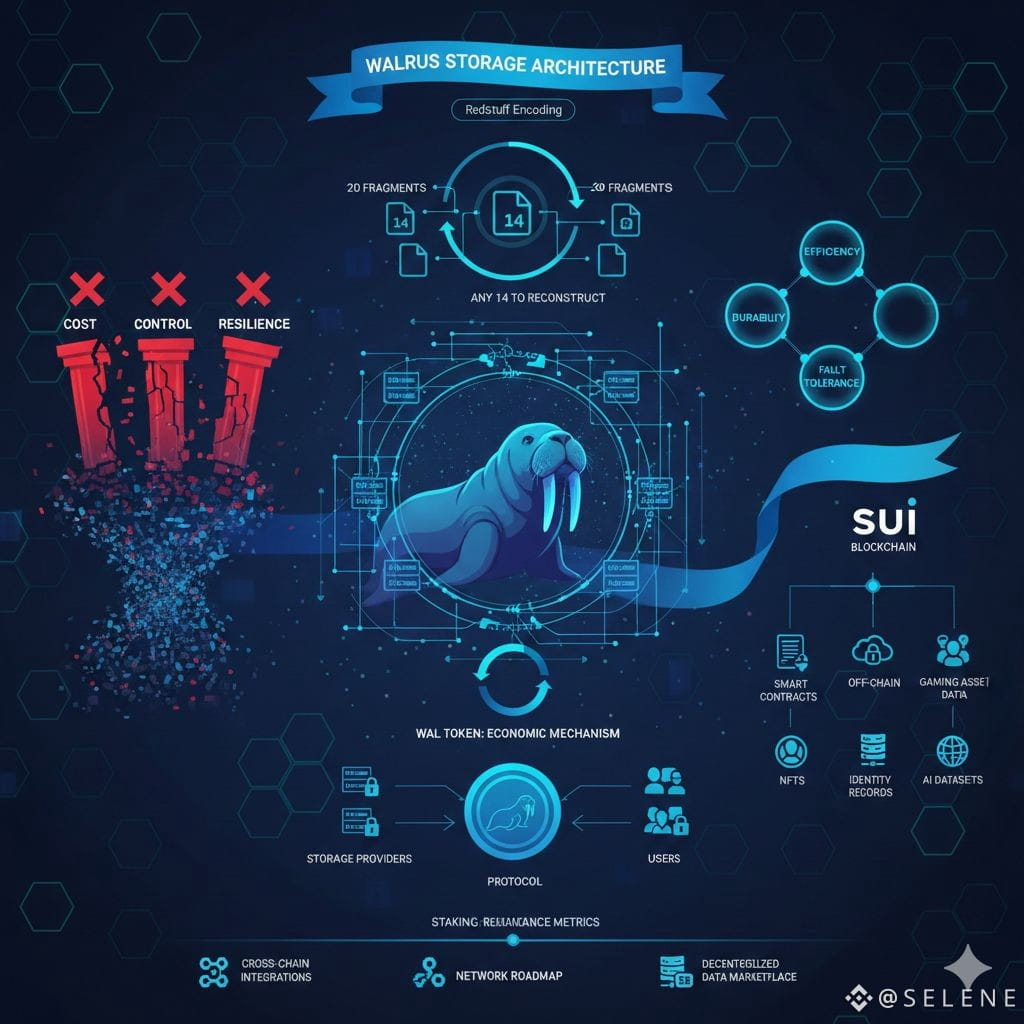
Walrus is built around an erasure coded storage model using an error correction algorithm known as RedStuff. Instead of storing full replicas, data is split into multiple fragments. Only a subset of these fragments is required to reconstruct the original file.
For example, a file may be divided into twenty fragments, with any fourteen being sufficient for full recovery. This means that several nodes can go offline or fail without affecting data availability.
This approach significantly reduces redundant storage while maintaining high durability and fault tolerance. By minimizing waste, Walrus achieves storage costs that are substantially lower than traditional replicated decentralized systems.
The design also improves network resilience. Rather than depending on specific nodes, the network relies on mathematical guarantees. Data availability becomes a function of probability and incentives rather than trust.
The role of WAL in network coordination
The WAL token functions as the core economic mechanism of the Walrus network. It aligns incentives between storage providers, users, and the protocol itself.
Storage nodes are required to stake WAL tokens in order to participate. This stake acts as collateral, ensuring that nodes have economic exposure to their performance. Nodes that fail to meet availability or reliability requirements may be penalized through stake reduction.
Users pay storage fees in WAL. These fees are distributed to storage providers based on performance metrics such as uptime, response reliability, and data integrity.
This model creates a self regulating system where honest participation is economically rewarded and malicious or negligent behavior becomes financially unattractive.
Rather than relying on centralized oversight, Walrus uses token economics to enforce service quality across a distributed network.
Integration with the Sui blockchain
Walrus is natively integrated with the Sui blockchain, enabling seamless interaction between on-chain logic and off-chain data.
Smart contracts on Sui can directly reference data stored on Walrus without relying on centralized gateways. This allows developers to build applications where NFTs, gaming assets, identity records, and AI datasets are tightly coupled with on-chain logic.
For AI related applications, this integration is particularly important. Training datasets, model checkpoints, and inference assets can be securely stored and programmatically accessed through smart contracts. Licensing, access control, and usage based compensation can be automated at the protocol level.
This creates new possibilities for data monetization and collaboration that are difficult to achieve with traditional storage systems.
Practical use cases across Web3 and AI
During early testing phases, Walrus has demonstrated applicability across multiple sectors.
In the NFT ecosystem, projects storing large volumes of metadata and media assets benefit from lower storage costs and increased permanence. High resolution images, three dimensional models, and dynamic assets can be stored without relying on centralized servers.
In gaming and metaverse applications, Walrus supports scalable asset storage while maintaining on-chain verification. Game states, environments, and user generated content can be accessed reliably without sacrificing decentralization.
AI applications represent one of the most significant opportunities. Large datasets required for model training can be stored efficiently while retaining cryptographic proof of integrity. Through smart contracts, dataset creators can define usage terms and receive automated compensation when their data is utilized by others.
This enables a more open and transparent data economy where contributors are rewarded directly and proportionally.
Network roadmap and future development
Walrus aims to expand its capacity and functionality through ongoing development.
Planned cross chain integrations will allow Walrus to support applications across multiple blockchain ecosystems. Network scaling targets include storage capacities measured in exabytes, enabling enterprise and research level adoption.
A decentralized data marketplace is also part of the roadmap. This platform will allow users to discover, license, and monetize datasets, media assets, and digital resources without intermediaries.
By positioning storage as shared public infrastructure rather than a proprietary service, Walrus aligns with the broader goals of decentralization and open access.
Conclusion
As AI and Web3 continue to converge, storage infrastructure must evolve to support new demands around scale, ownership, and interoperability. Walrus presents an alternative model that prioritizes efficiency, resilience, and economic alignment.
Through erasure coded storage, token based incentives, and deep blockchain integration, Walrus addresses key limitations of both centralized and existing decentralized storage solutions.
Rather than competing with cloud providers on convenience alone, Walrus focuses on building foundational infrastructure that supports long term data sovereignty. As decentralized applications grow more data intensive, storage protocols like Walrus may play a central role in shaping the next phase of the internet.