

I’m going to say this in the simplest way possible: Plasma feels like a chain built by people who actually watched how normal humans use stablecoins instead of how crypto people talk about them. Most people sending digital dollars are not chasing tech glory, they’re trying to pay someone, support family, run a small business, or protect savings. And yet on many chains you still have to think about gas tokens, congestion, delays, and random friction that turns a basic transfer into a small stress event. Plasma starts from the idea that money movement should feel calm, instant, and boring in a good way. If sending value feels like sending a message, adoption stops being a theory and becomes behavior.
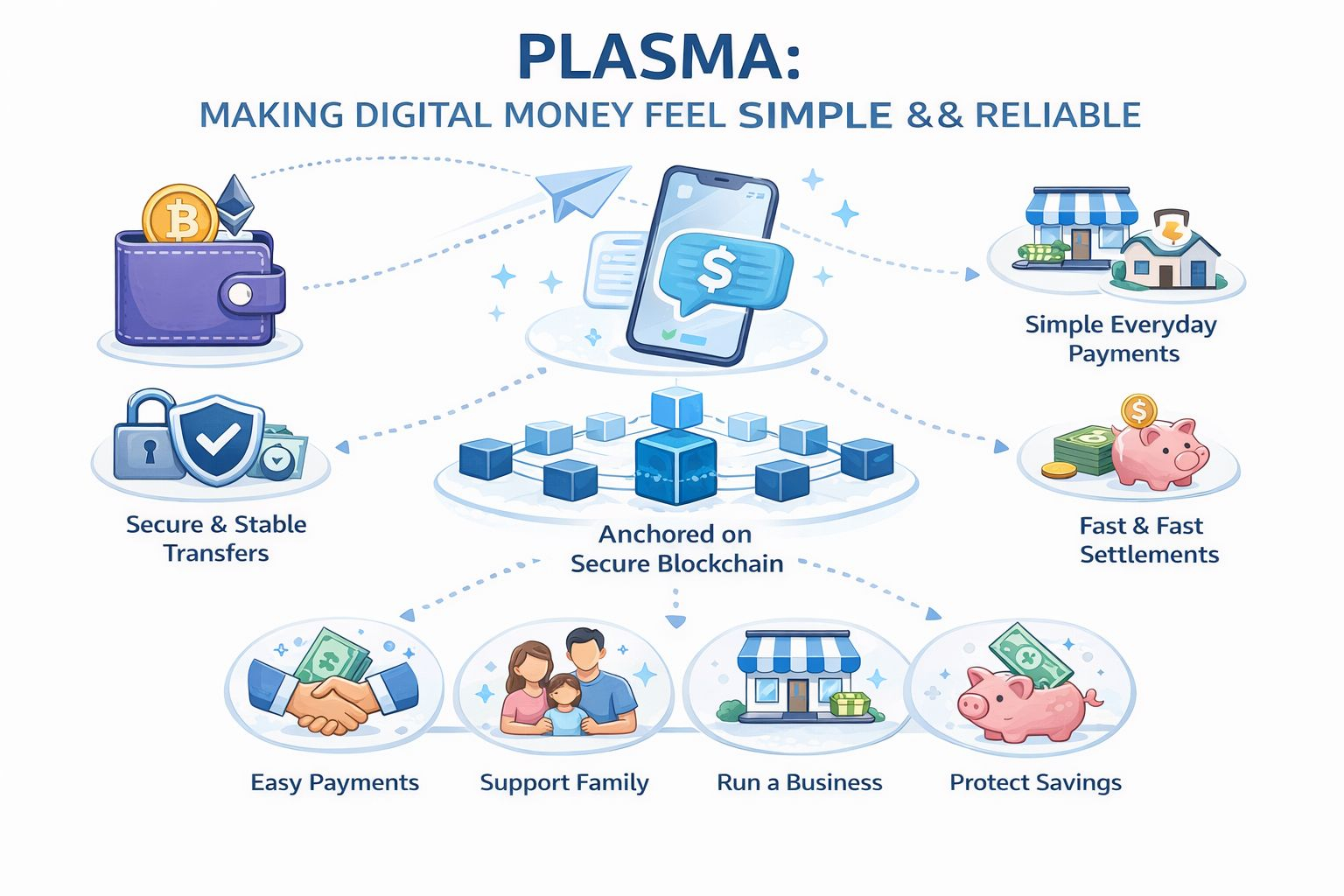
The whole identity of Plasma is stablecoin-first, which sounds niche until you realize stablecoins are already one of the biggest real use cases in crypto. They’re not experiments anymore, they’re daily infrastructure for millions of people. Plasma is basically saying: if this is already happening at scale, then the base layer should be designed for it from day one. Instead of treating stablecoins like guests on a general chain, Plasma treats them like the main character. That changes everything about priorities. Speed matters, but predictable speed matters more. Low fees matter, but fee clarity matters more. We’re talking about designing a chain around emotional trust, not just throughput numbers.
One of the smartest moves Plasma makes is staying fully compatible with the Ethereum world. Developers don’t want to relearn their craft every time a new chain appears. By keeping EVM compatibility, Plasma lets builders bring their existing tools, contracts, and habits without friction. That means apps can migrate faster, experiments happen quicker, and the ecosystem grows without forcing everyone to start from zero. If it becomes easy to build where you already understand the rules, more people will actually build. Growth isn’t just about innovation, it’s about lowering the mental cost of participation.
Then there’s finality, which sounds technical but is actually emotional. Finality is the moment you know a payment is done and cannot be reversed. Plasma focuses heavily on near-instant, deterministic finality because people don’t want to wonder if their money might bounce back. Imagine paying rent or sending support to someone and having to wait in uncertainty. That feeling kills trust. Plasma’s consensus design aims to remove that anxiety so transactions feel decisive. When money moves and stays moved, confidence grows naturally.
The stablecoin-native gas idea is where Plasma feels especially human. Normally you need a separate token just to pay fees, which confuses new users immediately. Plasma pushes toward a world where you can use stablecoins themselves in the fee logic, meaning fewer weird steps and less wallet confusion. If sending USD₮ doesn’t require a mini tutorial, more people will actually do it. Adoption isn’t blocked by lack of interest, it’s blocked by tiny moments of confusion that pile up. Plasma is trying to delete those moments.
Of course, power brings risk. A chain focused on stablecoins is tied to the future of stablecoins themselves, including regulation and issuer decisions. Bridges to other ecosystems add opportunity but also security pressure. Sponsored or low-fee systems invite abuse if they aren’t carefully defended. Plasma isn’t escaping those realities, it’s stepping directly into them. That’s what serious infrastructure looks like. It accepts that money systems attract attack and designs with that assumption from the start.
If Plasma works the way it hopes to, the result won’t look flashy. It’ll look normal. People will send stablecoins without thinking about the chain underneath. Businesses will treat onchain settlement like a routine tool instead of a gamble. Developers will build payment apps assuming reliability instead of apologizing for delays. Exchanges like Binance may act as doors into the ecosystem, but real adoption will come from usefulness spreading quietly through habit. The best infrastructure disappears into everyday life.
What makes Plasma interesting isn’t just the tech, it’s the intention. It’s trying to make digital money feel less experimental and more dependable. Less ceremony, less fear, more quiet confidence. If it becomes a system where value moves smoothly and people stop worrying about the plumbing, that’s not just a blockchain success. That’s a small upgrade to how humans experience money online. And honestly, that future feels worth building toward.

