
How the U.S. Presidency Shapes Wealth: Power, Timing, and the Evolution of Opportunity
Becoming President of the United States is often seen as the ultimate position of power—but power has not always translated into personal wealth. In fact, history shows a striking divide between early U.S. presidents who often lost fortunes and modern leaders who frequently multiplied their net worth after leaving office.
This contrast isn’t about corruption or virtue alone. It’s about how economic systems, media, and monetization opportunities have evolved over time.
The Early Presidents: Prestige Without Profit
America’s early presidents largely came from landowning or elite families, but the presidency itself was not a path to financial growth.
Figures like Thomas Jefferson, James Monroe, and Ulysses S. Grant left office financially worse off than when they entered. Jefferson, despite being one of the most influential thinkers in U.S. history, died deeply in debt. Monroe, a former president, relied on congressional aid late in life.
Why did this happen?
Presidential salaries were modest
Wars and personal debt drained private estates
There were no book deals, speaking circuits, or media platforms
Public service often meant personal financial sacrifice
In this era, the presidency was closer to a financial liability than an asset.
The Transition Era: Stability, Not Explosive Growth
By the early-to-mid 20th century, wealth outcomes stabilized.
Presidents like Herbert Hoover, Franklin D. Roosevelt, and Harry Truman neither dramatically lost nor gained wealth relative to their starting positions. Hoover entered office already extremely wealthy. FDR’s fortune remained largely intact.
This period reflects a time when:
Media exposure existed, but monetization was limited
Ethical norms discouraged overt profit from public office
The presidency still carried a strong “public servant first” identity
Wealth preservation, not expansion, became the norm.
The Modern Presidency: Influence Becomes an Asset
The real shift begins in the late 20th century.
Presidents such as Bill Clinton, Barack Obama, George W. Bush, and Jimmy Carter saw exponential post-presidency wealth growth. Clinton went from roughly $1.3 million to around $80 million. Obama followed a similar trajectory.
This wasn’t accidental. It reflects structural change:
Global book publishing
Paid speaking engagements commanding six figures per event
Media deals, documentaries, and advisory roles
Brand value attached to presidential identity
In today’s world, the presidency acts as a career multiplier, not just a public role.
Outliers That Prove the Rule
Some cases stand apart:
John F. Kennedy entered and exited office immensely wealthy—presidency neither added nor subtracted materially.
Donald Trump is one of the few modern presidents whose net worth declined, reflecting exposure to leveraged business cycles rather than post-office monetization.
Lyndon B. Johnson saw one of the largest increases, largely due to strategic investments and asset appreciation.
These examples show that personal business structures matter as much as political power.
The Core Insight: Wealth Reflects the Era, Not the Office
The presidency itself doesn’t generate wealth. The surrounding system does.
Early presidents served before capitalism, media, and personal branding converged. Modern presidents operate in an ecosystem where attention is monetizable, reputation is scalable, and global demand for political insight is constant.
This is why wealth trends tell us less about morality—and more about timing, technology, and opportunity.
Final Thought
Presidential wealth is a mirror of America’s evolution.
From land and debt… To stability and restraint… To influence-driven capital growth.
Political power alone doesn’t create wealth. But in the modern era, what you can do with that power after office often matters far more than the salary earned inside it.
In that sense, the presidency has transformed from a sacrifice into one of the mos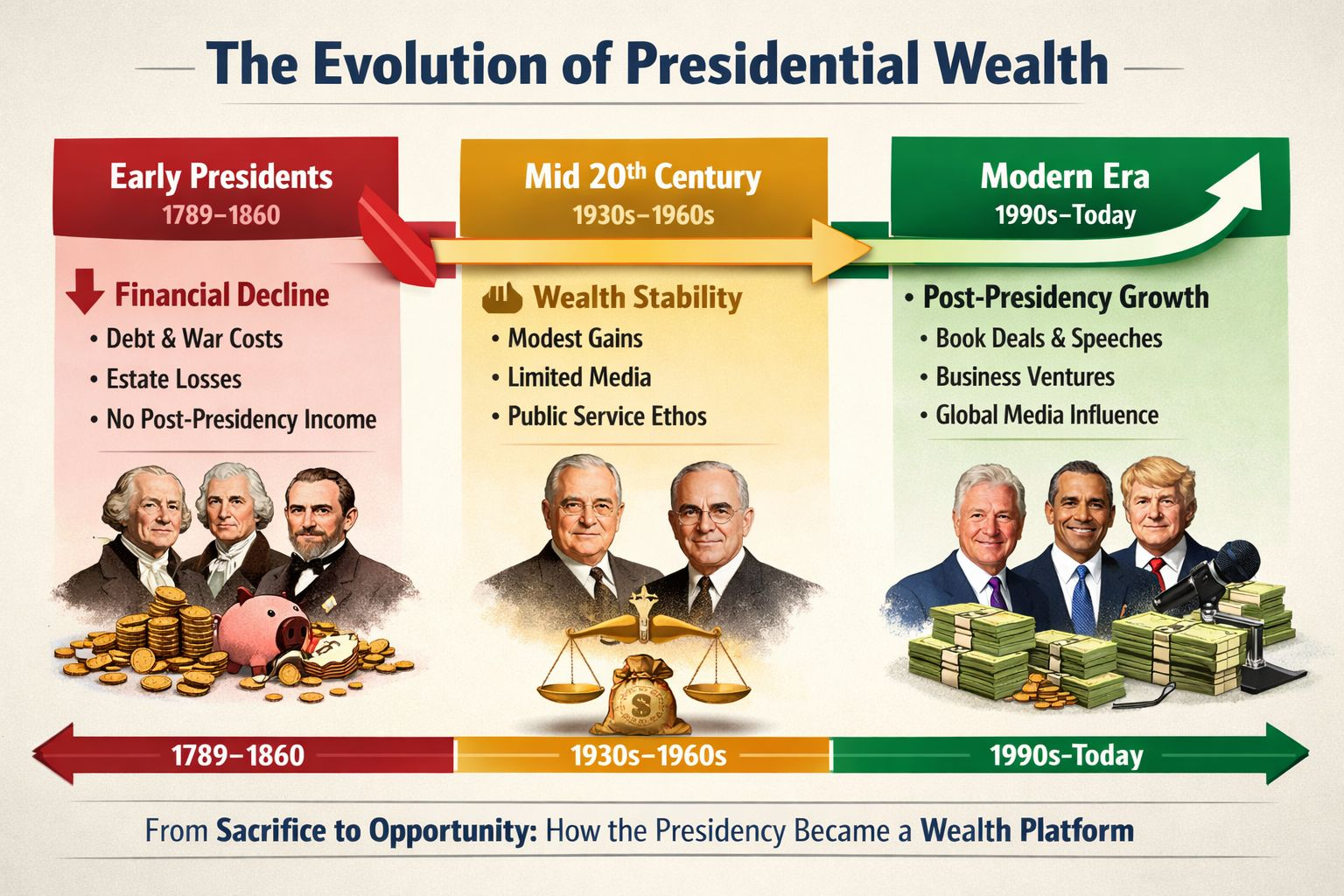 t powerful platforms in the global economy.