
The latest crypto downturn is not merely another speculative unwind—it reflects how deeply digital assets are now embedded in the global financial system. As Bitcoin $BTC evolved from a fringe experiment into a macro-sensitive asset class, its price behavior began mirroring high-beta equities rather than an isolated alternative system. Institutional adoption brought scale, legitimacy, and liquidity—but it also introduced new structural fragilities.
From Decentralized Ideal to Institutional Asset
Over the past cycle, Bitcoin’s growth was fueled by:
Spot ETFs and regulated investment vehicles
Corporate treasury allocations
Derivatives expansion and leverage access
Broader integration with traditional financial infrastructure
These developments strengthened credibility and expanded capital inflows. However, they also tied crypto performance more closely to interest rate policy, liquidity cycles, and macroeconomic sentiment.
When global risk appetite deteriorates, institutional capital does not hesitate—it rotates. That rotation can accelerate downside pressure faster than retail-driven corrections of previous cycles.
The Leverage Effect
Modern crypto markets are significantly more leveraged than in earlier eras. Perpetual futures, structured products, and cross-market collateralization create reflexive dynamics:
Falling prices trigger liquidations
Liquidations increase selling pressure
Volatility spikes reinforce risk-off positioning
This reflexivity makes drawdowns sharper and faster. What once required weeks now unfolds in hours.
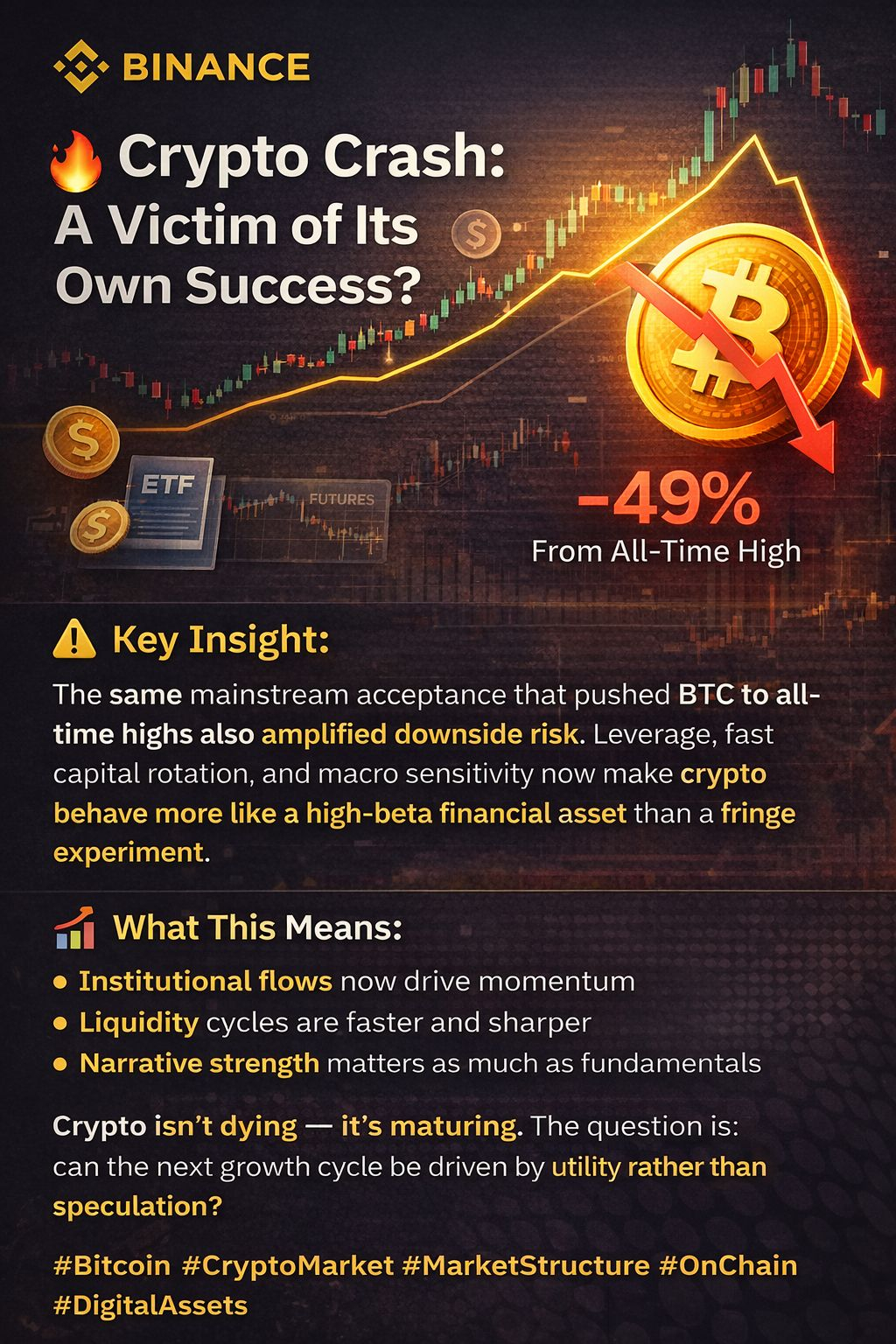
Crypto’s Crash: When Maturity Amplifies Volatility

A Structural Shift in Market Behavior
The key insight from the current correction is this:
Crypto is no longer isolated from traditional finance—it is intertwined with it.
Bitcoin increasingly trades as:
A liquidity-sensitive asset
A hedge against monetary instability (narrative-driven)
A speculative growth proxy in risk-on environments
This dual identity creates tension. In expansionary cycles, institutional flows amplify rallies. In tightening cycles, the same flows amplify declines.
Is This a Sign of Weakness?
Not necessarily.
Volatility does not imply failure—it signals integration. The market is transitioning from speculative adolescence to macro adulthood. Price behavior may become more correlated with global conditions, but infrastructure, developer activity, and on-chain innovation continue progressing beneath the surface.
The real question is not whether crypto will survive volatility—it always has. The deeper question is whether the next growth cycle will be driven by:
Real-world utility
Sustainable revenue models
Layer-2 and scalability adoption
Institutional custody and compliance frameworks
Conclusion
This crash may represent a maturation event rather than a collapse. Institutional participation changes the game: it increases capital depth but also increases sensitivity to global financial currents.
Bitcoin is no longer a parallel system observing the macro economy from a distance. It is now part of that system.
The coming cycle will likely reward resilience, fundamentals, and real adoption over narrative momentum alone.
#MarketRebound #Market_Update #BTC #MarketRebound #cryptouniverseofficial