
Vanar Chain begins with a feeling many people know but rarely say out loud. Web3 can feel like walking into a room where you might be judged for not knowing the rules. You open a wallet and you see warnings. You see fees. You see buttons that feel final. Your heart tightens because you do not want to be the person who loses money by making one small mistake. I’m not talking about a technical problem first. I’m talking about a trust problem. Vanar speaks from that place and it frames itself as an L1 built for real adoption and for mainstream use across areas like gaming entertainment and brands.
When an idea becomes serious it has to become specific. Vanar whitepaper describes a practical approach that starts from battle tested foundations. It points to Go Ethereum as a trusted base and then describes protocol level changes to reach a goal that sounds simple but is hard in reality. Fast responses and cheap usage and security that brands can rely on and scale that can handle billions of users. It even sets an ambition of zero carbon footprint by relying on green energy infrastructure. They’re not just describing speed. They’re describing comfort and confidence and long term responsibility.
The emotional heart of adoption is onboarding. Vanar whitepaper talks about helping new users enter Web3 in a way that feels more like Web2. It mentions account abstracted wallets as part of easing the typical friction people face at the start of a Web3 journey. That matters because the first day is where most projects lose people. If the first day feels confusing the person does not come back. If It becomes simple and familiar then the person has a chance to relax and explore.
For builders the project leans into familiarity too. Vanar is designed to be fully EVM compatible and it repeats a clear principle in the whitepaper. What works on Ethereum works on Vanar. It also points to Geth as a battle hardened client and it emphasizes Solidity support for smart contracts. I’m calling this a human decision as much as an engineering decision. Builders are people. They have deadlines and stress and limited time. When a chain meets them where they are they can ship faster and ship cleaner. And when products feel clean users trust them more.
VANRY sits at the center as the native gas token. In plain words it is the fuel for doing anything on the chain. Vanar documentation says VANRY is used for gas fees for transactions and smart contract activity. It also describes staking as a way to participate in network security and governance. That design links the everyday user action to the network heartbeat. You do something on chain and the system stays alive. You stake and you gain a role in shaping who validates and how rewards flow. We’re seeing Vanar try to make participation feel meaningful rather than passive.
A chain that aims for mainstream use cannot ignore the fear of surprise costs. Fees are where many people lose trust. Vanar documentation describes a fixed fee model focused on stability and predictability for users and projects. The docs also describe a goal of charging a fixed fee in fiat terms and then updating protocol level pricing using market data from multiple sources including CoinGecko and CoinMarketCap and Binance. This is not just an economics feature. This is an emotional safety feature. When the cost feels steady the user stops bracing for pain. When the user stops bracing they can enjoy the experience.
Vanar goes further and makes the target explicit in its fee tooling docs. It describes a system designed so end users get charged a fixed fee of 0.0005 dollars in fiat value for every transaction and it says the market price is regularly updated to keep that promise aligned with token price movement. If It becomes reliable in practice then builders can price their apps with confidence and users can click without fear. That is how a chain becomes usable for games and consumer products where small actions happen many times a day.

Security and governance are where honest projects show their real shape. Vanar whitepaper describes a hybrid consensus approach that relies on Proof of Authority complemented by Proof of Reputation. It also states that the foundation initially runs validator nodes and then welcomes external validators through a reputation pathway with community voting. This is a tradeoff. Early coordination can mean stability and smoother launches. But long term trust grows when power spreads and when participation becomes visible and measurable. They’re effectively saying we start stable and we aim to grow into broader community driven governance.
Staking ties directly into that governance story. The whitepaper describes staking into a contract that gives voting rights and it describes rewards that flow not only to validators but also to community participants involved in selection. It also describes delegated proof of stake sitting alongside proof of reputation. Token holders can delegate stake to reputable validators and share in rewards. When you translate that into human terms it is a promise of shared ownership. You are not only a user. You are part of the system that decides who earns trust.
Interoperability is another bridge between builders and real usage. Vanar whitepaper explains that VANRY functions as the native gas token and then introduces a wrapped ERC20 version to improve utility and support secure movement between Vanar and Ethereum and future EVM chains. This expands where VANRY can live and where applications can connect. But it also expands responsibility because bridges and wrapped assets increase complexity and can increase risk. The vision is bigger reach. The price is higher security discipline.
Now comes the question of why Vanar talks so much about gaming and metaverse and brands. It is because those are environments where people do not forgive friction. A gamer will leave in seconds if something feels slow or confusing. A fan will not stay if it feels like a trap. Vanar blog about its gaming ecosystem says it uses an SSO system so players can enter the VGN games network from existing Web2 games and experience Web3 without realizing it. That line matters because it shows the real intent. Hide the complexity. Protect the mood. Let fun lead and let infrastructure follow.
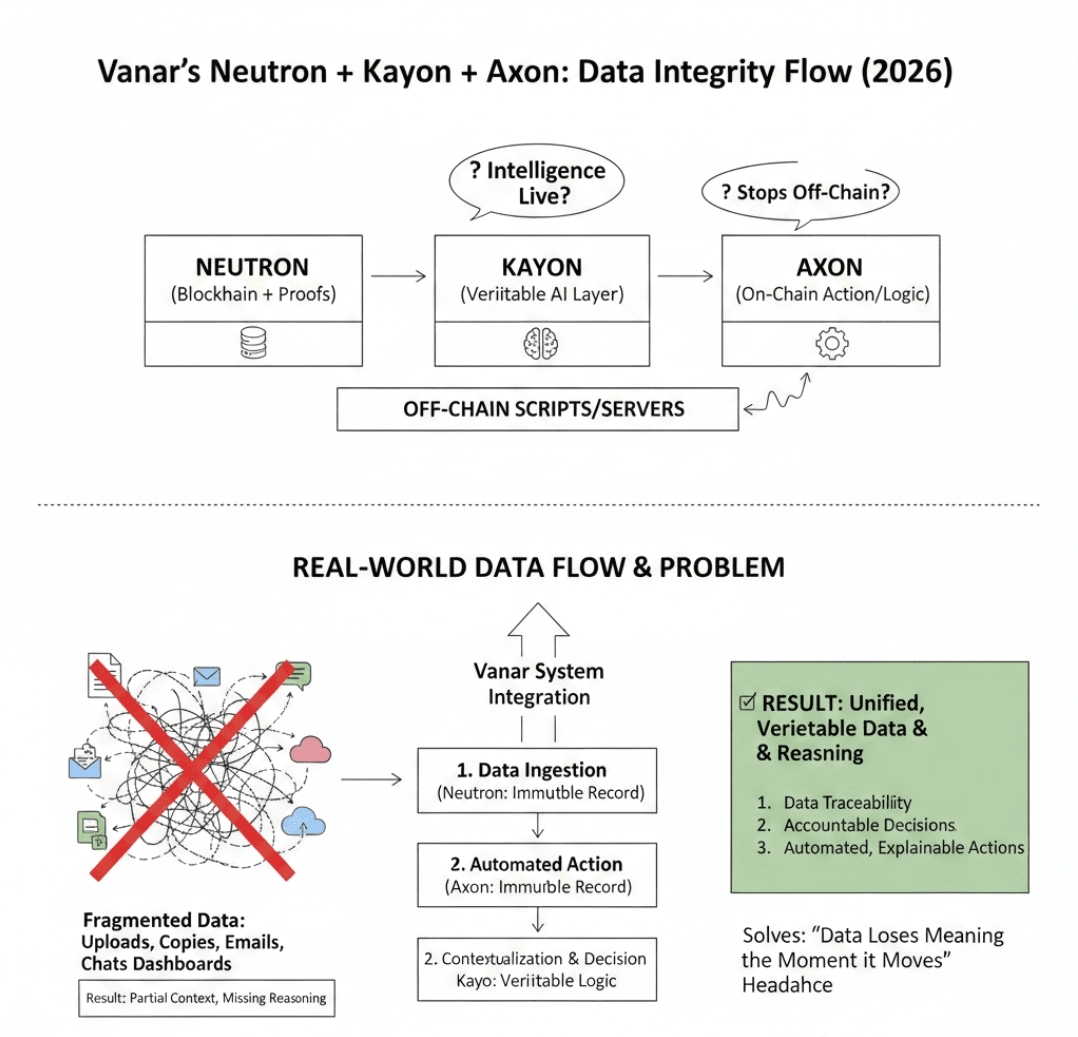
Vanar public positioning has also widened. The main site describes an AI native infrastructure stack for PayFi and tokenized real world assets. It describes a modular L1 base layer and additional layers that bring onchain intelligence and data handling. Whether someone loves that framing or not it reveals where the story is moving. They’re trying to go beyond gaming into systems that can support real world finance logic and compliance and data that needs to be structured and trusted. If It becomes real in shipped products then Vanar turns from a chain narrative into a platform narrative.
A deeply detailed project explanation is not complete without clear ways to measure progress. The first set of metrics are about reliability. Uptime and consistent block production and predictable fee behavior during market swings. Vanar whitepaper mentions a block time of 3 seconds in the context of reward distribution scheduling. That matters because consumer apps often depend on quick feedback loops. Another metric is fee stability in real buying terms because Vanar explicitly aims for fixed fees measured in fiat value. A third metric is developer ease. How fast teams can deploy Solidity contracts and how many migrations happen with minimal changes.
The second set of metrics are about people not just machines. Retention matters more than hype. Do users return tomorrow and next week. Do they keep playing. Do they keep trading. Do they invite friends. For a gaming network the key signals are repeat sessions and time spent and stable marketplace behavior. For brand experiences the signal is whether users stay after the campaign ends. We’re seeing a growing understanding across Web3 that repeat usage is the only kind of growth that lasts.
The third set of metrics are about access and credibility. Liquidity and exchange access matters because people need simple on and off ramps. Public trackers like CoinMarketCap and CoinGecko list circulating supply and maximum supply figures for VANRY and provide market activity signals like trading volume. Those numbers do not prove adoption on their own but they show whether the token can support a functioning economy around the chain.
No honest story is complete without risks stated clearly. The fixed fee model can create deep comfort but it also creates a trust dependency on the pricing update process. If users do not understand how updates happen they can feel uneasy. If updates lag behind market movement costs can drift from the promise. That can break the calm feeling Vanar is trying to protect. Vanar docs say the system validates market price using multiple sources including Binance and other providers. That is a strength because it reduces reliance on one feed. But it still needs transparency and resilience over time.
Another risk is the early stage validator structure described in the whitepaper. Proof of authority can be stable but it can also raise concerns about centralization if the validator set does not broaden meaningfully. The emotional risk here is simple. People fear hidden control. If the community can see participation growing and governance maturing then fear fades. If not fear returns.
Interoperability risk is also real. Wrapped assets and bridges are useful but they are historically sensitive parts of Web3 systems. One failure can hurt trust quickly because mainstream users do not separate technical components. They experience it as a single betrayal. That is why the whitepaper emphasis on security reviews and auditing for protocol changes matters. Security is not a one time event. It is a daily discipline.
So what does a future roadmap look like when it is grounded in real human adoption. First comes a reliability phase where the chain proves it can stay steady in quiet weeks and in stressful weeks. Fees feel predictable and transactions feel fast and the system keeps its promise without drama. Second comes a product gravity phase where more consumer apps arrive and users keep returning for reasons that are not speculation. Games keep players. Digital worlds keep creators. Brand experiences turn first time visitors into repeat community members. Third comes a visible decentralization phase where validator diversity increases and the reputation and voting pathway becomes more meaningful and more transparent. Fourth comes the quiet infrastructure phase where the chain fades into the background because people talk about the experience not the chain. If It becomes invisible in that way then it has finally done its job.
I’m going to end where Vanar begins. With emotion. Adoption is not a technical victory first. It is a trust victory. People choose what feels safe. People return to what feels fair. People stay where they feel respected. They’re not looking for a new way to worry. They are looking for a new way to play and build and belong. We’re seeing Vanar aim for that by choosing familiar developer paths and predictable costs and onboarding that feels closer to Web2. If it becomes consistent over time then the chain stops being a promise and becomes a place. And once a place earns trust it can hold the next billion stories without forcing anyone to be brave just to enter.